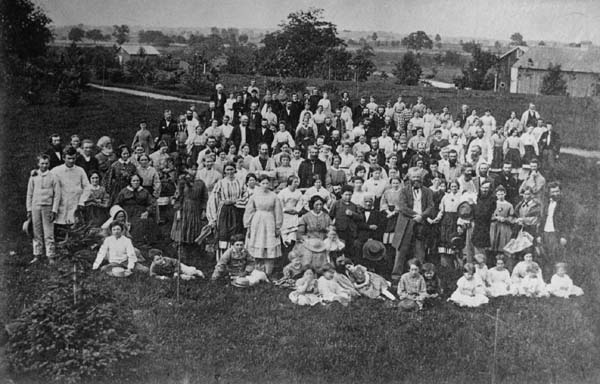
Antique methods of social engineering at the Oneida Commune.
Mutual Criticism
Guilt and shame systems are more common than not among pocket societies, regardless of whether the social glue is religious, political, or plain idealistic in nature. For the long-lost Oneida Community, guilt was called “mutual criticism”. This was both an act and a sort of town hall event. Every member of the community was subject to criticism by the “committee” or the community as a whole, and this occurred during a “general meeting”, a democratic Two Minutes Hate. The goal of these was to eliminate undesirable character traits.

An accounting of one of these General Meetings was recorded in the journal of one member. These texts can be read in the link I include below, but fair warning, they are tiresome and timeworn.
Charles sat speechless, looking before him; but as the accusations multiplied, his face grew paler, and drops of perspiration began to stand on his forehead. The remarks I have reported took up about half an hour; and now, each one in the circle have spoken, Mr. Noyes summed up. He said that Charles had some serious faults; that he had watched him with some care; and thought the young man was earnestly trying to cure himself. He spoke in general praise of his ability, his good character, and of certain temptations he had resisted in the course of his life. He thought he saw signs that Charles was making a real and earnest attempt to conquer his faults; and as one evidence of this, he remarked that Charles had lately come to him to consult him upon a difficult case in which he had in the end succeeded in doing right. ‘In the course of what we call stripiculture,’ said Noyes, ‘Charles, as you know, is in the situation of one who is by and by to become a father. Under these circumstances, he has fallen under too common temptation of selfish love, and a desire to wait upon and cultivate an exclusive intimacy with the woman who was to bear a child through him. This is an insidious temptation, very apt to attack people under such circumstances; but it must nevertheless be struggled against.’ Charles, he went on to say, had come to him for advice in this case, and he had at first refused to tell him anything, but had asked him what he thought he ought to do; that after some conversation, Charles had determined, and he agreed with him, that he ought to isolate himself entirely from the woman, and let another man take his place at her side; and this Charles had accordingly done, with a most praiseworthy self-sacrifice. Charles had indeed still further taken up his cross, as he had noticed with pleasure, by going to sleep with the smaller children, to take charge of them during the night. Taking all this in view, he thought Charles was in a fair way to become a better man, and manifested a sincere desire to improve, and to rid himself of all selfish faults.
The Internet Archive allows you to “checkout” scans of these books from forever ago to read here.
Male Continence

To control reproduction within the commune, a system of “male continence” or coitus reservatus was enacted. John Noyes decided that sexual intercourse served two distinct purposes. In Male Continence, Noyes argues that the method simply “proposes the subordination of flesh to the spirit, teaching men to seek principally the elevated spiritual pleasures of sexual connection.” The primary purpose of male continence, which means ejaculating, in case that wasn’t coming clear, was social satisfaction, “to allow the sexes to communicate and express affection for one another.” The second purpose was procreation. Of around two hundred adults using male continence, i.e. pulling out, there were only twelve unplanned births within Oneida between 1848 and 1868, indicating it was highly effective for them. Young men were trained in the methods of male continence by the post-menopausal women of the community.
John Noyes believed that ejaculation “drained men’s vitality and led to disease” and pregnancy and childbirth “levied a heavy tax on the vitality of women.” Noyes founded male continence to spare his wife, Harriet, from undergoing more difficult childbirths after five harsh births of which four had led to the death of the child. Such a justification is easy to sympathize with and I wonder how common it was in earlier centuries. One of those things that were prevalent, but that most cultures did not speak openly about, like premarital sex. A lot of cults, communes, and clubs have weird sex dynamics; rules and anti-rules, forced and forbidden pairings. There are aspects of Oneida’s that are stinking of this, but there’s often a lot of written explanation behind their tenets. These could have been carefully, sincerely, and maybe even democratically ratified, or it could have all been the usual culty brainwashing exerted by a big personality.
The Noyes favored the method of male continence over other methods of birth control (condoms, made of vulcanized rubber, or abstinence) because they found it to be more natural, healthy and favorable for the development of intimate relationships. Women found increased sexual satisfaction in the practice, and Oneida is regarded as highly unusual in the realm of cults for the value they placed in women’s sexual satisfaction. If a man failed to satisfy a woman he faced public disapproval or private rejection. Which, when I think about it, isn’t so far off from what can happen in our modern western days, but at least it’s not institutionalized.
On the Next… A closer look at the roles of women, and Stripiculture, the Oneida Community’s eugenics program.




 The Normal Times
Leave a comment