Jane Jacobs, 1961
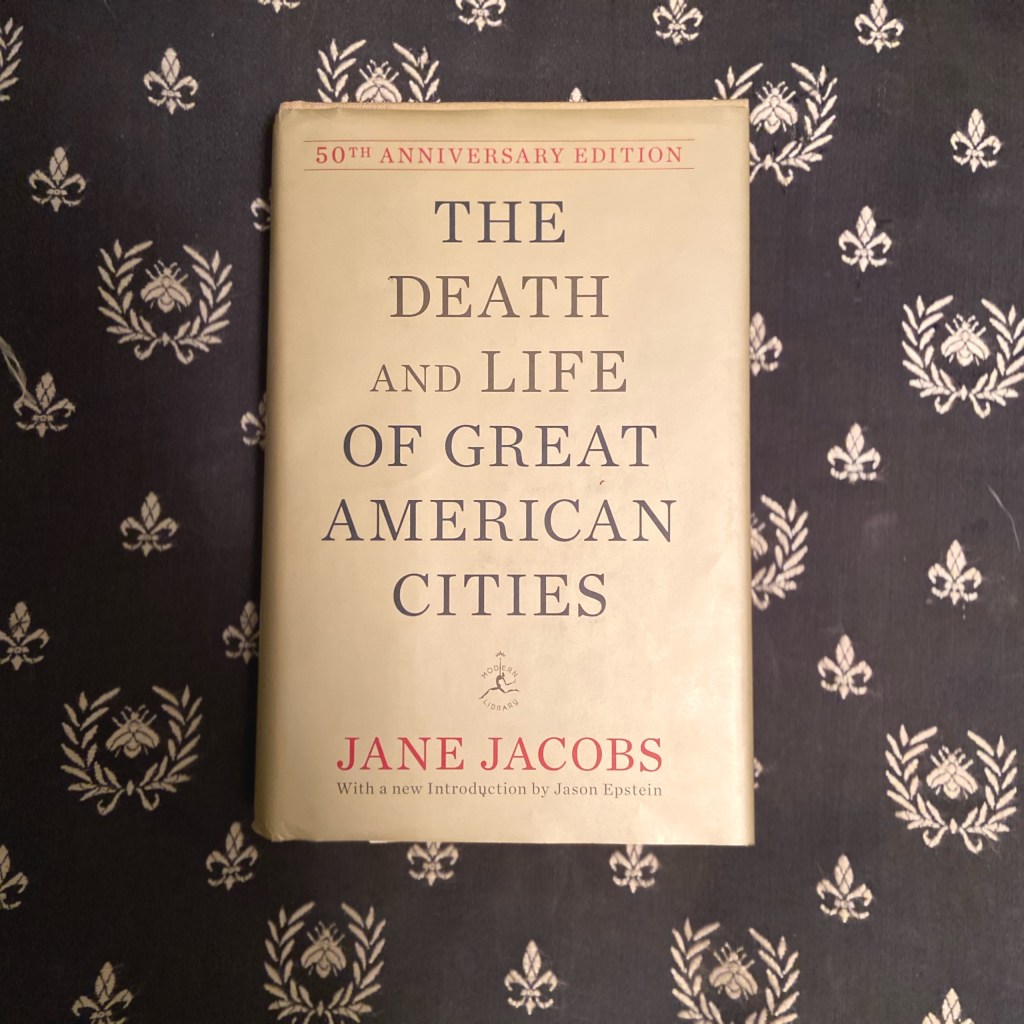
I just finished this one this morning. I’ve never had any great interest in city planning. I picked this book up because I had a free book credit from Thrift Books and I needed some reference material for a writing project where a major character inherits a piece of a capital city. I didn’t know anything about Jacobs, especially how revered she had become. I literally judged the book by its cover. Unique enough title that isn’t trying to be edgy or coy. Perfectly minimalist style, Times New Roman, or some other serif font, in black and red on a slightly iridescent beige.
First of all, city planning is fun from an armchair perspective. That’s probably why there are so many goofy people going online to rage against cars and zoning. This book actually softened my view on some of those points, but I wasn’t totally unsympathetic in the first place. I’ve lived in four big cities in my adult lifetime, and six total, and found myself reminiscing on some of the things I took for granted in those places. I thought I hated living in Philadelphia, but after reading Jacobs’ points about vitality and liveliness, I think it would have been my favorite city if I didn’t have to deal with the car thing. And every wall but two having a neighbor on the other side of it. And the inability to sit on a backyard/deck/slab area without another neighbor or five shuffling around two feet away from you.
So maybe it didn’t convince me so much that there’s a great virtue in building cities like an overstuffed and unorganized filing cabinet. But it did articulate most of the problems with my neighborhood. At this point, I became more critical of the book than I should have been. The neighborhood I live in is on the last official block of my local metro area’s namesake. There’s one road in and the neighborhood is shaped like a hand for some reason. To get to anything non-residential I have to go out to the main road, a two-lane street with no stoplights anywhere near me, and no sidewalk. Additionally, this road cuts through a nature preserve that conserves the remaining forestland that was here before developers built this road and these housing tracts in the 60s. To walk along the main road is to mostly walk in ditches and fight through tiny patches of woodland. I could do that and in ten minutes get to the nearest non-residential area from my house. However, this area’s offerings are a BP and a Minute-Mart (same offerings) which I avoid because I don’t want to do the language barrier dance just to get a lighter. The largest lot is taken up by the Charismatic Protestant church local to my area. Here they keep their 24-hour prayer room, prophecy stalls, coffee shop, book shop, and real estate office, all in what was once a modest strip mall. The church easily has the most financial clout of any enterprise in the surrounding area. (This isn’t intended to comment on that entity. I grew up Greek Orthodox and I don’t know how to describe it accurately without it coming off silly).
No one in government is going to put money they don’t have to into this area. It was built at a time when the biggest local commercial attraction was a mall just east of here. A mall so popular, so well poised to reap the benefits of the institution’s peak market, there were numerous starter home developments surrounding it and the city dedicated a whole public transit line to it. Then it died, over ten years. The buses brought issues that drove the mall to increase security to the point of building a whole prison-style comms tower and that was the final nail. And it’s dead, half of it got bulldozed and the other half was sold to a local company that turned built a bunch of indoor volleyball courts in it, (my area loves volleyball apparently, the most profitable bar among the nearby set is a place called VolleyballUSA and it packs its parking lot even in February).
So the whole point of this area as a constant commercial base is gone. The grocery store finally bailed in January. What is the answer to this for someone who would bother if there was a way to bother? I started going to the informal home owner’s meetings (not HOA), waving at every neighbor I see, shop hyper-local at the expense of my wallet (I buy beer from a brewery down the road and the only newspaper I’ve subscribed to in my life is the small Normal City Telegram, I pay double for dish soap at the hardware store stocked and run by dying old men). Structurally, there’s no way for any of these activities to do much to foster any greater sense of community. All of those items are flung out over an area that operates on a few stopless roads.
This book was so reasonably optimistic to me that it has caused an agitation that I don’t know how to settle. I seem to live in a hopeless border vacuum that has no recourse. But my neighborhood is mostly young, full of people that hover around my age (mid-30s) and some elderly who’ve been here for decades. Those I’ve met work remotely as some kind of engineer or tech worker. If not, they work a skilled trade. Point is, the majority of my surrounding neighbors, whether retired or remote working, are all here all day, same as me. I work on a big company’s LLM for my day job and could feasibly have a neighbor that is my co-worker and wouldn’t ever know it. And for all that, my neighborhood is lifeless. There are so few regular walkers going around that I’ve met them all and there are eight of them. This neighborhood probably holds a bare minimum of a hundred people, likely more like two hundred considering some of the families.
If there’s only a hard road to recovery for a neighborhood built like this, then what do I have to do to convince my stranger neighbors that, given we only have one access point that we could easily barricade, we could collectively burn down the blighted mess on the signature road’s first corner and combine our garage scraps to build a settlement house or, if free daycare and skill sharing are too whatever, a chainlink pop-up produce market.
If you’d like to refine your ability to sneer at bad city design, you can buy a copy here.


 The Normal Times
Leave a comment