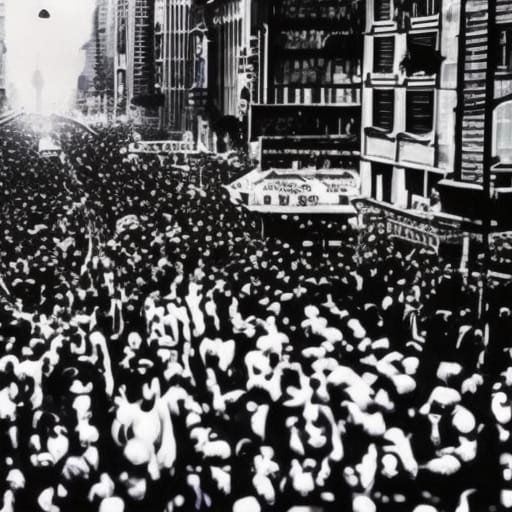
A Reading of between two ages: America’s role in the technetronic era, by ZBIGNIEW BRZEZINSKI
“Human life is reduced to real suffering, to hell, only when two ages, two cultures and religions overlap. . . . There are times when a whole generation is caught in this way between two ages, two modes of life, with the consequence that it loses all power to understand itself and has no standard, no security, no simple acquiescence.”
HERMANN HESSE, Steppenwolf
The above quote kicks off the start of Brzezinski’s prophetic book, Between Two Ages. Writing from 1970, the book begins with an accurate claim that the shape of international politics is undergoing a dramatic transformation. The time of the world being made up of “self-contained, “sovereign,” and homogeneous nations [which] interact, collaborate, clash, or make war,” was ending. The destructive power of nuclear weapons was one, and a major, reason. Another was that Brzezinski perceived a watering down of nationalist sentiment in favor of transnational ties. Perhaps appearances in 1970 made it seem that way, and he thought that nationalism was on its way out. This seems to have been a short-sighted observation. 1989 is one year that comes to mind in terms of nationalist expression. That was the year before Yugoslavia entered the first stages of its self-mutilation, and it was in December that Romania ran its leader and his wife through a drumhead court that followed an hour later with their execution. Greece, Bulgaria, Hungary, and on; all experienced sour times that were boiled by national tempers. Brzezinski being Polish, and his diplomatic assignments being focused around the area of the U.S.S.R. may have caused him to believe that nationalism had fallen out of favor in the calmer waters of 1970, but this seems a willful ignorance. Soviets and Titoists had only put a heavy lid on nationalism, it was still there waiting for a time when one could speak without fear.
The entire globe is in closer reach and touch than a middle-sized European power was to its own capital fifty years ago.
A further point made to back the claim of softening national barriers was the year over year improvements in communications tech. With the entirety of the world being more quickly reachable by sea and air, with long distance phone calls and the empires of television connecting people across greater distances, Brzezinski seems in agreement with a common theory of the time that by becoming more connected, people would become more understanding, more empathetic with those that may have once seemed strange and foreign. This doesn’t seem necessarily debatable, but it does seem like idealistic thinking.
The end result of this decline in prominence of individuated nation states, Brzezinski believed, was a new era of globalized politics.
The contemporary world is undergoing a change in many respects similar to that prompted by the earlier appearance of large population centers. The growth of such centers weakened intimate and direct lines of authority and contributed to the appearance of many conflicting and crosscutting allegiances.
Brzezinski refers to the sociological impacts of the Industrial Revolution in European cities. The drain of workers from the countryside, the decline of moderate religious practice, increases in religious zealotry on the fringes, declining physical and mental health, dangerous workspaces, etc. These places, however, we some of the breeding grounds of popular liberalism. The industrialists weakened the foundations of the old kings. The skies were darkened by machine smog carrying progress. Steamboat and railway advances modernized Europe and stitched America together. Printing presses and mass literacy forced all governments to give some consideration to the feelings of the common classes. A revolution so profound that it shook out and upended centuries of tradition in every culture.
A typical city dweller identifies himself simultaneously with a variety of groups—occupational, religious, leisure, political— and only rarely operates in an environment that is exclusively dominated by a single system of values and a unilinear personal commitment.
I tried to come up with any kind of urban social pocket that lived this way, isolated in a single system where the same people and rules of conduct are at home, work, worship, fun time, and representative places. I could only think of the rare cults I’ve heard of that lock down part of an armpit neighborhood.
Brzezinski uses the typical city dweller for an analogy about the changing form of global politics.
Some states possess overwhelming power; others, the “ministates,” are overshadowed by multimilliondollar international corporations, major banks and financial interests, transnational organizations of religious or ideological character, and the emerging international institutions that in some cases “represent” the interests of the minor players (for example, the UN) or in other cases mask the power of the major ones (for example, the Warsaw Pact or SEATO).
Due to this urbanization of international politics, the methods of conflict are evolving into something similar to the methods of dealing with urban discord. Conflict is made routine, a matter of confinement, punitative fines, and paperwork. Direct physical violence becomes regulated and restricted, In cities only the police may wield it offensively, and only in some certain ways, even these get whittled down and refined over time. The use of uniformed, salaried personnel, confines violence to socially tolerable limits. Direct military violence gets more stringently ‘regulated’ the closer it gets to America. In cities the result has been to make public violence a deviation from the norm. There are no more public executions in town squares and if two people get into a fist fight everyone in proximity is fascinated by the audacity whether they approve of it or not.
A certain amount of crime is accepted as unavoidable in cities. On a broad scale organized crime is generally preferred to anarchic violence. Plenty would prefer, if they must meet a grisly end, to die in a sudden explosion than by being repeatedly stabbed with a cheap knife. Just so, the new world order would accept a certain amount of conflict as unavoidable, but it would be more preferable if it were organized conflict with specific aims, rather than the flare ups of ancient grudges.
The appearance of rapid communications, which created not only physical proximity but also instant awareness of distant events, and the onset of the nuclear age, which for the first time made truly destructive global power available to at least two states, fundamentally altered the pattern of international conflict. On the one hand these factors depressed its level, and on the other they heightened its potential and increased its scope.
The violence of organized crime is usually little more than some numbers on a news report to most. What goes on between gangs and smugglers is a bunch of nasty business over elsewhere. It is not typically regarded as a threat to the overall social peace. Only outbreaks of violence that target the greater social peace cause moral revulsion; acts of terrorism, mass shootings in public places, aimless rioting. This type of violence is mobilizes far more response resources to combat it. In Brzezinski’s world politics analogy, wars in the Third World thus seem tolerable as long as their international scale is contained at a level that does not seem to threaten major interests.
The routinization of conflict has also meant a shift from sustained warfare to sporadic outbreaks of violence.
Sustained, prolonged warfare was made possible by the industrial age. Before then, armies met on their fated battlefields and fought head on battles of numbers, ending with either decisive victories or falling in defeat. Both sides then moved their weapons, supplies and soldiers on to the next objective, stopping to make camp several places along the way. Wars could last decades, but there could be days, week, and months between battles. The productive output of the industrial age allowed societies to mobilize their manpower and resources for prolonged yet often indecisive struggles.
Nuclear weapons changed that. Brzezinski’s view is the common one, that the surety of mutual annihilation in a conflict between nuclear powers enforces a passive restraint on these powers. This is the sort of stew that makes proxy wars more common. Brzezinski confidently claims that if nuclear weapons hadn’t existed, a prolonged war would have broken out between the United States and the Soviet Union long before his time in 1970.
In the case of urban politics, the weakness of accepted and respected immediate authority is compensated for by the sense of higher allegiance to the nation, as represented by the institutional expression of state power. The global city lacks that higher dimension—and much of the contemporary search for order is an attempt to create it, or to find some equilibrium short of it.
The menacing specter of one world government, the nightmare that haunts the minds of sci-fi writers and conspiracy theorists. Brzezinski was convinced that in the same way the urban environment blurred the lines of social difference, once rigid and set from birth, the globalized markets and communication technologies would blur the lines of nation-states and water-down the clash points of different cultures. For Brzezinski, a nuclear attack by Germany in an effort to take back Alsace-Lorraine in the year 2000 would be as offensive, yet as unlikely, as a pogrom in Boston.
This concludes the first section of the first chapter in Between Two Ages. The next entry will cover the onset of the technetronic age and the impacts of science and technology on society and the individual.


 The Normal Times
Leave a comment