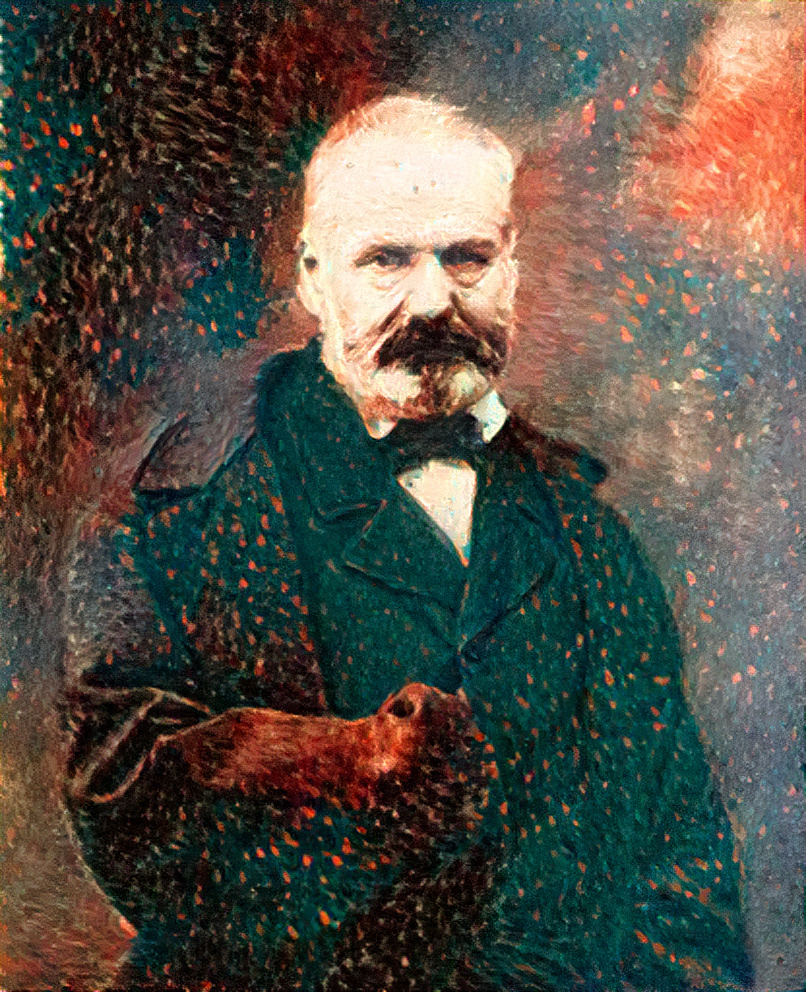
“Ocean man, take me by the hand
Lead me to the land that you understand”
Victor Marie Hugo, also known as the Ocean Man apparently, was born in February of 1802, the same year that Napoleon ate Italy alive. His father was a general in Bonaparte’s army, and his mother was a woman with a cool name (Sophie Trebuchet). Hugo’s father once informed him, be letter, that he had been conceived on the highest peak of the Vosges mountains, which his father believed was the source for Hugo’s creative temperament.
Sick of all the moving required of a general’s family, Hugo’s mother left and took the children to Paris. They moved into a former convent in the, at that time, ratty and abandoned Left Bank. In the chapel at the back of their rotting mansion lived a fugitive named de La Horde, who was avoiding a death sentence for attempting to restore the Bourbons. He became a mentor to Victor and his brother until he was finally found and executed in 1812.
“I shall be Chateaubriand or nothing.”
Hugo’s success came early. At age twenty he had published a collection of poetry that earned him a royal pension from Louis the 18th, one of those neutered post-Revolution kings. Hugo’s first heavyweight hit was The Hunchback of Notre Dame, which became so popular across Europe that Paris had to bother with cleaning up the cathedral, lest they embarrass the city in front of the tourists.
Les Miserables didn’t start coming together until 1845. It ended up taking seventeen years to write the beast. A classic novel of human misery and social injustice, Hugo considered it the “crowning point” of his writing career. Copies of the book sold out within hours of the first release. The literary elite of his time eloquently shat all over it, but the unwashed masses gobbled it up.
Interesting enough, the same year that Hugo started writing Les Mis he was nominated by the king to enter the Upper Chamber of Parliament as a pair de France. In 1851, eleven years before the publication of the book, Hugo was driven into exile when the third Napoleon seized power, after calling him a traitor to France. He returned home in 1870, after Napoleon 3’s fall, and immediately he was elected back into the National Assembly. He was treated like a national hero, and there were rumors he would be given the dictatorship. In his diary he wrote, “Dictatorship is a crime. This is a crime I am going to commit.”
Hugo died from pneumonia at the age of 83 and all of France went into mourning. Despite his request of a pauper’s funeral, he was given a state service that Friedrich Nietzsche, in attendance, described as a “veritable orgy of bad taste,”.


 The Normal Times