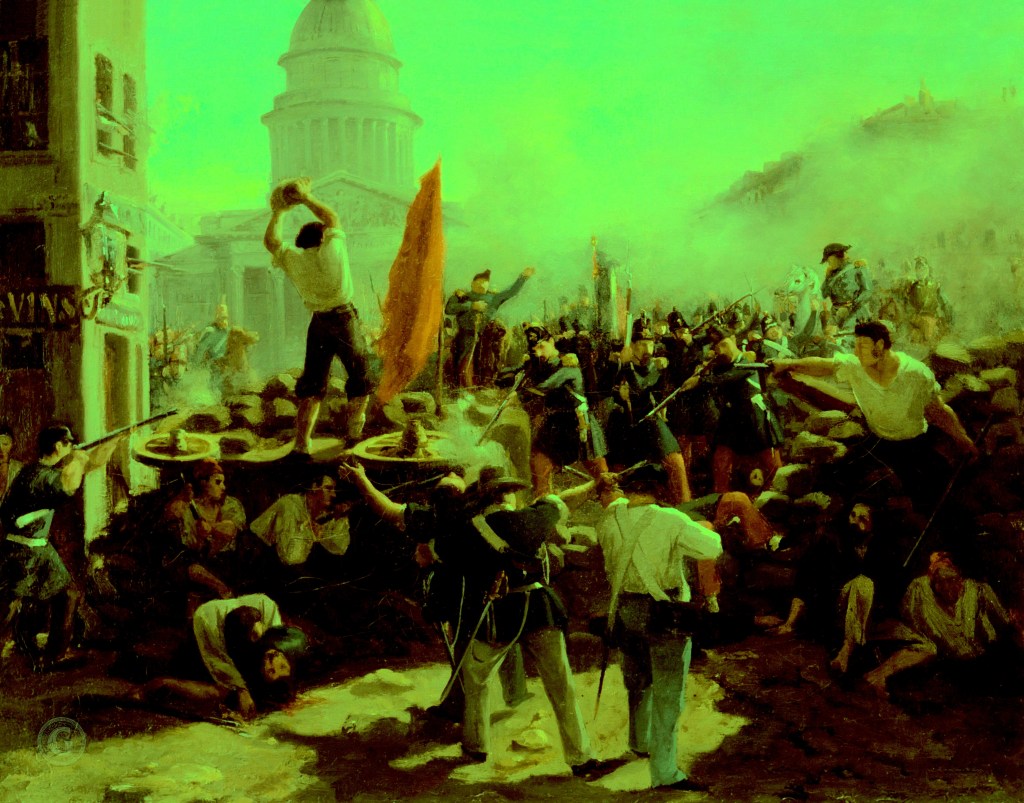
In the 1840s, some God really hated Europe. Poverty, patchwork unemployment, and cultural distress spread sticky like an oil spill across the continent. By 1846, even the potatoes had forsaken those funny-talking wretches. And by 1847, people went to bed nervous and woke up broke. Naturally, they started rioting over bread.
What happens when too many people get to feeling like everything sucks? Everything as in every thing; their house, their future, their job, their youth and all the years they had left to suffer through this pile of shit, their government and their meaninglessness in the face of it, their health, their lack of wealth and all that trash always blowing down the fucking street. In one person, it’s just a private hell. It’s a bad vacation, everything’s all sunshine and bromides and every one else seeming vaguely happy except you. Slowly degrading, it’s an almost terminal insanity caused by understanding that the one thing you want is not where you are.
But once it’s everybody, or everybody enough, this becomes a true grievance, and it doesn’t matter one whiff how good or bad the argument is. It’s a profound and righteous gripe, a doomspeak, an info hazard. The pot boils over and suddenly there’s a faceless horde hungry for changes and hungrier for blood.
One such time happened in Europe (actually, many such time; Europe’s a sad place) in 1848. That same year there were barely literate Americans dropping their lives and families like a bad habit and tearing ass to Californ-i-a with goldust clouding their eyes. Meanwhile, in Europe, they were sick of eating the same shitty old bread, and the potatoes were rotting in the ground. Then along comes a fat boy named Marx, who gives them an effort-post that agitates all their lost hopes and dreams like nothing before (unless you were Franch). The shit life of urban industrial society, all that dust and death and deadly dust, combined with all your friends also being pissed for all the same reasons, combined with Karl I-love-streudel Marx telling you all that you’re RIGHT to be pissy; all came together in a hellish boil that bred social violence and gave a new edge to radical movements everywhere. One disturbance set off another, and the outcome was a continent-wide explosion of revolution which for a time seemed to endanger the whole Vienna settlement.
The revolutionaries of 1848 were provoked by very different situations, had many different aims, and followed divergent and confusing paths. What’s new?
Symbolic Start
The February Revolution in Paris. The year is 1848 (obviously), the dirty bastard is King Louis Phillippe d’Orleans, the so-called Citizen King. This is the son of Philippe Égalité, the guy who not only watched, but voted for his cousin (Louis XVI) to get thrown into a hell-tower along with the wife and kids to await a beheading that he had no idea was coming (he, XVI, really kinda didn’t, the dude loved wine and hot chocolate and was a bit of a simpleton who didn’t learn how to fuck until like a decade into his marriage with Antoinette), and Phillippe Égalité is the guy who sees all that and says, “This is a supercool time to start a populist gimmick, I will never regret this,” (He did, at least when his own head got took).
Anyway, back to February, 1848. Louis Phillipe, Citizen King, son of the opportunistic cretin described above, this guy had lost his middle class support base mostly because of his ongoing opposition to the extension of suffrage. So he bails before a bunch of French lawyers could make a football out of his head too. And so the Second Republic of France was established, the dreams of thirty years’ worth of radical plots and conspiracies seemed realizable. In the rest of Europe, the mood grew tense as insidious whispers dumped kerosene on kindling flames. Heavyweight rumors flew about French armies once again marching to spread France’s funky new principles, (this ended up being an unfounded fear, by the way, the only military operations that France undertook was in defense of the pope against Roman revolutionaries, lol). A few old aristocrats probably cursed the name “Napoleon,” at the time, but if only they knew that a new fat boy was in town.
Meanwhile…
In most of Italy and Central Europe townsmen rebelled against governments thought to be illiberal and therefore oppressive. The common demand was for a constitution to guarantee essential freedoms. In their defense, Italy and Germany were frail as newborns at the time. They had barely been sewn together by then, and naturally there was plenty of unhappiness about some of the stitches. I guess that’s just what you get when you let Austrians do most of the tailoring. Some of these revolutions sought national independence rather than constitutionalism, though for a time this seemed to be a way towards independence because it weakened dynastic autocracy. Granted, it only took four or five – and really only one – ballsy Bosnian, to put that superfluous ruin in the ground for good. (No offense intended to any living Hapsburgs. I really want to be in the Illuminati, don’t let this deter you from granting me that gift).
A revolution in Vienna strongly suggested5 the chancellor into exile and paralyzed the government throughout much of Central Europe, where the Holy (not) Roman (not) Empire (eh) had about as strong a network as a discount cellphone service provider. This opened up more opportunities for revolutions in Germany, as they no longer had to fear Austrian intervention. Ya know what they say, when the iron is hot…
The King of Sardinia led a bundle of Italians against the Austrian armies in Lombardy and Venetia. A republic appeared in Rome once again, and the pope fled the city. I shouldn’t side track anymore, but if you don’t know, the career of Pope Pius IX is wild. He fled in 1848, he came back a couple years later, and then in twenty years he either was or melodramatically pretended to be, imprisoned in the Vatican after the Savoys led an army into Rome. AKA the beginning of the end of papal rule in Rome. There is a very sexy conspiracy around this and similar papal strifes that I once wrote about and intended to keep exploring, but now realize I forgot about entirely.
Hungarians revolted in Budapest, it was to be expected. Dual Monarchy, you both go down together. Czechs revolted Prague, also to be expected, secretaries and janitors hit the dirt the same as the CEO when a big biz goes tits up in the glorious fires of fury.
Lost Causes
The German revolutions ultimately failed because the liberals realized that if the Slavs or Pan-Slavs achieved their national liberation, then states previously considered as German would be shorn of huge tracts of territory, due to the aforementioned shit needlework. Popular thinking was that if the German nation-state was going to stick, it required the preservation of German lands in the east, which required support of a strong Prussia, which would require the acceptance of Prussia’s terms for the future organization of Germany. I imagine some kind of chase music from Hanna-Barbera played throughout all Germany while this era went on.
In Paris, an uprising which could have given the Revolution a further shove in the direction of democracy was crushed with the bloodshed of the June Days. Americans of cognizant age in the 1960s-80s will know this trend, as well as those who didn’t fall off the station wagon in one direction or another between 2015 and 2025. The bullshit nuisance, however dramatic or dull it actually was, annoyed enough people. This settled the French Republic as firmly fuck-you conservative.
The Austrian army defeated the Sardinians in northern Italy. Score a measly one point for the establishment. The Sardinian army has been the only shield of the Italian revolutions, and after its defeat monarchs all over the peninsula went to pieces and came crawling back to the cold comfort of the Austrian under-boot. Germany did the same, but the boots were cuter and Prussian. Croatia and Hungary tried to maintain pressure against the Habsburgs, but they were always puny and of little consequence when they were the only bubble bursting. Besides that, Russia didn’t give a fig about Croats or Magyars, so the Russian army aided the Hapsburg dynasty in suppressing it.
Nationalism
Nationalism had been a trendy cause in 1848, but was too weak to sustain revolutionary governments. Too bad, so sad.
In that year nationalism failed to stick because Nationalism was, for the masses, too abstract, too dang nerdy. Only a few pretentious and over-educated people cared much about it. There had been some truly popular uprisings in that year, ones energized by the desires of the populace. And those were where the party was at. Not in the ~salons~ of fucking nerds who take to long to say a single thing.
In Italy it was in the towns rather than the countryside that nationalist ideas stirred the heart. In Lombardy the peasant cheered the Austrian army, seeing no good in a revolution led by aristocrats. This was the pride of the redneck, the urban versus rural. The I-Grow-the-Food crowd snubbing the I-Went-to-College crowd. Flannery O’Connor would understand this.
In Germany it was also the country people that were disturbed. German peasants behaved as the French had in 1789, burning their landlords’ houses, both out of personal resentment and to destroy the records of rents, dues, and labor services. Such outbreaks frightened the pants off German liberals as much as the June Days frightened the middle classes in France. In Germany working class antics alarmed the better-offs because the leaders of revolutionary movements talked excitedly into the night about the fat boy’s socialism. Thing is, what they actually sought was a return to the past; the safe world of guilds and apprenticeships. This was driven by anxieties about all the new machinery, the smog-belching and deathly urban factories, the steamboats that put boatmen out of work, the dropping of gates long kept in trades – ultimately, the all-too-obvious signs of the onset of market society.
In France, because the peasantry was mostly conservative, the government was assured the support of the provinces in crushing the Parisian poor who had given radicals a brief success. The rurals barely knew they were Franch, or about the idea of France. So nationalism crashed and burned quick here.
And In the End…
The revolutions of 1848 changed society the most in the countryside of eastern and central Europe. Liberal principles and fear of popular revolt forced concessions from the landlords; resulting in the abolition of peasant labor and bondage to the soil. By 1848’s end, these conditions only remained in Russia. This opened the way for the reconstruction of agricultural life on individualist and market lines in Germany and the Danube valley. With some lag here and there, the medieval economic order had in effect now come to a stumbling end. Mission accomplished?


 The Normal Times