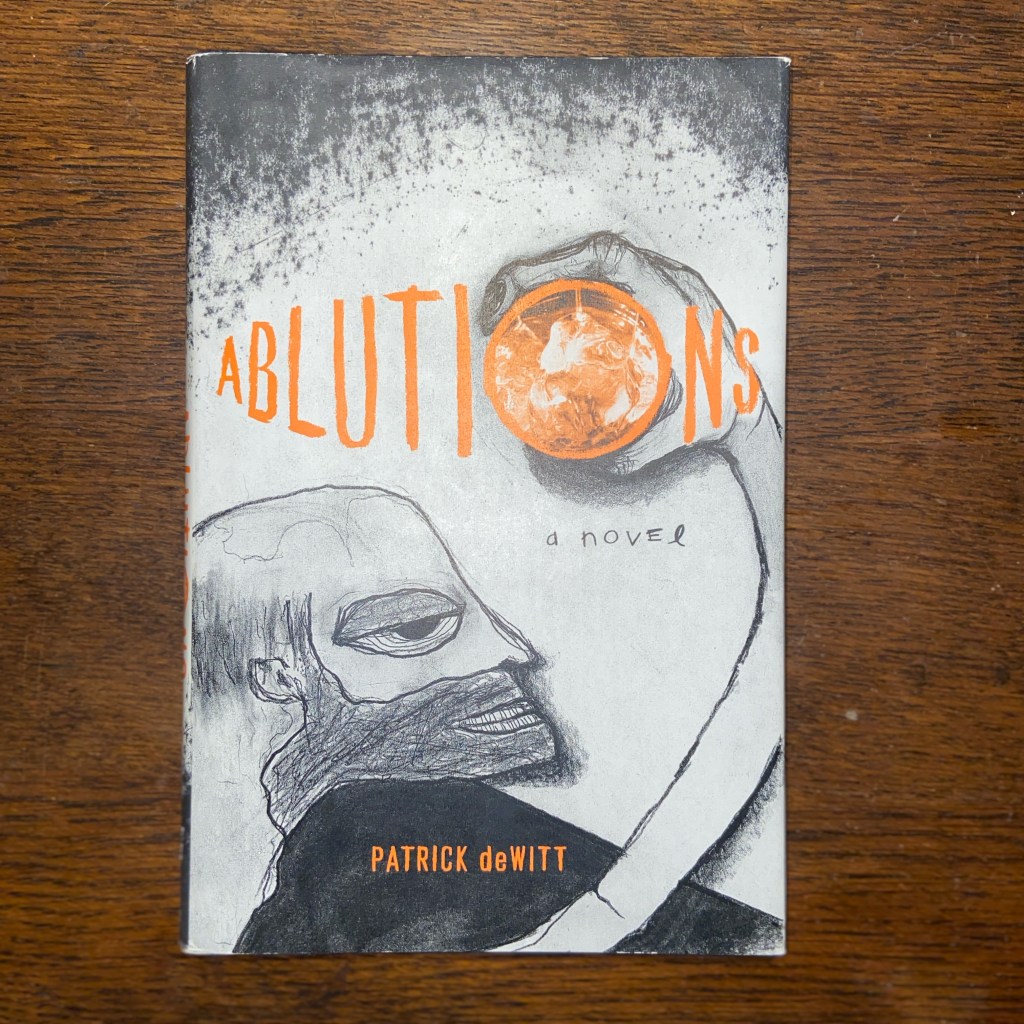
Key Terms: Writers writing about writing – drunks describing drinking – the enduring mediocrity of 21st century fiction
Fiction: Patrick deWitt, 2009
“What will you be doing in five years? In ten years? There is no one who will look after you and you could die tomorrow and the only people who would care would be your bosses, and they would not be sad at your passing but only annoyed about having to interview new staff.”
If you’re a little dummy like me, you didn’t know that “ablutions” means: the act of washing oneself (often used for humorously formal effect). Fair enough. Like all stories with a fiend of some kind for a narrator, the book is soaked in self-deprecation. It’s The Way. That’s why Bukowski is a novelty, the shamelessness is refreshing.
Not an important book, or one of profound creativity. It’s actually quite trite. A writer writing about writing AND a drunk writing about drinking. A fusion of the two most tired premises in fiction.
The main setting is in a once-hot spot Hollywood bar in decline, its splendor long spent but still glimmers enough to get the occasional tourist. The main character is one of the bartenders. He took the job thinking the sad regulars that haunt the place would provide quality fodder for a novel he wants to write. So yeah, it’s one of those. A story about writing that hardly bothers to veil the autobiographical nature of the material. This almost always renders a book average in quality to me. It is just too masturbatory.
Anyway, the main character has a personality that could be described as “unlovable”, but not hateable. It’s actually great most of the story is set in a workplace; the main character is that coworker you’re not that excited to see, but one you don’t mind sharing a shift with. He is smugly amused by the decadent decay that surrounds him, feeling himself as above the rot rather than a part of it. The man sees this stage of his life as a temporary setback, one that will be a distant memory once he finishes his novel. After all, its fount of creative material is the only reason he works there, according to him. He believes his novel will lift him out of this gutter. The novel he barely works on besides a few napkin scribbles, the one he is often too drunk or hungover to work on. Such shortcomings are just part of the job, even when such shortcomings lead his wife out the door and taking the functioning car along with her.
It’s a fast read and the themes are simple, and of course predictable. The spiral of addiction; the inevitable erosions of places, people, and ideas over time; and that who you tell yourself you are has little bearing on what you actually are. Like all books about addiction, it is constantly depressing. Like few books about addiction, the clouds never part, the man never successfully saves himself. The book ends irresolutely. I’m not sure what the ideal reader for this book looks like. A bartender maybe, a bartender who wants to be a writer. A former addict who wants a reminder for why they Don’t anymore. A current addict who wants out, maybe. I dunno. The book is neither great nor bad.
One thing I’ll give it is the successful use of second-person narrative. I usually hate these attempts, but it did work for this story. It creates an unsettling distance. Like being close enough to a house fire to smell smoke, but you’re pretty sure it’s not your house that is burning. It’s a neat gimmick. Not enough to raise this book up from being firmly mid.
“When you sleep, your dreams are those of a dullard: You polish ashtrays, stock the ice bins, reach for a bottle and find it there or not there, and exchange names and pleasantries with familiar-looking customers. These scenarios run in a spinning wheel and are identical in texture to your drunken memories. As a result you have only a dim idea what is fact and what is fiction and are constantly referencing past conversations with people you have never spoken with or else ignoring those you had for fear you had not. And so the general public is of split minds about you: Some say you are stupid, and some say you are rude.”
If you had fun reading this, consider donating to my campaign to censure the Soviet Lollipop Guild.


 The Normal Times
Leave a comment