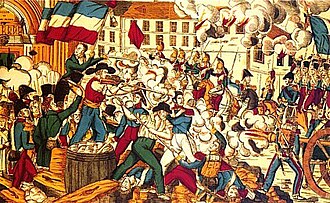
A quick n shitty bit on the July Monarchy
The new king, Louis Philippe, was head of the junior branch of the French royal house, the Orleans family, and to many conservatives he was the Revolution incarnate, though he hardly struck radicals as anything of the sort.
A History of Europe, J.M. Roberts, pg. 352
Louis Phillipe took the crown after the overthrow of the doomed weakling known as Charles X, last of the Bourbon line. The Orleans line is the same thing, really. It’s not some Shakespearean rival family. The Sun King’s gay chad brother was the branch’s founding member. I don’t yet know why they founded a fake family offshoot, but my guess is it involves lots of drunken money spending and profound levels of post-fronde paranoia that are not entirely unjustified.
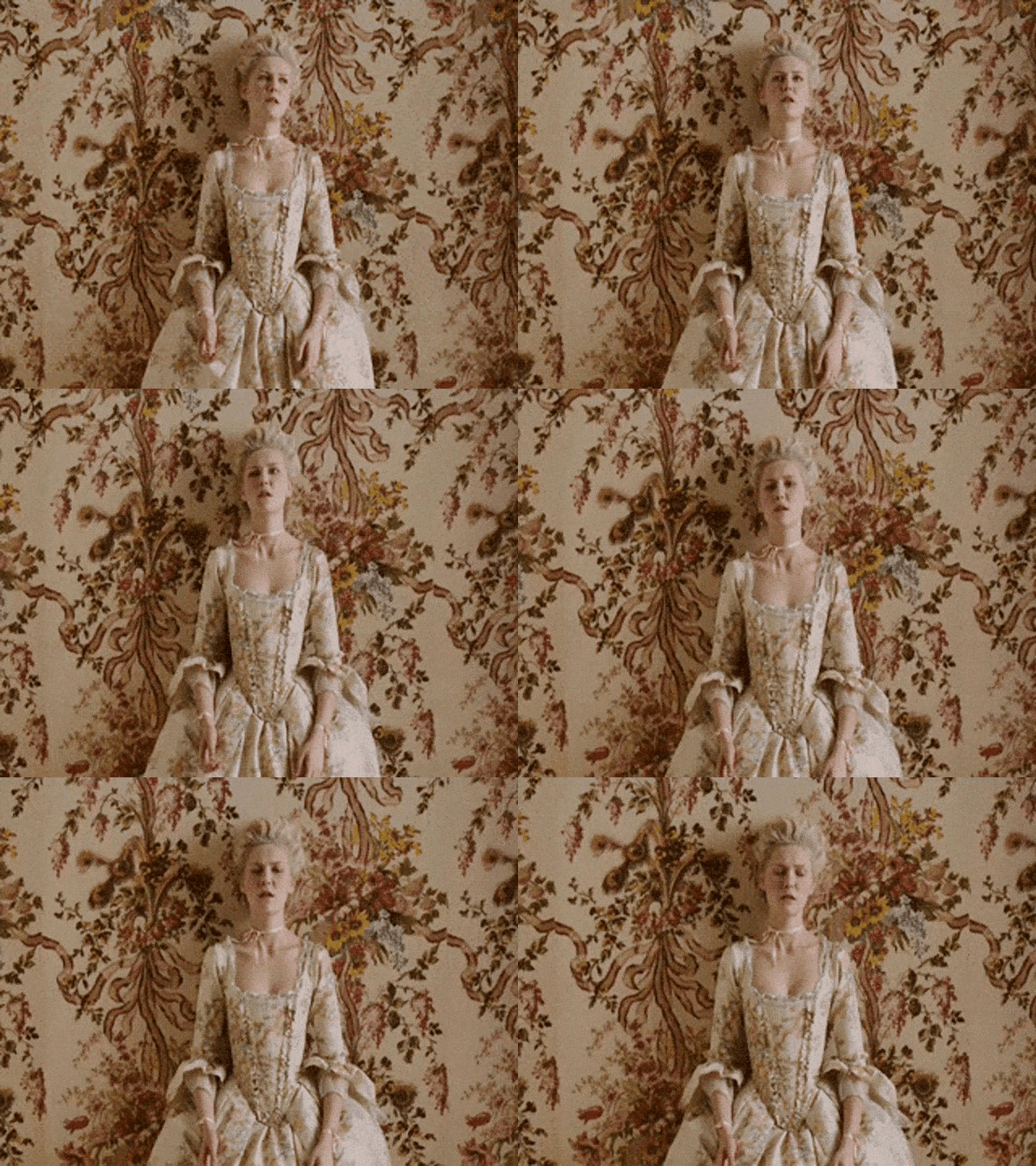
Louis Philippe’s father is famous for having voted for the beheading of his cousin and the foreigner he married, King Louis XVI and Marie Antoine(tte), respectively, and went to the guillotine himself soon after. Louis had fought as an officer in the republican armies and had even been a member of the Jacobin club in the 1790s. He made so many law school assholes waste away their days in coffee shops, it’s a wonder he wasn’t branded a counter-revolutionary and violently shortened by the grand autist Robespierre even sooner.
For liberals (Adam Smith edition), Louis Phillippe was an appealing choice for king because he appeared to reconcile the Revolution with the stability provided by the monarchy. They helped him into his dusty old birthright, and he ruled for 18 years as a pseudo-constitutional monarch and made sure the upper middle consumers never experienced any hardship harsher than going a day drinking their coffee without cream. Which was, in fair France, borderline Not fucking Cool.
His downfall became destiny after he lost support from the left, both the Adam Smith brand left, for the urban disorder the exploded in the 1830s, and the bitchy St.-Simon left, for cracking down bigly on said urban disorder. Indeed, history rhymes.
Problem was, the ancienne regime no longer had the old chosen-one mysticism to back them. The justification for one inbred rich fucker deciding everything for everyone this time rested, in theory, on the revolutionary principle of popular (elected) sovereignty, which in this case meant what some handful of dudes with the right kind of property or holdover legal privileges wanted. Hilarious how the French Revolution managed to perma-bake some of its biggest gripes into the fold of the future republics. When Louis was ~elected~ around a third as many Frenchmen as Englishmen had a vote in national elections, while the population of France was twice that of England’s.
Louis Philippe was the last king of France1. He gave up the throne to his nine-year-old nephew in 1848 and, jumpy over the potential loss of his head, he popped a wig on and snuck out of the country. He spent the remainder of his life in exile in dreary, rainy, awash-with-beans England.
- It’s more accurate to say he was the last king who was officially called “king”. After he bailed, the National Assembly shoved his pre-pubescent replacement aside and gave Napoleon’s nephew the presidency. Three years later, as he neared the end of this four year term he executed a top-down coup and through a weird mess of French political pettifoggery, that resulted in giving him the ability to revise the constitution. Predictably, he used it to automatically re-elect himself for life. He changed his title to Emperor Napoleon no. 3 and got away with it for twenty more years until famed big dick, Otto von Bismarck, knocked the stuffing out of him. Napoleon III was the last emperor of France, and like Louis Philippe, the last king of France, he spent the rest of his life in exile in England. ↩︎



 The Normal Times