-
Key Terms: Writers writing about writing – drunks describing drinking – the enduring mediocrity of 21st century fiction
Fiction: Patrick deWitt, 2009
“What will you be doing in five years? In ten years? There is no one who will look after you and you could die tomorrow and the only people who would care would be your bosses, and they would not be sad at your passing but only annoyed about having to interview new staff.”
If you’re a little dummy like me, you didn’t know that “ablutions” means: the act of washing oneself (often used for humorously formal effect). Fair enough. Like all stories with a fiend of some kind for a narrator, the book is soaked in self-deprecation. It’s The Way. That’s why Bukowski is a novelty, the shamelessness is refreshing.
Not an important book, or one of profound creativity. It’s actually quite trite. A writer writing about writing AND a drunk writing about drinking. A fusion of the two most tired premises in fiction.
The main setting is in a once-hot spot Hollywood bar in decline, its splendor long spent but still glimmers enough to get the occasional tourist. The main character is one of the bartenders. He took the job thinking the sad regulars that haunt the place would provide quality fodder for a novel he wants to write. So yeah, it’s one of those. A story about writing that hardly bothers to veil the autobiographical nature of the material. This almost always renders a book average in quality to me. It is just too masturbatory.
Anyway, the main character has a personality that could be described as “unlovable”, but not hateable. It’s actually great most of the story is set in a workplace; the main character is that coworker you’re not that excited to see, but one you don’t mind sharing a shift with. He is smugly amused by the decadent decay that surrounds him, feeling himself as above the rot rather than a part of it. The man sees this stage of his life as a temporary setback, one that will be a distant memory once he finishes his novel. After all, its fount of creative material is the only reason he works there, according to him. He believes his novel will lift him out of this gutter. The novel he barely works on besides a few napkin scribbles, the one he is often too drunk or hungover to work on. Such shortcomings are just part of the job, even when such shortcomings lead his wife out the door and taking the functioning car along with her.
It’s a fast read and the themes are simple, and of course predictable. The spiral of addiction; the inevitable erosions of places, people, and ideas over time; and that who you tell yourself you are has little bearing on what you actually are. Like all books about addiction, it is constantly depressing. Like few books about addiction, the clouds never part, the man never successfully saves himself. The book ends irresolutely. I’m not sure what the ideal reader for this book looks like. A bartender maybe, a bartender who wants to be a writer. A former addict who wants a reminder for why they Don’t anymore. A current addict who wants out, maybe. I dunno. The book is neither great nor bad.
One thing I’ll give it is the successful use of second-person narrative. I usually hate these attempts, but it did work for this story. It creates an unsettling distance. Like being close enough to a house fire to smell smoke, but you’re pretty sure it’s not your house that is burning. It’s a neat gimmick. Not enough to raise this book up from being firmly mid.
“When you sleep, your dreams are those of a dullard: You polish ashtrays, stock the ice bins, reach for a bottle and find it there or not there, and exchange names and pleasantries with familiar-looking customers. These scenarios run in a spinning wheel and are identical in texture to your drunken memories. As a result you have only a dim idea what is fact and what is fiction and are constantly referencing past conversations with people you have never spoken with or else ignoring those you had for fear you had not. And so the general public is of split minds about you: Some say you are stupid, and some say you are rude.”
If you had fun reading this, consider donating to my campaign to censure the Soviet Lollipop Guild.
-
Key Terms: TSA humiliation ritual – Oh neat, real buttons – GeorgeCostanzaSociety.gif
In such conditions there is no place for industry, because the fruit thereof is uncertain, and consequently no culture of the earth, no navigation nor use of the commodities that may be imported by sea, no commodious building, no instruments of moving and removing such things as require much force, no knowledge of the face of the earth, no account of time, no arts, no letters, no society, and which is worst of all, continual fear and danger of violent death, and the life of man, solitary, poor, nasty, brutish, and short.
Thomas HobbesA couple years ago I spent far more money than it was worth to ride an Amtrak from these United States’ most blessed central hills to L’Enfant’s dull cosmopolitan fever dream that we call Washington DC, our stupid fucking capital. I chose the Amtrak for no good reason. I think I’ve just watched too many Wes Anderson movies and read too many Modernist novels.
Apparently, I thought it worth spending a thousand and fifty-six bucks on, but not worth writing about at the time, because like our nation’s capital, I am also stupid and self-involved. It was one of the oddest things I’ve done in the last few years, and I shrugged it off. ‘Twas a novelty, nothing more. Slapped by the monkey’s paw, I was wrong in my delusions, but I was also a little bit right.

By my own petard. I have flown too much in the last couple years. Soared the skies in a way that the ten years ago me would have blown a booger at and said, “Where the fuck are you flying to, dumb bitch, you’ve got the whole world right here?”
Every time that I have stood around at these airports, be it super-duper revamped MCI or the Royal Reagan Airport, I thought of that unending railroad ride. How could I not? After all, it was an unsuspecting incoming flight to Reagan where some hundred of my cross-river Kansan brethren laughed at their last doom scroll meme by the time a military helicopter run had already gone sideways and sent them on to their cold, wet death.
Even without the tales of grim death, the helplessness one feels on an airplane is almost too much. The engines get to purring, and you, the rider, become the hostage. From then until that plane reaches the ground on the other side, your autonomy is limited. Anyone who ever had a couple beers in the lounge before boarding and realized they should have used the bathroom before takeoff knows this. You are 5 years old all over again, strapped in the back of the car on the sixth hour of a road trip you barely understand, and grandpa is not going to entertain another piss stop. Even without that, air travel is atrociously degrading. We degrade ourselves, just this one time, because we just want to go home. We eat the TSA’s shit, we let them rifle our once neatly folded delicates, let them gawk at our unmentionables, we let them do and say whatever they want to us, because what else are we going to do? Make a scene? Of course not.
Most people intrinsically know this experience is fucked and weird and put up with it anyway because we’re supposed to be a super society. This is a nice world, and so many of us are nice in it. But some of us remember that we paid money, only to be treated like shit. I once even said “Thank you,” to the grumpy old cooze that thought my makeup bag looked dangerous, even though she gave it back so rummaged through that I couldn’t latch it shut and had to crouch on the floor to put it all back together while she glared at me like I was some poisoned rat.

She looked exactly like this. What makes me sick of air travel is the shrinking quarters and the ass quality service staff. If I wanted the freakish Grayhound experience, I’d be surfing the highways like that Kerouac slut. And so I took my chance on the great American railways. After all, it couldn’t get any worse.
I know I could have died on the Amtrak. I guess. They have little stickers on the windows that tell you where to punch them if the whole show goes sideways. Besides that, I have a harrowing memory from an afternoon spent day drinking with some forgettable co-workers in Port Richmond, Philly. We were walking to the corner store to buy another set of singles when some Amtrak derailed a couple blocks over. Until that day, I legit had no idea that a train can still derail and violently kill people. I thought that was some awful old-timey disaster from the days when people casually coughed blood into hankies and children worked in mine shafts. Something mitigated by time and tech.
Passenger Amtrak is Motel 6 strapped to rails. But maybe a Motel 6 where people at large are not methy freaks. We are all seemingly trying to be very, very polite. And it is not hard because, pretty much everyone you interact with between east Missouri to the Alleghenies is Amish as hell. The dexterity with which those humble bumpkins dodged the Chicago Union Station junkies is commendable. I followed them. Like a scavenging bird, I followed them. They, out of all of Chicago’s Hell, were my only chance of escaping to Elysian.

Better pay for the lounge upgrade if you don’t want to spend five hours sitting on this fucking thing. Ok, about the trains. The trains as they are and not the temporal state I so wish they were. Those busted old bundles of bolts. Them, and all their whirly girly guaranteed industry shit, THEM trains.
The interiors are like what I think 1985 felt like, delusional glitter and all. Hard angles, fake wood panels, beige and brown and thin carpet. Train people are obnoxiously friendly in that John Candy kinda way. These people seem to live their whole lives on this thing, and they want to get to know you. It’s cloying. It’s enough to make you eat all those fuzz words you said about community building. At least, it was for me.
Stuck as fuck dials and push buttons are still king on the Amtrak. They don’t give you tiny ad-stuffed monitors in the back of every seat like the planes do, but you do get a radio in your roomette. No, it doesn’t seem to actually work. But the hot/cold fan works, and the outlets work so long as you never move the thing you hope to charge, otherwise plug falls out like a limp noodle.
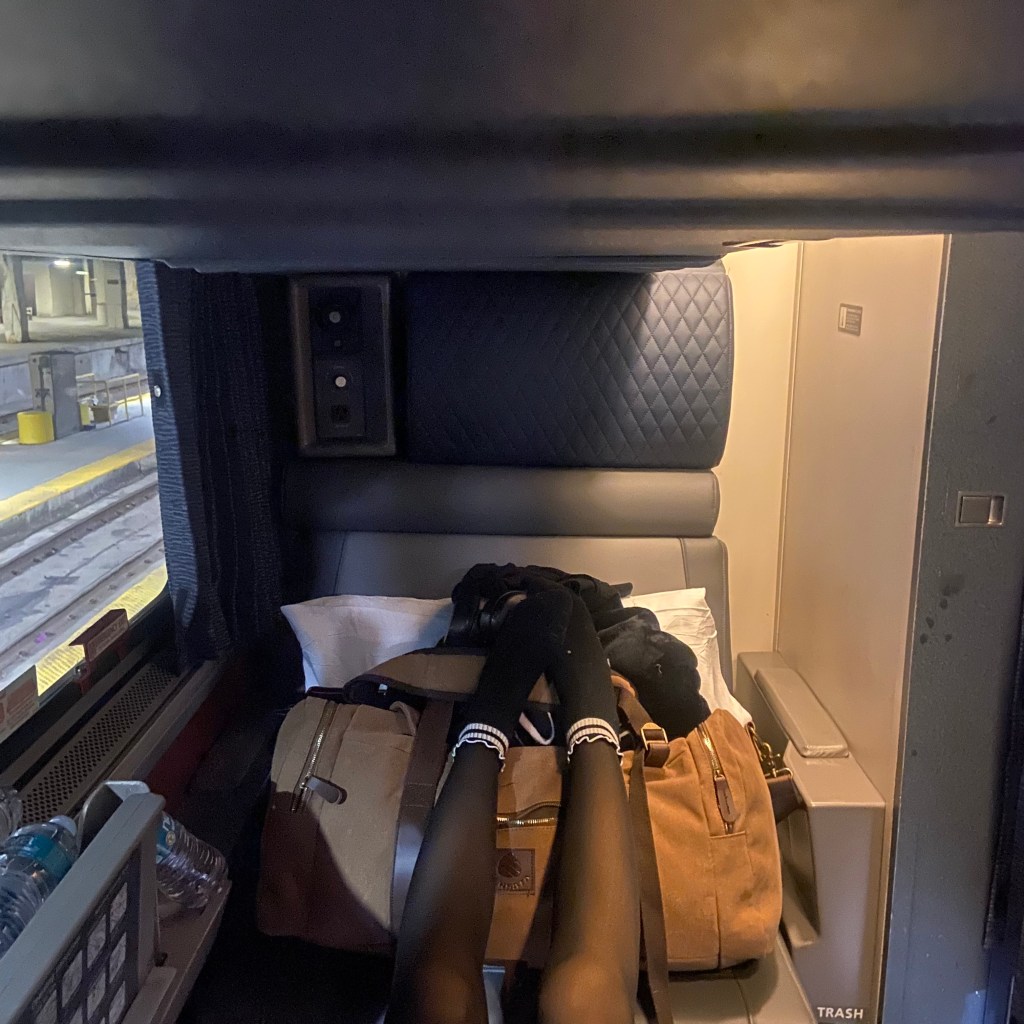
Luxury. The beds are shit obviously. I can’t imagine any person ever would expect a cot on a train to be dreamy. That said, the seats in coach and the observation cars are fabulous. Literally several calibers above the seats you get when you drop top dollars on a room. Amtrak is the only mode of mass travel where the quality of amenities sharply decline with each ascending tier of fare class. The toppest titty of an Amtrak ticket gets you nothing more than 18 inches of walkable space once the beds are down (once you unlatch the beds in a roomette, that’s the end of your floor space, it pretty much become a bunk bedded coffin), and you get your own bathroom stuff. Not a proper bathroom, mind you. It’s a hose shower and sink over in a corner and, for some god awful reason, a toilet that is literally right next to the beds. As in, one bed borders it, and whoever may be sleepily climbing down from the top bunk above better hope someone put the lid back down or their foot is going right into the mouth of the beast.
Frankly, the beds could be heaven sent and you still wouldn’t be able to sleep well on the train. Unless you’re a sailor or have some crazy sleeping pills or something. Sleeping on these things is like trying to sleep on a mechanical bull. The whole night is spent getting your cookies tossed from station to station. This is another thing that isn’t as bad in coach.
Like I said earlier, only the top dollar rooms get their own bedside toilet. For everyone else, it’s one per narrow corridor. Anywhere from 10-30 people, depending on how ~happening~ things are that night. I’d guess the hallways to be around three feet wide, and I felt like a plinko ball every time I had to shimmy down to the water closet. The bathrooms are, of course, grotesque. We could have been the daintiest, tidiest set of passengers in the world, and they still would have been grotesque. When the train’s a-going, which is almost always, there’s no standing still. The most graceful man in the world would be as much of an out of control firehose as the world’s greatest slob trying to aim at those toilets. When I went to brush my teeth I had to brace myself, shoulders pushing against one wall with my feet kicked up against the other like I was trying to split the room in two. The next morning, I took a mascara brush to the eye. I got off that train looking like I’d crawled out of a swamp.

Just like this. So, why would anyone take an Amtrak? If you’re going to drive a long distance, it’s pretty decent. You don’t have to worry about operating a vehicle so you can get drunk and silly, if you wish. You don’t have to stop for gas and, more importantly, you don’t have to stop for sleep. For those who *would* consider a plane, it’s a harder sell. Amtrak is definitely a better coach ride regardless, but it’s probably especially cozier if you’re substantially oversized. You also don’t have to spend 20 minutes disassociating in order to cope with the fact that you’re letting the window lickers of the TSA degrade you with their nudie box walk of shame. Unless of course, you paid the extortion money so you could get PreCheck CLEAR and came on one of the lucky days when all the scanny machines are actually working. I wonder if whoever named that program has realized it sounds like an at-home jizz tester.
Beyond that, the train is only practical if you’re Amish, afraid of planes, or you just really like trains. Most people seem to be the first or the third. Train riding for the sake of train riding is, apparently, a thing. It’s like a cruise, but on land and there’s no pool and the food and drinks are airplane prices along with sad, plastic airplane quality, and you never go outside. They say you get step out at the station stops, but what they mean is you’ll be forced off at the four hour Chicago layover and if you step off to have a stretch or a smoke during one of the other stops, they’ll leave without you.
It’s a weird scene, but so what. Everywhere seems to be odd feeling and liminal these days. I’ve already publicly made the claim that large smears of the US are low- or no-trust societies.
That argument extends to planes, trains, and buses. Cramming people into the tin like ground tuna locks in a certain degree of good behavior, depending on which hell you choose. Last I knew, buses were the most dangerous pick of the litter, particularly those two-level monsters. Makes sense. Is there any security on a bus besides its tired old driver? Planes are probably fine because there’s no room to do anything and you can’t exactly wander aimlessly without a stewardess eventually asking you what your problem is. The train is like a hybrid of the two. More staff about than a Grayhound, but more wiggle room to get up to shit for the maliciously inclined. There are locks on the doors, but I’ve bought $2 skirts off Shein with sturdier closures than those wiggly little latches.
What happens is everyone does that subtle little dance of American niceties. That fast fading virtue of being not only polite, but courteous to strangers. Pardon me, excuse me, thank you, you’re welcome. Good manners are the cross beams that keep the social contract from collapsing, and those beams have grown ever more tenuous since 2020. It’s a simple system, and one that you know intrinsically if you were raised to not beclown yourself in public. This casual etiquette has the added value of making it much less awkward to audit the potential danger of the weirdos you end up surrounded by on a train.
When people sit down next to you, they fire off a hey-how’s-it-going that gives both parties a chance, with little effort spent, to make sure no one’s a mumbling crazy fidgeting with a knife. Assuming it’s a busy train of course. If someone sits next to you on an empty train they are a freak and deserve to be shamed for being one. If you’re one of us high rollers in the sleeper cars, there’s this sort of bird ritual with a wave and a “Been riding long?” that you go through with the person across the hall. You could be talking to a friendly kidney bandit, but the odds are low and if you’re charming enough, you may haved turned them into your friend. What kind of short-sighted kidney bandit would harvest the gizzards of a friend?

There ain’t nobody here but us pigeons. Casual manners used to be more ubiquitous. Now they’re gone from planes, long gone from most if not all buses, and definitively extinct on public transit. Everyone seems to know that polite society has been evaporating and most seem to have some favored answer for why. Tech is the common scapegoat in my circles. Polite society shut out by addictive screens and noise cancelling headphones. I don’t disagree, but I’d call it more of a symptom, a means to ignore the rot. I’ve been wearing headphones on every plane, subway, and sidewalk for over a decade now. Most of the time I’m not even listening to anything. It’s just the only way to ignore the toothless woman angrily asking you to give her a dollar, or that certain kind of dude that compulsively pesters any woman who had the bad luck to be within 30 feet of him.
Polite society is likely never coming back. Some puddles of it will gather in a few unique suburbs and small towns, but it never comes back. For the rest of the century we will continue getting meaner and meaner until most of the nation is like that city in Judge Dredd. Riding the Amtrak won’t change any of that, but, for now at least, it’s the last bastion of the old way among the mass transit options that I’ve experienced. If I ever take a multi-day steamboat ride and the people are majority lovely, I’ll amend this opinion.

If you had fun reading this, consider leaving a tip.
-
How local lunatics color communities.
Warning: This is a self-indulgent nostalgia post. If you came here expecting a bleeding-heart screed on the tragedy of homelessness, you’re going to hate this.
There’s something like Christmas morning when you return to your hometown after being gone awhile. Passing through all the old haunts, wowed or depressed by all the little changes. Where once there stood rotting a tantalizing old ruin of a factory, now there stands a Taco Bell Cantina. The coffee spot you once lazed around for hours with your friends like it was an opium den is still there, full of weird faces. Your old friends all privately tucked away with their young families or the addictions they’ve cultivated. The colorful bums once regarded as neighborhood “characters” have been replaced with spastic tweakers yelling at their busted women to push the junk cart faster.
I got hung up on the lost schizos recently for no reason. Just happened to be going down the stairs thinking about a particular neighborhood, and with each step down their names flashed into my consciousness like neon. Rune1, Wimpy Wellington2, Mouse/Streetfighter3. Some of their names chosen and some given, no one knew who they were born as. They wore the same kooky get-ups every day, maybe adding a boa in the Fall or a sombrero in the Summer. You and your peers swapped details of their backstories over some weed in the park, little bits of stupid lore that passed the time and served as cautionary tales against getting too into smoking weed in the park, lest you find yourself living in it fifteen years down the line.
There are obvious reasons for why they disappear from public life. They’re chronically nuts, after all, and most had destructive lifestyles. Death comes sooner for many. Besides that, I no longer spend afternoons in parks smoking weed and politely listening to the ramblings of crazy people. That was an activity for the young and the restless, for people living in their childhood home or a dorm while earning the kind of piddly part-time income most make between the ages of 18 and 22. We sought out free loitering spots, like the rest of the degenerates. And we walked or biked to get to them because the cars we had if we had them were usually leaking or grinding something. Walking comes with a zoomed in view of a cityscape. Surprise lurks around every corner, and it can be great or terrible.
I don’t know why I care about this. I got hung up recently on an idea about the meaning of “a sense of community” versus living in a city and going to places where you consume things around other people that you likely won’t directly socialize with. Paying to crowd up with strangers to watch a musician whose performance grows hazy in your memory with every day that passes versus the enduring memory of the day you helped your friend rip out their basement floor after their plumbing exploded, the whole gang coming with their shovels, high on camaraderie.
Not sure how the schizo bums I used to see around factor in here, either. But they do haunt me, a bit. Maybe their outrageousness is part of the spice mélange that makes a place feel so special. It’s not like any of us cared about them or liked them. They were just around all the time, we traded stories about seeing them tilting at their windmills and commiserated on our odd inescapable interactions with them. In short, they were objects of free entertainment at best, nuisances we could put up with at worst. Their particular blends of mental instability wasn’t scary, like other street dwellers, it was just funny. In a way, they could add a bit of adventure to a plain day. I can’t really say I’d be joyed to run into them in the presently, either. Or that I wouldn’t chase them off my lawn with a big stick. They’re like libraries. I never want to engage with them, but I’m sorta glad they’re out there somewhere.
Maybe it’s because when I think of “community” I think of the home I knew best and how I remember it from my tender years when every pocket of it felt so uniquely its own, and everywhere you went you ran into friends. The world was big and timeless, except that it wasn’t. Time moves on and businesses get painted gray and sold to another gray colored business. Fabulous hobos get exorcized once new signs go up naming districts things like Northern (Noun), The Salt-(Something). It seems so impossible that one giant condo building can get enough people to live in it, let alone justify an endless sky-blocking stretch of them, in the place where you used to watch your boyfriend and his chums skateboard badly while rubbing elbows with the freakiest freaks. But there they are, selling out faster than they get built.
It’s stupid to think a community never changes as you age, I know. It just feels like it won’t when you’re in the moment. The people coming to your parties will always be coming to your parties, and your parties will never end. Until they do, until people move away, til they die, til you’ve grown sick of each other or sick of this empty living. In a way there is no grand community, only a series of social spheres that we float into until some life event comes along and pulls your focus down so deeply you forget who you were, what you were doing, and who you were doing it with. We drop the torch, and we only start to care that it fell when we stand on a street we’ve been on a hundred thousand times and feel like the stranger in a strange land.
Ah, youth. - Rune may have been the most notable of the bums because he was only a few years older than us. He didn’t seem to have the patina of a street person. Probably because he had a home, or his parents did at least, so he didn’t have to live like a bridge troll. His one outfit was a black t-shirt over tan Dickies, with a Berkley School of Music hoodie (we weren’t in California) thrown on in the cold months. He was a very tiny man who hung out with two giant dumb dudes I always thought of as his goons. No one knew them, they never spoke. The three of them spent all day walking from one coffee shop to another in pursuit of bummed cigarettes.
His backstory was that he was kind of musical genius who got a scholarship to Berkley. He attended the school for a couple years and picked up a ketamine dependency that turned him into Rune. He either flunked out or gave up school and returned to his home city to spend his days wandering around, intermittently breakdancing very badly in the grass. Occasionally he’d give people a CD he’d recorded his mumbly rap songs on. I never would have guessed that the dude was ahead of his time.
↩︎ - Wimpy Wellington was what we, the people he harassed from his milk crate, called him. His real name would eventually come out in a local newspaper expose. J. Wellington Wimpy was the name of the Popeye character who did the “I’ll gladly pay you Tuesday for a hamburger today,” bit. A fancy man who never had the cash to pay for his own burgers. He was basically a wino but for hamburgers instead of booze. Wimpy Wellington was a fat old man who panhandled outside the McDonalds in the city’s most expensive shopping district. He plopped down on a milk crate and asked anyone who passed to give him a dollar for a cheeseburger. To anyone who ignored him he hurled a quick insult, to anyone who gave him money he never said thanks. He was infamous because he was such an ogre. Far as I know, no one ever witnessed him actually buying a cheeseburger with his alms.
The guy must have eventually insulted the wrong small-time journalist because one day his whole scam was exposed in the local free paper. It wasn’t a publication of great renown, but occasionally they’d bother to dig into some niche local thing and everyone would be talking about it for a while. All the writer did was perch in the parking garage across the street to spy on Wimpy Wellington until he picked up his milk crate and headed for the bridges. But it wasn’t the bridges he was really headed for. It was a shiny Lincoln Town & Country, with a driver who idled it on the edge of the district waiting to pick up old Wimpy every single day. Afterward, he was driven to his stately manor, where he presumably dumped out his ill-gotten gains into a swimming pool of gold coins that he promptly dove into while cackling at his own genius.
↩︎ - Every city seems to have some very visible schizo dude running around in a makeshift cape. Mouse/Streetfighter lived like a goblin in the limestone rock wall of a small park in the middle of a hiply historic part of town. Sit in that park long enough, and he would pop up like an opera phantom to show off his gangly kung fu and beg for weed. He was somehow ever-present in that park, yet also everywhere else. Always lurking, watching, waiting, while also jumping a mile over to incoherently argue with the Black Hebrew Israelites. He was the most mysterious of all. No one knew his any of his actual backstory. Only that he called himself Mouse until he started donning his cape, after that he became Streetfighter. We really do write the poetry of our own lives. ↩︎
If you liked reading this, consider leaving a tip.
- Rune may have been the most notable of the bums because he was only a few years older than us. He didn’t seem to have the patina of a street person. Probably because he had a home, or his parents did at least, so he didn’t have to live like a bridge troll. His one outfit was a black t-shirt over tan Dickies, with a Berkley School of Music hoodie (we weren’t in California) thrown on in the cold months. He was a very tiny man who hung out with two giant dumb dudes I always thought of as his goons. No one knew them, they never spoke. The three of them spent all day walking from one coffee shop to another in pursuit of bummed cigarettes.
-
Bango Skank was here.
From Beaux-Arts to slummification to Gray McDonalds, anyone at any time that has lived at least twenty years in cities has seen some degree of big changes. Pizza Huts become bistros, highways widen and roads narrow to make way for bike lanes, lovely old ruined houses are blown down and replaced with plasti-glass condo towers, downtowns are chopped into quaintly named districts and revitalized. Ages fade and one thing remains constant, the human urge to draw on the walls.
Unlike my last city life entry, this isn’t a rant post. It’s a pretentious art appreciation post. As an art school drop out, I am an absolute authority on these matters. Like a cultural acrobat, I am keyed into all the high and fine things of life.
I don’t have strong feelings about graffiti. Like the heavens above, spray-painted scribbles have been present in the backdrop of most of my life. I could probably be made to care more about it, given the circumstance. Fury and wrath if someone drew a big crooked dick on the side of my car. Or perhaps some mild aesthetic pleasure if I came across something neat enough, or whatever. I don’t mean those high-production murals commissioned by city governments after one of those artsy weirdo districts has finally gotten expensive enough to squeeze out the last of the local schizo old guard. No, never that.
The first time I saw graffiti that took my breath away was when I was living in either New Orleans or Philly. I’m a little bit stupid so it’s hard to remember. There was this towering ruin of an old manufacturing building. I’d guess twenty or so floors tall. Some beautiful dreamer climbed to the top five levels to paint a letter into the west corner window of each floor. The cascade of block letters flowed down the side of the building to spell out B-O-N-E-R. This is art.
Last week I came across another slight delight.
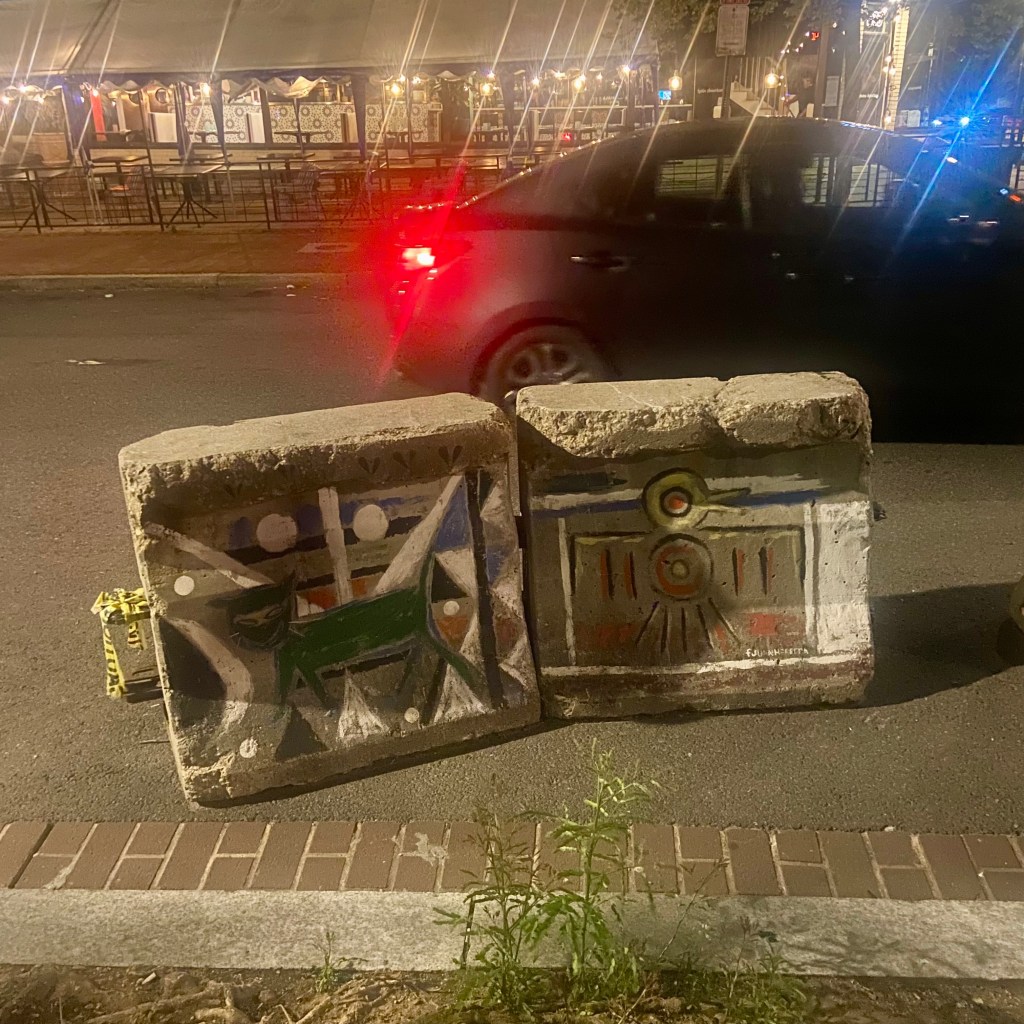
Ta-da! It’s not that great. It’s not particularly clever. I call it Suburban Primitive because I imagine the person who did this was raised in a soft house nested in some cul-de-sac tangle with two parents who always encouraged them to Express Yourself and gave them money for their hobbies, no matter how fleeting. Nothing wrong with that, because this delicate creature I just made up managed to create something so different from the standard fare that I stopped to look at it. Cliché in design though it may be, it’s certainly an improvement on those cement blocks the city leaves sprinkled all over town in case a president gets an incurable hankering for ice cream and is sick of what he’s got in the fridge at home. Ugly, overbearing, inconvenient. The barricades could be a symbol of 21st century edition DC. But if they must be there, they can at least look cute. And again, it beats the typical decor.
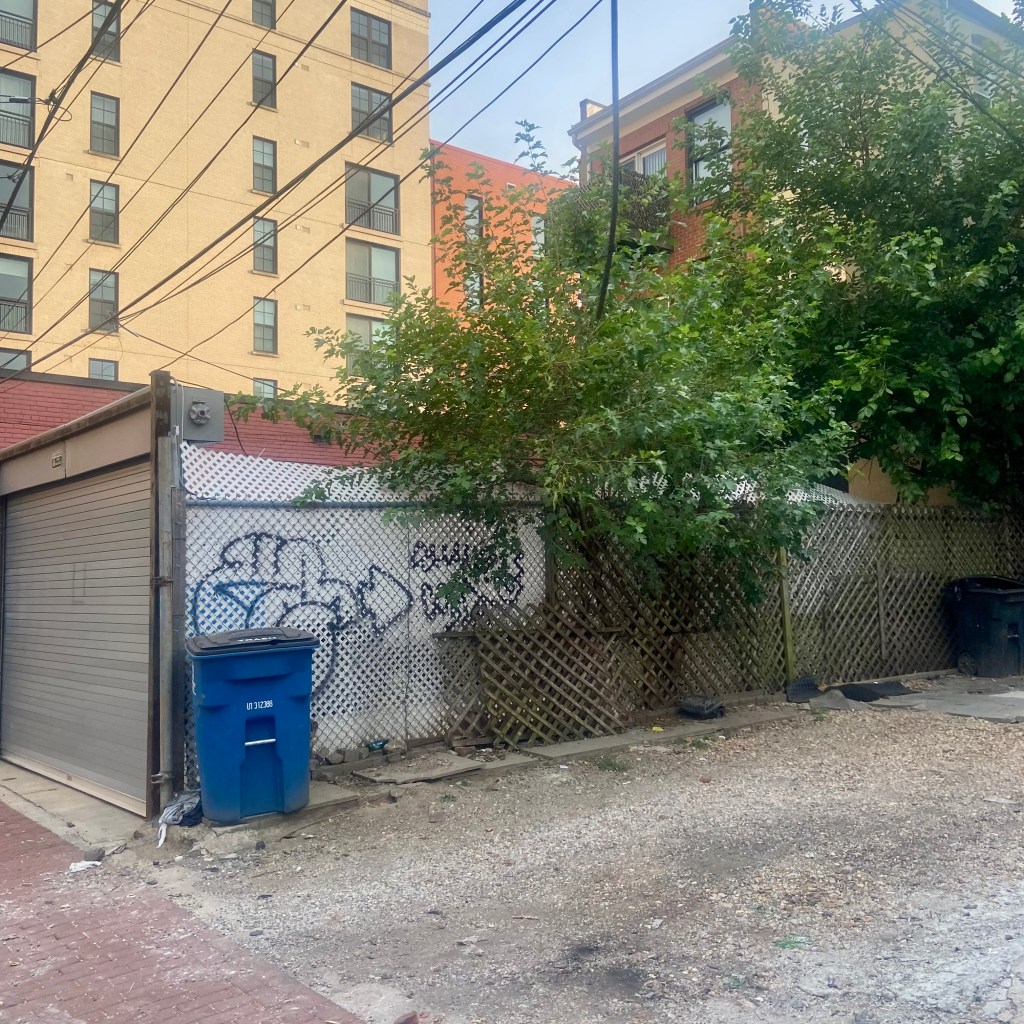
Yawn, how gauche. Graffiti is almost never “art” and it’s not because it’s ugly, trashy, illegal, anti-social, or whatever. It isn’t art because that’s not the usual intent of it. Primarily it is an act of ego with a side of adrenaline rush. Occasionally you see some sentence-long lettering from a hapless poet desperate to get their message to the world. “Fuck (something or someone)”, “Money is stoopid”, “Tasha is a SLUT”, etc. I don’t count these. They’re either a transcription of the cause du jour to earn peer cred, or they’re the leavings of a bored person who is wasting their time getting baked under bridges instead of figuring out how to do something tangibly helpful for their social concerns. Then again, I did recently cite the below image as one of my favorite things1 about my present environment.
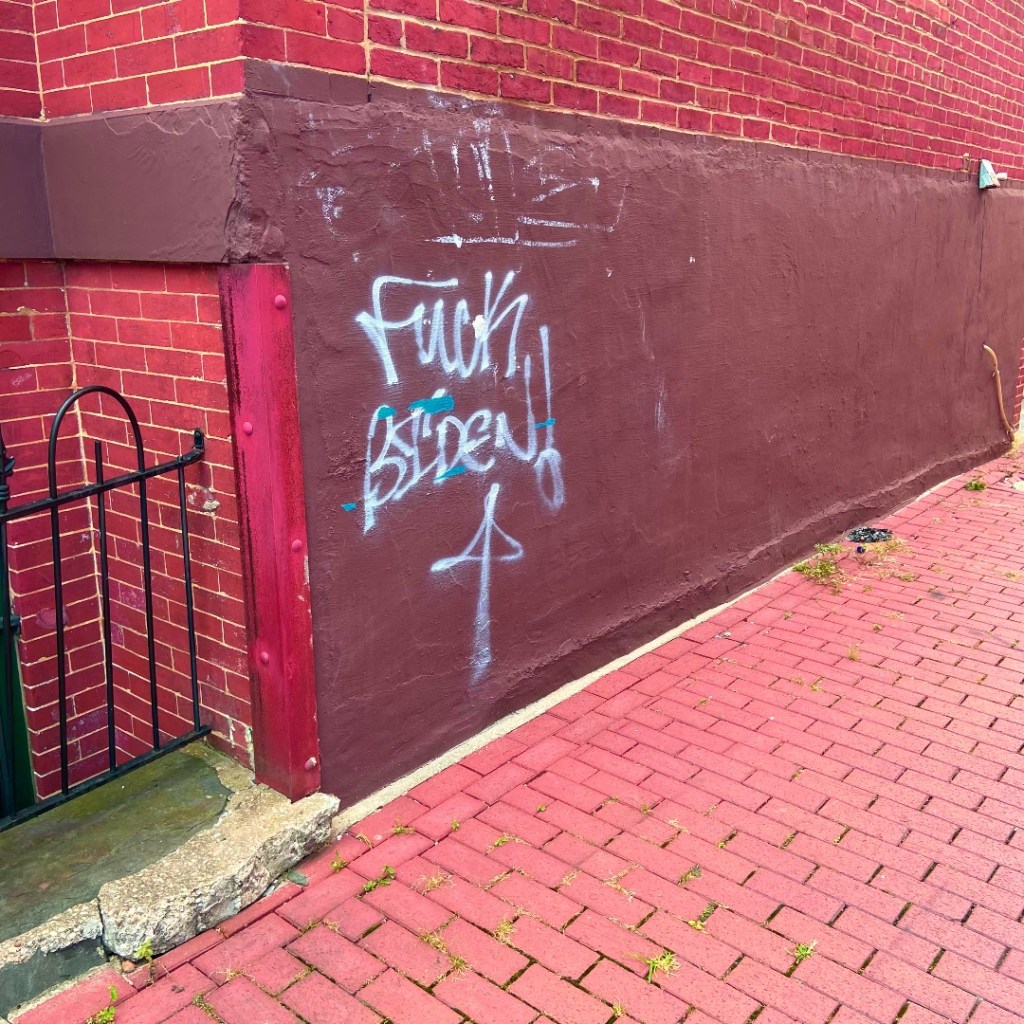
It ain’t art, but it is funny. Warning: Snootiness incoming.
But even the shitty stuff sorta kinda is art. It does modify the area it exists in, it does set a certain mood. Whatever the image, is speaks different sentiments to any beholders that are varied and often polarized. “Oh, this must be a bad neighborhood”, “Oh, this must be a cool neighborhood”, “Oh, shit, that’s my dead ex-boyfriend’s tag lol”. In tidy, sterile places most people will make themselves small and quiet. Fewer rip their shirt off and start screaming in the Apple Store. Museum voice is only a few decibels above a whisper. You feel like a rampaging ass if you get too boisterous in these places.
Defaced places pierce the unseen etiquette barrier. They carry subtle vapors of anarchy. Sometimes the scary kind, sometimes the fun kind. When you’re there, you can sense it. These are the places you can day drink while bullshitting the hours away with your buds. Inside or outdoors, these are the places where you can be excited and loud, and anyone who looks at you shitty for it is an un-fun prude. One of my favorite venues is floor to ceiling with this kind of patina. It tells all who enter that, short of brutal assault, anything goes.

Fun! This is probably the time to admit, to myself at least, that this post is basically a second installment in an informal series on community or something. I hadn’t planned to do that kind of thing, but between the trash dumping post and the pile of unrefined drafts I’m sitting on, it’s clearly happening. Apparently I have a lot of deep feelings about things like locally famous crackheads and a vague thing I call neighborhood-as-identity. Not sure where it comes from, but I blame Jane Jacobs for making urban development too interesting.
- I don’t even strongly agree with the sentiment. What makes it funny to me is that in DC there is either one guy who goes around every time the presidency changes hands to write “Fuck (Name)”, or there are two dudes carrying out a rivalry with one painting “Fuck Biden” and the other painting “Fuck Trump”. I’ve yet to see some washed out old “Fuck Obama” or “Fuck Bush”, so I’m not sure how far back the lore goes. ↩︎
If you enjoyed reading this pretentious ramble, consider tipping.
-
And if you gaze long into a trash pile, the trash pile also gazes into you.
Warning: this is a rant post that suggests no solutions, just classic bitching.
My working days are spent in a barely underground basement. It is so barely a basement that is has some of the biggest and beautifulest windows I’ve ever suffered the morning under. At the exact spot where I work, I’m as good as eye-level with the sidewalk. On that sidewalk in front of me is a decent tree (for the East Coast), and a free book box that sees a lot of activity.

The book box is one of my favorite things about this place, except for that hot day when someone put a tube of ground chicken in it. I’ve learned a lot working my day job in this corner. I learned that one fucker on a rental bike steals a majority of the Amazon packages around here. He follows a regular schedule, a ratty version of hustle culture. I’ve also learned an unexpected stereotype that my wandering subconscious strung together after seeing so many members of one demographic niche pee all over everything. I even know what their piss walk posture looks like on approach, like dogs to the fire hydrant. And I’ve learned that no matter the city, to live in the urban mid-Atlantic is to opt for daily anxiety over parking or daily anxiety over moshing among the pervy rabble of public transit.
Out here, you’ve got no choice but to tolerate the whims of every shithead in a three-mile radius. Your life goes fine and unannoying for some ten day stretch until another cretin dumps her chewed and stained clutter out on the sidewalk in front of the space you happen to pay to sleep in. When this happens, the savvy thing to do, as considered by most, is to call a bot automated line to file your complaint. This gets you out a single something-hundred fine, but only sometimes depending on how cantankerous the city worker who answers the call is, and it doesn’t get rid of the mess pile. The bitch at 311 will lazily scold you for thinking you don’t have to go clean that shit up with your own stupid hands.
This kind of rule making is not made for heterogeneous societies. This works for communes, it works for cults. It works in silly places that barely exist in the global awareness, like Switzerland and archaeology museums. The logical conclusion of such a system, in an age and place that renders its assumptions irrelevant, is You deal with it. After all, you were the one dumb enough to associate yourself with it on record. You’re the one that can be leveraged because you gave them your name and details. The ghoul that dragged the mess there is absolved the second they take they drop their bag of shame. They’re as anonymous as a firehouse foundling. This is the homeowner’s version of the curse that tells you that answering the debt collector’s phone call is welcoming a half-year of personal burden, even if the caller is wrong. The absolute truth is that you did not cause this disorder, and it doesn’t matter at all. The skank who did this said, “Not my problem.” The city that will take more of your money over it with fines says, “Not my problem.” And if one were to try to balance the scales of fairness with the logical solution of staking out the corner from a high window with a loaded airsoft rifle aimed at the degenerate’s haunches, the city will quickly arrest you.
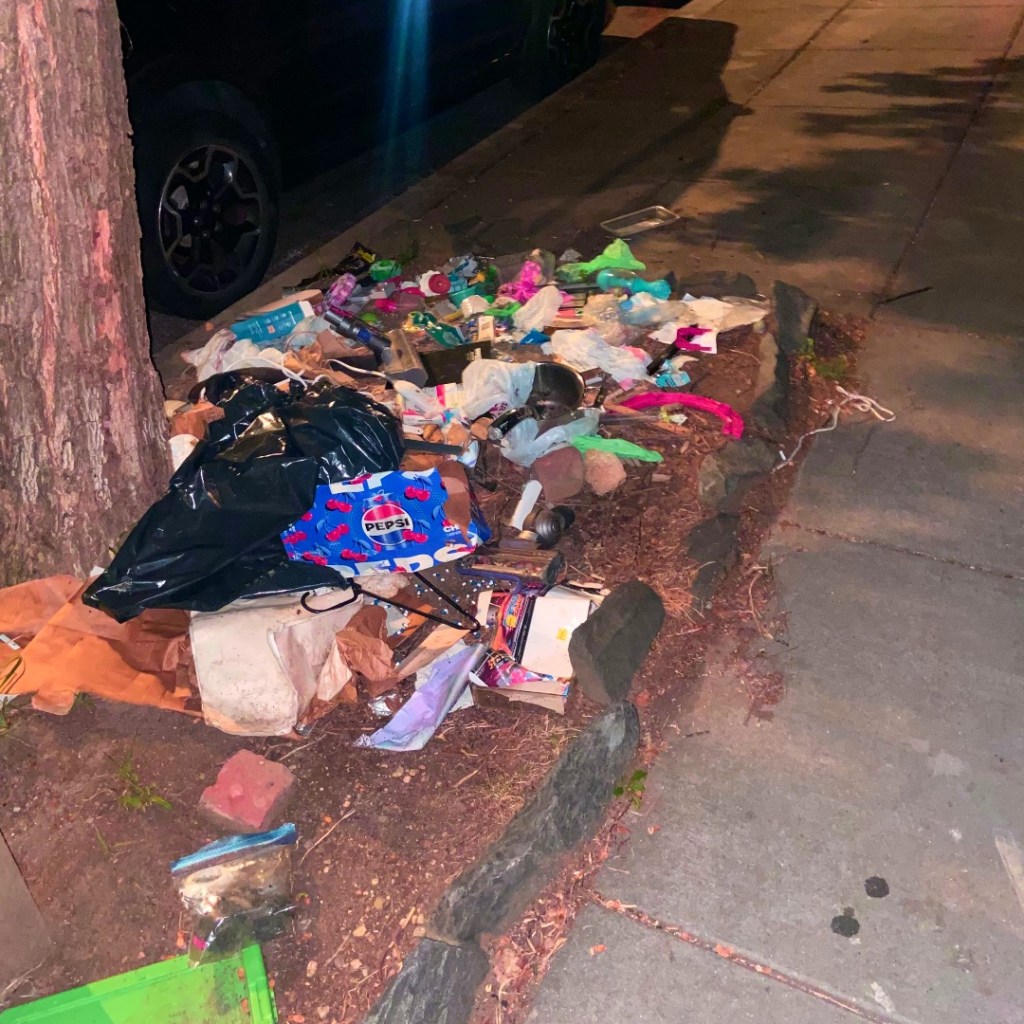
Shame on me, using the assigned trash cans instead of scattering my unmentionables to the wind. But you should be able to answer weird numbers on your own phone without concern that you’re getting tricked into another MoneyGram scam over toll booth fines you can’t possibly owe. You should be able to assault people, to beat them with a wire coat hanger, for dumping trash they made with their own dumb lifestyle that you will inevitably have to grasp in your own thinly-gloved hands after vomiting up your pride and living with your own full trash bags for yet another week for the sake of not having their shit out front. You should be able to traumatize these people, to mutilate them just enough that they can’t think of your block without shaking.
If you don’t make a fuss when you pay these fucking taxes, that should be the only signal necessary to get your city government’s workers off their unbelievably fleshy asses. Your complaint should carry weight since you pay the bill, and they should be paying for municipal employees that can identify the pattern of the problem while it’s merely budding. Obviously, that’s not what we have. We have checkmarks and bandaids on bandaids while any city worker we ever interact with has one scornful eye on us, and one bigger, less lazy eye on the pensions that we, the people who put money down, will pay for. Subsidizing the most useless years of the most useless workers in the world.

This is my second favorite thing about this place. The urban cores of the East Coast each contain a lesson in how low trust societies are formed. Not by murder nor mere gang violence. Not aborted fetuses nor by not not aborted fetuses. It starts with taking people’s money and being indulgent with it. Rainbow crosswalks and corny commissioned murals are regarded with less hostility in places where people aren’t regularly greeted with the mess of strangers on their own doorstep. Cities out here punish the people who were fool enough to bother staking their money on their chosen shithole’s future. Punished by way of intentional systems that will never stop using the window-licker choices of tax burden citizens to siphon more cash from tax funding citizens.
And this is the nation’s capital. It’s a small picture of electoral failure, twice over. First, because this is a problem that requires heavy political hands, and those hands are softened and bound when hobos and property renters get a vote. Rootless people think rootlessly and those who have something more to lose by fleeing on a whim will always have the higher stake. There’s just no give-and-take for that risk anymore. And it’s not a money thing. The house I see this from costs ten piles more than I could have imagined when I was sweating through the Midwestern starter homes market. The second failure here is the idea that this kind of environment can be solved with any voting bullshit. Voting can only prevent, it cannot clean or clear or make the careless care. It’s the slobs’ world now, we just live in it.
If you enjoyed this rant, consider leaving a tip.
-
A Glimpse at Lesser Houses
You’ll have to be patient with me this time. Yes, I promised secrets, and what I’m writing about for you today isn’t so much a Directory secret as much as it’s a Directory no-one-wants-to-talk-about. For good reason. These situations usually come to horrible ends. You see, we, or rather, the Directory used to allow the Old Families (OFS) to adopt children like anyone else and were at one time putting together a program to streamline the adoption process for non-producing union contracts. After all, we knew they had the means to care for children and we already have them firmly contained in the existing surveillance system. It was in the Directory’s more idealistic era, what I like to call “phase three”; phase one was all the uprising and violence and struggle, phase two was when victory was apparent but still not assured, when we had founded our buildings and the first whiffs of legitimacy, phase three was when the Directory began to be clearly cemented as the new authority. Phase three had a lot of the more daring dreamers coming out of the woodwork to finally propose whatever insane utopist fever dream they’d been sitting on for the last decade whilst dreaming of the brave new future we were said to be building.

Subscribe to continue reading
Become a paid subscriber to get access to the rest of this post and other exclusive content.
-
A quick n shitty bit on the July Monarchy
The new king, Louis Philippe, was head of the junior branch of the French royal house, the Orleans family, and to many conservatives he was the Revolution incarnate, though he hardly struck radicals as anything of the sort.
A History of Europe, J.M. Roberts, pg. 352Louis Phillipe took the crown after the overthrow of the doomed weakling known as Charles X, last of the Bourbon line. The Orleans line is the same thing, really. It’s not some Shakespearean rival family. The Sun King’s gay chad brother was the branch’s founding member. I don’t yet know why they founded a fake family offshoot, but my guess is it involves lots of drunken money spending and profound levels of post-fronde paranoia that are not entirely unjustified.
Louis Philippe’s father is famous for having voted for the beheading of his cousin and the foreigner he married, King Louis XVI and Marie Antoine(tte), respectively, and went to the guillotine himself soon after. Louis had fought as an officer in the republican armies and had even been a member of the Jacobin club in the 1790s. He made so many law school assholes waste away their days in coffee shops, it’s a wonder he wasn’t branded a counter-revolutionary and violently shortened by the grand autist Robespierre even sooner.
For liberals (Adam Smith edition), Louis Phillippe was an appealing choice for king because he appeared to reconcile the Revolution with the stability provided by the monarchy. They helped him into his dusty old birthright, and he ruled for 18 years as a pseudo-constitutional monarch and made sure the upper middle consumers never experienced any hardship harsher than going a day drinking their coffee without cream. Which was, in fair France, borderline Not fucking Cool.

Skim milk?!? Noooooo… His downfall became destiny after he lost support from the left, both the Adam Smith brand left, for the urban disorder the exploded in the 1830s, and the bitchy St.-Simon left, for cracking down bigly on said urban disorder. Indeed, history rhymes.
Problem was, the ancienne regime no longer had the old chosen-one mysticism to back them. The justification for one inbred rich fucker deciding everything for everyone this time rested, in theory, on the revolutionary principle of popular (elected) sovereignty, which in this case meant what some handful of dudes with the right kind of property or holdover legal privileges wanted. Hilarious how the French Revolution managed to perma-bake some of its biggest gripes into the fold of the future republics. When Louis was ~elected~ around a third as many Frenchmen as Englishmen had a vote in national elections, while the population of France was twice that of England’s.
Louis Philippe was the last king of France1. He gave up the throne to his nine-year-old nephew in 1848 and, jumpy over the potential loss of his head, he popped a wig on and snuck out of the country. He spent the remainder of his life in exile in dreary, rainy, awash-with-beans England.
- It’s more accurate to say he was the last king who was officially called “king”. After he bailed, the National Assembly shoved his pre-pubescent replacement aside and gave Napoleon’s nephew the presidency. Three years later, as he neared the end of this four year term he executed a top-down coup and through a weird mess of French political pettifoggery, that resulted in giving him the ability to revise the constitution. Predictably, he used it to automatically re-elect himself for life. He changed his title to Emperor Napoleon no. 3 and got away with it for twenty more years until famed big dick, Otto von Bismarck, knocked the stuffing out of him. Napoleon III was the last emperor of France, and like Louis Philippe, the last king of France, he spent the rest of his life in exile in England. ↩︎
-
how the meatball gets made, a timeline of 1815 to 1871
1815
The land that would become Italy consists of:
- Kingdom of Sardinia (Savoy, Piedmont, Genoa, Sardinia)
- Duchies of Modena, Lucca, and Parma
- Grand-duchy of Tuscany
- The Papal States
- The Kingdom of the Two Sicilies (1816; formed by the merging of the Kingdom of Sicily and the Kingdom of Naples)
- Republic of San Marino
- Lombardy and Venetia, given to Austria.
1820
Waves of temporarily successful uprisings and coups in Naples, Turin, Modena, Parma, and Papal States; all suppressed with Austrian aid.
1831
Popular Unification activist Mazzini fails to bring about insurrections in Piedmont and Savoy.
1846
Election of Pius IX, believed to be a “liberal” pope.
1847
Founding of the newspaper Il Risorgimento at Turin by Cavour; Austrian occupation of Ferrara (Papal States).
1848
- January to March: Constitutional and patriotic (anti-Austrian) uprisings in Sicily, Naples, Tuscany, Piedmont, Romagna, Milan, and Venice; Sardinian declaration of war on Austria.
- April: Pius IX pronounces against war with Austria as a Catholic power.
- August: Sardinia forced to armistice by defeat.
- November: Uprising in Rome and the pope flees the city.
1849
- February: Proclamation of a Roman Republic.
- July: French expedition suppresses Roman Republic and restores Pius IX.
- August: Sardinia resumes war with Austria and is defeated, forced to pay indemnity, and the king abdicates; Venice surrenders to the Austrians.
1850
Cavour enters the Sardinian government (prime minister by 1852) and promotes anti-clerical legislation.
1855
Sardinia joins the Crimean War against Russia, and Cavour uses the peace congress to publicize Italy’s plight.
1856
National Society created to work for Italian unity under Sardinian monarchy.
1858
Secret agreement of Cavour and Napoleon III for a new war with Austria.
1859
Austria provokes war with Sardinia; Revolutions in Tuscany, Modena, Parma, and Papal States; Defeat of Austrians by France in Lombardy; Peace of Villafranca between France and Austria.
1860
- Napoleon III agrees to Sardinian annexation of Parma, Modena, Tuscany, and Romagna; in return for cession to France of Nice and Savoy.
- With covert support from Cavour, Garibaldi invades Sicily with the “Thousand”, crosses to Italy, and overthrows the Naples monarchy.
- Uprising in Papal States provides an excuse for Sardinian invasion which then blocks Garibaldi’s advances on Rome.
- Naples, Sicily, Umbria, and Papal Marches vote for annexation to Sardinia.
1861
Proclamation of the Kingdom of Italy under Vittorio Emmanuele II.
1862
Italian forces halt an expedition by Garibaldi; who is wounded and captured by them at Aspromonte.
1866
Italo-Prussian alliance and transfer of Venetia to Italy after Austrian defeat in Seven Weeks’ War with Prussia.
1867
Garibaldi’s invasion of Papal States halted by Papal and French forces at Mentana.
1870
Withdrawal of French garrison from Rome during Franco-Prussian War; Italian forces enter the city after bombardment and assault; After plebiscite, Rome is annexed and become the capital of Italy.
1871
Law of Guarantees defines Italo-Papal relations, assuring income and independence of the pope, and extra-territoriality of the Vatican State.
Home
1–2 minutes
 The Normal Times