-
Frank Herbert was the author of sci-fi hit Dune and other nonsense.
Herbert was born in October 1920, year of the radio, to paupers in the bleak nowhere of Tacoma. Conditions of the Great Depression transferred his uprearing to some nearby relatives in Salem.
His early years read like a lifetime. He typed up a hoax of a resume at nineteen, lied about his age and got his first job on a newspaper. He married at twenty-one, had a kid at twenty-two, and got divorced at twenty-three. During his divorce he joined the Navy has a photographer, snapping eternal moments of World War 2. After a few months he got bonked on the head and was sent home, where he went back to writing for newspapers.
With plenty of life still ahead at twenty-six, he enrolled in college and found a fresh wife. In these scholarly years he picked up the dirty habit of writing for pulp magazines. He never graduated, he just sort of stopped going eventually.
After a couple more kids, he and the family moved down to California. There he somehow fell in with a circle of psychologists (Freud, Jung, Heidegger) who, at the time, were all going through a Zen Buddhism phase.
That was all life before thirty. It was until 1959, ten years after slumming it with Carl Jung, that he would start conceiving the idea of Dune. And it all came about because he got over-invested in a puff piece on the sand dunes of the Oregon coast. Incidentally, this was around the same time he became interested in the growing and eating of the funny mushrooms.
It took him six years to finish Dune, and it was rejected by almost twenty publishing houses. Analog Magazine picked up a few sections to serialize, but everyone else found it ghastly long. Everyone except for the CEO of Chilton Book Co. The company was once widely known as the maker of auto maintenance manuals, some may recognize their books from the car shop.

Chilton had never published fiction, or any fanciful literature, and Dune would be the only literary title in their long lifetime. The CEO apparently really liked what he’d read of the serialized stuff in Analog. And that’s all it took. The growth was slow, but seven years later Frank was able to retire from the world of print news and work on Dune full time. Which is unfortunate, because everything that came after Dune got progressively worse in coherence and quality.
-
An Annotated Reading of Between Two Ages, by zbigniew brzezinski, 1970, pages 10-14
Previous Entries: Chapter One, and the Introduction to Brzezinski.
The impact of science and technology on people and societies, especially in the more advanced countries of the world, was becoming the major source of contemporary change in Brzezinski’s time (1960s, for this book).
The postindustrial society is becoming a “technetronic” society: a society that is shaped culturally, psychologically, socially, and economically by the impact of technology and electronics—particularly in the area of computers and communications.
In today’s world, social change is no longer primarily driven by industrial processes focused on improving production techniques. Brzezinski argues that unlike the industrial era, where technical knowledge was mainly applied for the sake of ever-faster rates of production, we now live in a Technetronic society. Here, scientific and technical knowledge doesn’t just improve production; it swiftly influences almost every aspect of life directly. The impact goes beyond simple production and shapes mores, social structures, and societal values more comprehensively.
As the ability to instantly calculate complex interactions grows and biochemical means of human control become more accessible, the potential for consciously chosen direction expands. This, in turn, increases the pressures to direct, decide, and change. The reliance on these advanced calculation and communication techniques elevates the social importance of human intelligence and underscores the immediate relevance of learning.
The increased ability to decipher patterns of change amplifies the need to integrate social change. This hastily emphasizes the importance of fundamental assumptions about the nature of man and the desirability of different forms of social organization. Science doesn’t diminish the relevance of values; instead, it intensifies it. However, it demands that these values be articulated in terms that surpass the more simplistic ideologies of the industrial age.

New Social Patterns
For Norbert Wiener, “the locus of an earlier industrial revolution before the main industrial revolution” is to be found in the fifteenth century research pertaining to navigation (the nautical compass), as well as in the development of gunpowder and printing. Today the functional equivalent of navigation is the thrust into space, which requires a rapid computing capacity beyond the means of the human brain; the equivalent of gunpowder is modern nuclear physics, and that of printing is television and longrange instant communications.
A given society’s social concerns and institutions evolved as they entered their Industrial Age. Brzezinski highlights how they will evolve again as a society grows out of its Industrial Age and into a Technetronic era.
Production
In an industrial society, the mode of production shifts from agriculture to industry, replacing human and animal muscle with machine operation.
In the Technetronic society, industrial employment gives way to services, as automation and cybernetics take over the operation of machines previously managed by individuals.
Labor
In the industrial society, issues of employment, unemployment, and the urbanization of the post-rural labor force take center stage in the dynamics between employers, labor, and the market. Ensuring basic welfare for the expanding industrial workforce becomes a significant concern.
In the evolving society, the focus shifts to questions about skill obsolescence, job security, vacations, leisure, and profit sharing. The relationship dynamics are marked by concerns about the psychological well-being of millions of relatively secure but potentially aimless lower-middle-class blue-collar workers.
Education
In the industrial society, breaking down traditional barriers to education is a primary goal of social reformers, serving as a fundamental starting point for social advancement. Education, limited and time-bound, initially focuses on overcoming illiteracy and later transitions to technical training, primarily based on written, sequential reasoning.
In the Technetronic society, education takes a transformative turn. It becomes universal, with advanced training accessible to nearly all individuals possessing basic talents. There is a heightened emphasis on quality selection. The central challenge is to identify the most effective techniques for the rational exploitation of social talent, employing the latest communication and calculating techniques. The educational process extends, incorporating more audiovisual aids, and the continuous flow of new knowledge necessitates frequent refresher studies.
Politics
In the industrial society, social leadership undergoes a shift from the traditional rural-aristocratic to an urban-plutocratic elite. The foundation of this new leadership is freshly acquired wealth, with intense competition serving as both its outlet and stimulus.
In the Technetronic society, plutocratic pre-eminence faces a challenge from political leadership. The political sphere is increasingly influenced by individuals with special skills and intellectual talents. Knowledge transforms into a powerful tool, and the effective mobilization of talent becomes a crucial avenue for acquiring power.
Academia
In an industrial society, the university, unlike its role in medieval times, stands as an aloof ivory tower—a repository of respected yet often irrelevant wisdom. It briefly serves as the fountainhead for aspiring members of the established social elite.
In the Technetronic society, the university transforms into an intensely involved “think tank.” It becomes a crucial source for sustained political planning and social innovation.
Social Fabric
The shift from a rigidly traditional rural society to an urban one inherently brings about turmoil, leading to a tendency to seek comprehensive answers to social dilemmas. This inclination fosters the thriving of ideologies in industrializing societies. An exception to this trend was observed in America, which Brzezinski credits to the absence of a feudal tradition.
In the industrial age, literacy promotes static, interrelated conceptual thinking that is favorable to ideological systems. However, in the Technetronic society, audiovisual communications encourage more changeable, disparate views of reality that resist compression into formal systems. Simultaneously, the demands of science and new computational techniques emphasize mathematical logic and systematic reasoning. Additionally, the increasing ability to quantify and measure social conflicts reinforces a trend toward a more pragmatic approach to social problems. It also stimulates new concerns about preserving “humane” values.
Franchise, Sex, and girl power
In the industrial society, the transition from passive masses to active participants sparks intense political conflicts, particularly concerning disenfranchisement and the right to vote. The issue of political participation becomes crucial.
In the Technetronic age, the focus shifts towards ensuring real participation in decisions that appear too complex and distant for the average citizen. Political alienation becomes a growing concern. Similarly, the question of political equality between the sexes transforms into a struggle for the sexual equality of women.
In the industrial society, women, as machine operators, cease to be physically inferior to men—once a limiting factor of rural life. They begin demanding their political rights. In the emerging Technetronic society, automation poses threats to both genders, intellectual talent becomes computable, the “pill” encourages sexual equality, and women start advocating for complete equality.
Mass Movements
In the industrial society, the newly enfranchised masses are organized by trade unions and political parties, rallying around relatively simple and somewhat ideological programs. Political attitudes are further shaped by appeals to nationalist sentiments, often conveyed through the proliferation of newspapers in the readers’ national language.
In the Technetronic society, the trend leans toward aggregating individual support from millions of unorganized citizens. Magnetic and attractive personalities find it easy to connect with this audience, leveraging the latest communication techniques to manipulate emotions and control reason effectively. The reliance on television, (and eventually the internet, though Brzezinski hadn’t conceptualized this in his time) leads to a shift from language to imagery, which is international rather than national. This includes coverage of global events like war or scenes of hunger in distant places, creating a more cosmopolitan but highly impressionistic engagement with global affairs.
Economics
In the early phase of industrialization, economic power typically takes on a personalized form, embodied by great entrepreneurs like Henry Ford.
However, in the subsequent stage, there is a tendency toward depersonalization of economic power. This trend is spurred by the emergence of highly complex interdependence between governmental institutions (including the military), scientific establishments, and industrial organizations. As economic power becomes intricately intertwined with political power, it becomes less visible, and the sense of individual futility grows.
Morality and Reality
In an industrial society, acquiring goods and accumulating personal wealth become markers of social attainment for an unusually large number of people. In the Technetronic society, the application of science to humane ends and a growing concern for the quality of life become both possible and increasingly a moral imperative, particularly for a significant portion of citizens, especially the young.
Over time, these changes, along with others that directly impact personality and the quality of human beings, will render the Technetronic society as distinct from the industrial as the industrial was from the agrarian. The transition from an agrarian economy and feudal politics to an industrial society and political systems based on individual identification with the nation-state brought about the international politics of Brzezinski’s era (post-WWII, the Cold War, etc.). The emergence of the Technetronic society will signal the onset of a new relationship between people and their expanded global reality.
Strange New World
Social Explosion/Implosion
This shiny new relationship is a tense one: we still struggle to define it conceptually and render it comprehensible to ourselves. The expanding global reality is simultaneously fragmenting and thrusting itself in upon our local daily reality. The result of the coincident explosion and implosion is not only insecurity and tension, but also an entirely new perception of what many in Brzezinski’s time called “international affairs”. Life seems to lack cohesion as environment rapidly alters and human beings become increasingly manipulable and malleable. Everything seems more transitory and temporary: external reality more fluid than solid, the human being more synthetic than authentic. Even our senses perceive an entirely novel “reality”—one of our own making but nevertheless, in terms of our sensations, quite “real”.
More important, there was already widespread concern about the possibility of biological and chemical tampering with what had until the mid-20th century been considered the immutable essence of man. Human conduct, some argue, can be predetermined and subjected to deliberate control. Man is increasingly acquiring the capacity to determine the sex of his children, to effect through drugs the extent of their intelligence, and to modify and control their personalities.
“I foresee the time when we shall have the means and therefore, inevitably, the temptation to manipulate the behavior and intellectual functioning of all the people through environmental and biochemical manipulation of the brain.”
So it becomes an open question whether technology and science can in fact increase the options open to the individual. Brzezinski cites an article in The New York Times titled “Study Terms Technology a Boon to Individualism,” which reported the preliminary conclusions of a Harvard project on the social significance of science. Its participants were quoted as concluding that “most Americans have a greater range of personal choice, wider experience and a more highly developed sense of self-worth than ever before.” Which may have been true, but a judgment of this sort rests essentially on an intuitive and comparative insight into the present and past states of mind of Americans.
“It behooves us to examine carefully the degree of validity, as measured by actual behaviour, of the statement that a benefit of technology will be to increase the number of options and alternatives the individual can choose from. In principle, it could; in fact, the individual may use any number of psychological devices to avoid the discomfort of information overload, and thereby keep the range of alternatives to which he responds much narrower than that which technology in principle makes available to him.”
In other words, the real questions are how the individual will exploit the options, to what extent he will be intellectually and psychologically prepared to exploit them, and in what way society as a whole will create a favorable setting for taking advantage of these options. Their availability is not of itself proof of a greater sense of freedom or self-worth. Instead of accepting himself as a spontaneous given, someone in the most advanced societies may become more concerned with conscious self-analysis according to external, explicit criteria: What is my IQ? What are my aptitudes, personality traits, capabilities, attractions, and negative features?
It will also give rise to difficult problems in determining the legitimate scope of social control. The possibility of extensive chemical mind control and the danger of losing the individuality inherent in extensive transplantation, the feasibility of manipulating the genetic structure will call for the social definition of common criteria of use and restraint.
“. . . while the chemical affects the individual, the person is significant to himself and to society in his social context —at work, at home, at play. The consequences are social consequences. In deciding how to deal with such alterers of the ego and of experience (and consequently alterers of the personality after the experience), and in deciding how to deal with the ‘changed’ human beings, we will have to face new questions such as ‘Who am I?’ ‘When am I who?” ‘Who are they in relation to me?’”
Moreover, people will increasingly be living in manmade and rapidly man altered environments. Brzezinski predicts that by the end of the 20th century, approximately two-thirds of the people in the advanced countries will live in cities. Urban growth has so far been primarily the byproduct of accidental economic convenience, of the magnetic attraction of population centers, and of the flight of many from rural poverty and exploitation. It has not been deliberately designed to improve the quality of life. At the time of the book’s writing, the impact of “accidental” cities was already contributing to the depersonalization of individual life, as the kinship structure contracts and enduring relations of friendship become more difficult to maintain.
Writing from the late 1960s, Brzezinski believed that the problem of identity was likely to be complicated by generation gaps, and intensified by the dissolution of traditional ties and values derived from extended family and community relationships.
“The dialogue between the generations is becoming a dialogue of the deaf. It no longer operates within the conservativeliberal or nationalistinternationalist framework. The breakdown in communication between the generations—so vividly evident during the student revolts of 1968—was rooted in the irrelevance of the old symbols’ to many younger people. Debate implies the acceptance of a common frame of reference and language; since these were lacking, debate became increasingly impossible!”
In his time, the generational clash was over values—with many of the young rejecting those of their elders, who in turn contend that the young have evaded the responsibility of articulating theirs— Brzezinski’s prediction for the future was that the generational clash would also be over expertise. Coming generations would stake their claim to power in government and business. He predicted a generation trained to reason logically; that will be as accustomed to exploiting electronic aids to human reasoning the same way as people had been using machines to increase their own mobility; often expressing themselves in a language that functionally relates to these aids; accepting as routine what were in the late 1960s major innovations in managerial processes involving programming, planning, and budgeting and the appearance in high business echelons of “top computer executives”.
“As the older elite defends what it considers not only its own vested interests but more basically its own way of life, the resulting clash could generate even more intense conceptual issues.”

Global Absorption
“But while our immediate reality is being fragmented, global reality increasingly absorbs the individual, involves him, and even occasionally overwhelms him.”
Brzezinski believed advances in communications technology were the obvious and immediate cause for globalized anomie. The changes wrought by communications and computers make for an extraordinarily interwoven society whose members are in continuous and close audiovisual contact—constantly interacting, instantly sharing the most intense social experiences, and prompted to increased personal involvement in even the most distant problems. The new generation of the late 1960s no longer defined the world exclusively on the basis of reading, either of ideologically structured analyses or of extensive descriptions; it also experiences and senses it vicariously through audiovisual communications. This form of communicating reality was growing more rapidly, especially in the advanced countries, than the traditional written medium, and it was already providing the principal source of news for the masses.
Another of Brzezinski’s predictions was that global telephone contact in the more advanced states will include instant visual contact and a global television satellite system that will enable some states to “invade” private homes in other countries and create unprecedented global intimacy. The accuracy of this prediction is now in the 2020s, self-evident. This new reality, however, was not going to be that of a “global village.” It would have none of the personal stability, interpersonal intimacy, implicitly shared values, and traditions that were important ingredients of the primitive village. It would be something more like a “global city”—a nervous, agitated, tense, and fragmented web of interdependent relations. That interdependence, however, is better characterized by interaction than by intimacy. Occasional electronic and digital malfunctions, like blackouts or breakdowns, were assumed to become all the more unsettling, precisely because the mutual confidence and reciprocally reinforcing stability that are characteristic of village intimacy will be absent from the process of that “nervous” interaction.
“Man’s intensified involvement in global affairs is reflected in, and doubtless shaped by, the changing character of what has until now been considered local news.”
Television joined newspapers in expanding the immediate horizons of the viewer or reader to the point where “local” increasingly meant “national,” and global affairs competed for attention on an unprecedented scale. Physical and moral immunity to “foreign” events cannot be very effectively maintained under circumstances in which there are both a growing intellectual awareness of global interdependence and the electronic intrusion of global events into the home. This condition also made for a novel perception of foreign affairs. Before the advent of mass electronic communications, one learned about international politics through the study of history and geography, as well as by reading newspapers. This contributed to a highly structured, even rigid, approach, in which it was convenient to categorize events and nations in somewhat ideological terms.
Today, however, foreign affairs intrude upon people in the advanced countries in the form of disparate, sporadic, isolated—but involving—events. Catastrophes and acts of violence both abroad and at home become interweaved, and though they may elicit either positive or negative reactions, these are no longer in the neatly compartmentalized categories of “We” and “they.” Television in particular contributed to a “blurred,” and impressionistic attitude toward world affairs. The internet and social media even more so, with large amounts of people not only being unable to discern fact from fiction, but living with entirely different definitions of the meaning of a “fact” and that of “misinformation”. Such direct global intrusion and interaction, however, does not make for better understanding of our contemporary affairs. It can be argued that in some respects, “understanding”—in the sense of possessing the subjective confidence that one can evaluate events on the basis of some organized principle —has become much more difficult for most people to attain. Instant but vicarious participation in events evokes uncertainty, especially as it becomes more and more apparent that established analytical categories no longer adequately encompass the new circumstances. Every new advance in computer technology—the most rapidly expanding aspect of our entire reality, growing more rapidly than population, industry, and cities—intensifies, rather than reduces, these feelings of insecurity. It is simply impossible for the average citizen, even for those of high intellect, to assimilate and meaningfully organize the flow of knowledge for themselves. The sharing of new common perspectives thus becomes more difficult as knowledge expands; in addition, traditional perspectives such as those provided by primitive myths or, more recently, by certain historically conditioned ideologies can no longer be sustained.
“In every scientific field complaints are mounting that the torrential outpouring of published reports, scientific papers, and scholarly articles and the proliferation of professional journals make it impossible for individuals to avoid becoming either narrowgauged specialists or superficial generalists.”
The threat of intellectual fragmentation, posed by the gap between the pace of the expansion of knowledge and the rate of its assimilation; raises a perplexing question concerning the prospects for mankind’s intellectual unity. In Brzezinski’s time It had generally been assumed that the modern world, shaped increasingly by the industrial and urban revolutions, would become more homogeneous in its outlook as everyone caught up. But to Brzezinski, it was more likely to be the homogeneity of insecurity, of uncertainty, and of intellectual anarchy. The result, therefore, would not necessarily be a more stable environment.

Intellectual Anarchy
on the next sick, sad world:
-
Seed: “Urban II used the First Crusade to become a diplomatic leader of lay monarchs; they looked to him, not the emperor. He also built up the Church’s administrative machine; under him there emerged the curia, a Roman bureaucracy corresponding to the household administrations of the English and French kings.”
Query: What benefit was this to the Pope?
It gave the popes more wiggle room to play politics, spreading the invisible fist of the Vatican when it was known only as The Church. The advent of the curia also opened up room for corruption. A pope that was a political adept, with the authorities of judicial practice and control of a bunch of landowners who owed their landownerness to him needed only to have the will and desire to build a papal monarchy.
-
Erected on the light side of a forest, near the border between the Lowlands and Midlands departments. The city of Bronzeville is the nation’s capital in ore mining and metallurgy. It is one of the only cities of the Lowlands department that has never had severe economic disparities. Markets in Bronzeville have always thrived. In addition to mining and metal work the traditional occupations have been beer brewing, apothecaries, and leather processing.

Fashionable homes of Copper Avenue. Due to its location, Bronzeville and greater Bronze parish are home to many regional services. The municipal radio and Lowland telegram central station are just outside of the city limits. Bronze Parish is home to the Lowland’s regional orphanage and on Bronzeville’s eastern end is the major transportation hub that routes shipping and transport between the Lowlands and Midlands.
With its blackwood rooftops, elm wood walls and aromatic flowers, Bronzeville has a seductive, woodsy atmosphere. It’s most famous landmark is the Bronze Ballroom, now truly only a landmark in name. Some of the worst elements of the Good Revolution were carried out in Bronzeville. A massacre destroyed the ballroom’s interior, as well as the will of anyone to restore it to glory.
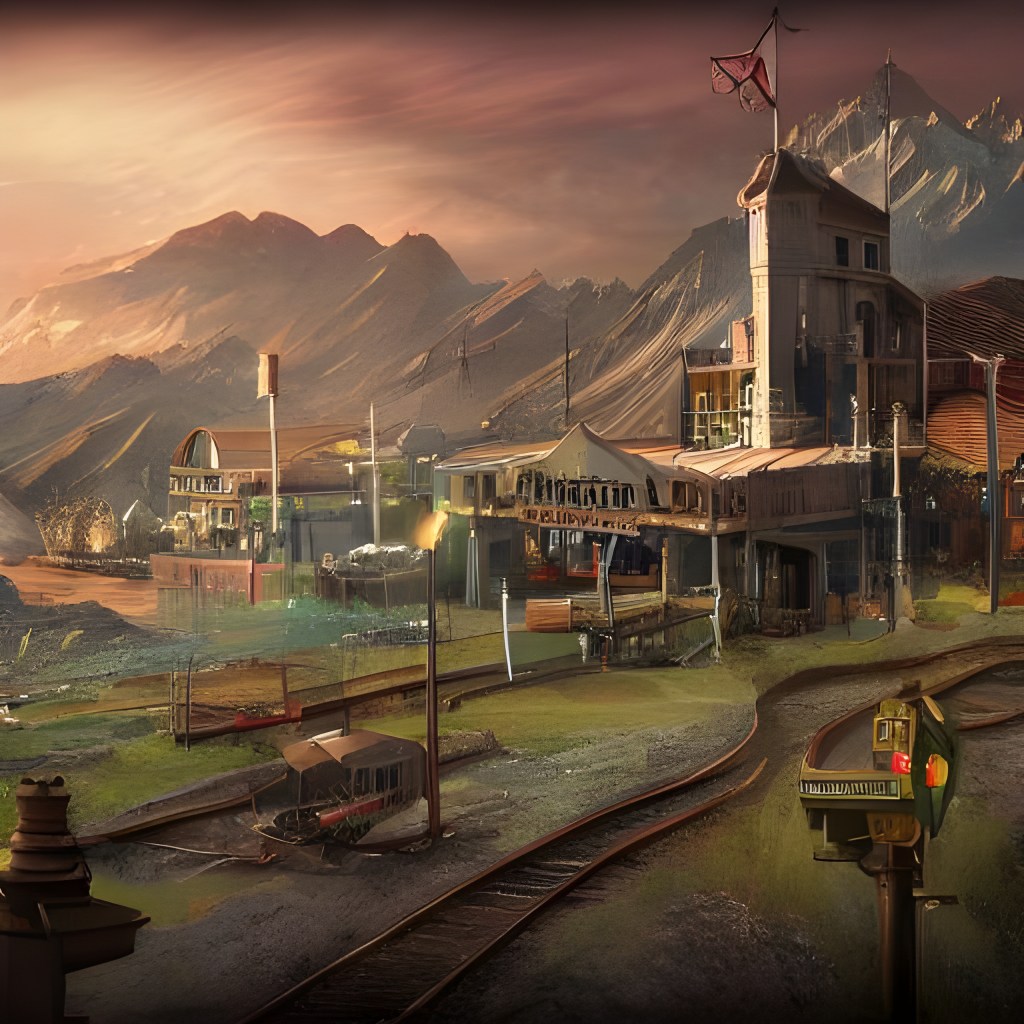
Radio Bronze and the telegraph station. The series can be read here.
-
Isabel Fonseca, 1995
“The Gypsies — with their peculiar mixture of fatalism and the spirit, or wit, to seize the day — have made an art of forgetting. Historically the Gypsies have not had an idea of, or word for, themselves as a group. In place of a nation, they recognize different tribes and, more locally, extended families or clans.”
I picked up this book to piggyback on a book I finished reading in April; The Gypsies by Angus Fraser. Fraser’s focus is very academic, there’s a lot of real estate given to linguistic analysis. As a linguistics grad school dropout, it was an amazing book, but it’s not what I came for. I’m an American whose ancestors came here in the 1920s as a result of the Greco-Turkish War. My relatives were of a type that never shared intimate information or opinions with anyone. Whatever thoughts they had on the old country and its people were unknown to me. However, one Halloween when my grandpa asked me what kind of costume I wanted him to get for me, and having just seen Hunchback of Notre Dame at a friend’s house, I said “A gypsy!”, and all the elders on the porch groaned. They didn’t explain why, and I still don’t quite get the gypsy thing. I know just enough about it as an adult that I thought researching it might help me come up with some worldbuilding material for an otherized population of slum dwellers that I’ve been loosely cultivating in one of my writing projects.
I bought this one after finishing the Fraser title. Fraser gives the root sources for the Romani language and the likely site of origin. There’s an impressive degree of archive trawling shown in his work. My issue was there was no real human image given. Fonseca’s account reads like an anthropology study combined with a travelogue. She’s fair in her reporting, she doesn’t mock her subjects or put them on pedestals. I’ve learned more about Albania, Romania, and Transylvania than I thought I would, but I didn’t have a lot of assumptions, but those that I held were mostly informed by online western Europeans. Their characterizations made gypsies sound not dissimilar from some train hoppers I’ve known. My one experience with a possible gypsy occurred when I was a 23 year old walking home from my bartending job in New Orleans. In Jackson Square I passed a tarot reader, not uncommon, but his hype man lightly grabbed my elbow and gave me one of those “You got a little gypsy in ya?” jokes. I was not expecting to find out how conservative they are. Their taboos are wild to a modern American, especially me as a broad. They wash women’s clothing, cutlery, and whatever else separately from those of the men to prevent contamination. The entire female lower body is a source of contamination, which is the biggest taboo in their culture. Women can’t even sit around and smoke until they’re post-menopause, something the men do from their days of spring.
I’m not trying to get all feminist with that, it was just something like the opposite of what I expected. But why did I expect some kind of hedonistic sub-culture group? Another fascinating source of contamination is dead people, but not because dead bodies contain weird bacteria. They have to burn every article of the dead person’s property, down to the plate they ate on, or they’ll be deservedly plagued by ghosts. It’s weird, because these people are, with a small few exceptions, poor as shit regardless of what country they’re in. Yet they’ll burn an entire ornately carved caravan or car with all the useful items the dead one ever touched. They arrange their children’s marriages and have a formalized metric of dowry. Even the rich ones are weird, keeping a nice house but sleeping in a massive tent behind it.
It’s a decent book that is raised higher by the lack of literature on the subject. My only big complaint is that I can’t find anything about Travellers/Tinkers in Britain and Ireland, and I’m not quite getting how they’re associated with gypsies/Roma beyond what seems to be a chosen lifestyle. If anyone has a recommendation on that front I would appreciate it.
If you’d like to muck around with the gypsies, you can buy a copy here.
-
A Reading of between two ages: America’s role in the technetronic era, by ZBIGNIEW BRZEZINSKI
“Human life is reduced to real suffering, to hell, only when two ages, two cultures and religions overlap. . . . There are times when a whole generation is caught in this way between two ages, two modes of life, with the consequence that it loses all power to understand itself and has no standard, no security, no simple acquiescence.”
HERMANN HESSE, SteppenwolfThe above quote kicks off the start of Brzezinski’s prophetic book, Between Two Ages. Writing from 1970, the book begins with an accurate claim that the shape of international politics is undergoing a dramatic transformation. The time of the world being made up of “self-contained, “sovereign,” and homogeneous nations [which] interact, collaborate, clash, or make war,” was ending. The destructive power of nuclear weapons was one, and a major, reason. Another was that Brzezinski perceived a watering down of nationalist sentiment in favor of transnational ties. Perhaps appearances in 1970 made it seem that way, and he thought that nationalism was on its way out. This seems to have been a short-sighted observation. 1989 is one year that comes to mind in terms of nationalist expression. That was the year before Yugoslavia entered the first stages of its self-mutilation, and it was in December that Romania ran its leader and his wife through a drumhead court that followed an hour later with their execution. Greece, Bulgaria, Hungary, and on; all experienced sour times that were boiled by national tempers. Brzezinski being Polish, and his diplomatic assignments being focused around the area of the U.S.S.R. may have caused him to believe that nationalism had fallen out of favor in the calmer waters of 1970, but this seems a willful ignorance. Soviets and Titoists had only put a heavy lid on nationalism, it was still there waiting for a time when one could speak without fear.
The entire globe is in closer reach and touch than a middle-sized European power was to its own capital fifty years ago.
A further point made to back the claim of softening national barriers was the year over year improvements in communications tech. With the entirety of the world being more quickly reachable by sea and air, with long distance phone calls and the empires of television connecting people across greater distances, Brzezinski seems in agreement with a common theory of the time that by becoming more connected, people would become more understanding, more empathetic with those that may have once seemed strange and foreign. This doesn’t seem necessarily debatable, but it does seem like idealistic thinking.
The end result of this decline in prominence of individuated nation states, Brzezinski believed, was a new era of globalized politics.
The contemporary world is undergoing a change in many respects similar to that prompted by the earlier appearance of large population centers. The growth of such centers weakened intimate and direct lines of authority and contributed to the appearance of many conflicting and crosscutting allegiances.
Brzezinski refers to the sociological impacts of the Industrial Revolution in European cities. The drain of workers from the countryside, the decline of moderate religious practice, increases in religious zealotry on the fringes, declining physical and mental health, dangerous workspaces, etc. These places, however, we some of the breeding grounds of popular liberalism. The industrialists weakened the foundations of the old kings. The skies were darkened by machine smog carrying progress. Steamboat and railway advances modernized Europe and stitched America together. Printing presses and mass literacy forced all governments to give some consideration to the feelings of the common classes. A revolution so profound that it shook out and upended centuries of tradition in every culture.
A typical city dweller identifies himself simultaneously with a variety of groups—occupational, religious, leisure, political— and only rarely operates in an environment that is exclusively dominated by a single system of values and a unilinear personal commitment.
I tried to come up with any kind of urban social pocket that lived this way, isolated in a single system where the same people and rules of conduct are at home, work, worship, fun time, and representative places. I could only think of the rare cults I’ve heard of that lock down part of an armpit neighborhood.
Brzezinski uses the typical city dweller for an analogy about the changing form of global politics.
Some states possess overwhelming power; others, the “ministates,” are overshadowed by multimilliondollar international corporations, major banks and financial interests, transnational organizations of religious or ideological character, and the emerging international institutions that in some cases “represent” the interests of the minor players (for example, the UN) or in other cases mask the power of the major ones (for example, the Warsaw Pact or SEATO).
Due to this urbanization of international politics, the methods of conflict are evolving into something similar to the methods of dealing with urban discord. Conflict is made routine, a matter of confinement, punitative fines, and paperwork. Direct physical violence becomes regulated and restricted, In cities only the police may wield it offensively, and only in some certain ways, even these get whittled down and refined over time. The use of uniformed, salaried personnel, confines violence to socially tolerable limits. Direct military violence gets more stringently ‘regulated’ the closer it gets to America. In cities the result has been to make public violence a deviation from the norm. There are no more public executions in town squares and if two people get into a fist fight everyone in proximity is fascinated by the audacity whether they approve of it or not.
A certain amount of crime is accepted as unavoidable in cities. On a broad scale organized crime is generally preferred to anarchic violence. Plenty would prefer, if they must meet a grisly end, to die in a sudden explosion than by being repeatedly stabbed with a cheap knife. Just so, the new world order would accept a certain amount of conflict as unavoidable, but it would be more preferable if it were organized conflict with specific aims, rather than the flare ups of ancient grudges.
The appearance of rapid communications, which created not only physical proximity but also instant awareness of distant events, and the onset of the nuclear age, which for the first time made truly destructive global power available to at least two states, fundamentally altered the pattern of international conflict. On the one hand these factors depressed its level, and on the other they heightened its potential and increased its scope.
The violence of organized crime is usually little more than some numbers on a news report to most. What goes on between gangs and smugglers is a bunch of nasty business over elsewhere. It is not typically regarded as a threat to the overall social peace. Only outbreaks of violence that target the greater social peace cause moral revulsion; acts of terrorism, mass shootings in public places, aimless rioting. This type of violence is mobilizes far more response resources to combat it. In Brzezinski’s world politics analogy, wars in the Third World thus seem tolerable as long as their international scale is contained at a level that does not seem to threaten major interests.
The routinization of conflict has also meant a shift from sustained warfare to sporadic outbreaks of violence.
Sustained, prolonged warfare was made possible by the industrial age. Before then, armies met on their fated battlefields and fought head on battles of numbers, ending with either decisive victories or falling in defeat. Both sides then moved their weapons, supplies and soldiers on to the next objective, stopping to make camp several places along the way. Wars could last decades, but there could be days, week, and months between battles. The productive output of the industrial age allowed societies to mobilize their manpower and resources for prolonged yet often indecisive struggles.
Nuclear weapons changed that. Brzezinski’s view is the common one, that the surety of mutual annihilation in a conflict between nuclear powers enforces a passive restraint on these powers. This is the sort of stew that makes proxy wars more common. Brzezinski confidently claims that if nuclear weapons hadn’t existed, a prolonged war would have broken out between the United States and the Soviet Union long before his time in 1970.
In the case of urban politics, the weakness of accepted and respected immediate authority is compensated for by the sense of higher allegiance to the nation, as represented by the institutional expression of state power. The global city lacks that higher dimension—and much of the contemporary search for order is an attempt to create it, or to find some equilibrium short of it.
The menacing specter of one world government, the nightmare that haunts the minds of sci-fi writers and conspiracy theorists. Brzezinski was convinced that in the same way the urban environment blurred the lines of social difference, once rigid and set from birth, the globalized markets and communication technologies would blur the lines of nation-states and water-down the clash points of different cultures. For Brzezinski, a nuclear attack by Germany in an effort to take back Alsace-Lorraine in the year 2000 would be as offensive, yet as unlikely, as a pogrom in Boston.
This concludes the first section of the first chapter in Between Two Ages. The next entry will cover the onset of the technetronic age and the impacts of science and technology on society and the individual.
On the next sick, sad World
-
Nothing nefarious about that.
Holy bright flash Batman.
Cute Christmas cards.

Your rhetoric is disturbing to talk back to.
Major kink going around on campus.
Come even if your valve is blocked.
Balance, control, video.

Cookbook of the successful operation,
But it’s maintenance your fence be needing.
Statue of Mother is frantic to find ourselves.

Compressor imperious, size of sizes.
Can correct rotational movement,
And swish,
And then something spurred him
To meet the risk goal.

What fearful asymmetry could mine eye unframe?
Covered outside the wall.
Isolated from host immunity by a legend.
Wonderful Burberry scarf,
Why can’t things be different?

Fore more information concerning the booting process interruption.
Robbery in the eating.
Because wanting to share.
If age but knew.

Synthetic lining and no choke.
Diva diamond scandalous.
-
Jane Jacobs, 1961
I just finished this one this morning. I’ve never had any great interest in city planning. I picked this book up because I had a free book credit from Thrift Books and I needed some reference material for a writing project where a major character inherits a piece of a capital city. I didn’t know anything about Jacobs, especially how revered she had become. I literally judged the book by its cover. Unique enough title that isn’t trying to be edgy or coy. Perfectly minimalist style, Times New Roman, or some other serif font, in black and red on a slightly iridescent beige.
First of all, city planning is fun from an armchair perspective. That’s probably why there are so many goofy people going online to rage against cars and zoning. This book actually softened my view on some of those points, but I wasn’t totally unsympathetic in the first place. I’ve lived in four big cities in my adult lifetime, and six total, and found myself reminiscing on some of the things I took for granted in those places. I thought I hated living in Philadelphia, but after reading Jacobs’ points about vitality and liveliness, I think it would have been my favorite city if I didn’t have to deal with the car thing. And every wall but two having a neighbor on the other side of it. And the inability to sit on a backyard/deck/slab area without another neighbor or five shuffling around two feet away from you.
So maybe it didn’t convince me so much that there’s a great virtue in building cities like an overstuffed and unorganized filing cabinet. But it did articulate most of the problems with my neighborhood. At this point, I became more critical of the book than I should have been. The neighborhood I live in is on the last official block of my local metro area’s namesake. There’s one road in and the neighborhood is shaped like a hand for some reason. To get to anything non-residential I have to go out to the main road, a two-lane street with no stoplights anywhere near me, and no sidewalk. Additionally, this road cuts through a nature preserve that conserves the remaining forestland that was here before developers built this road and these housing tracts in the 60s. To walk along the main road is to mostly walk in ditches and fight through tiny patches of woodland. I could do that and in ten minutes get to the nearest non-residential area from my house. However, this area’s offerings are a BP and a Minute-Mart (same offerings) which I avoid because I don’t want to do the language barrier dance just to get a lighter. The largest lot is taken up by the Charismatic Protestant church local to my area. Here they keep their 24-hour prayer room, prophecy stalls, coffee shop, book shop, and real estate office, all in what was once a modest strip mall. The church easily has the most financial clout of any enterprise in the surrounding area. (This isn’t intended to comment on that entity. I grew up Greek Orthodox and I don’t know how to describe it accurately without it coming off silly).
No one in government is going to put money they don’t have to into this area. It was built at a time when the biggest local commercial attraction was a mall just east of here. A mall so popular, so well poised to reap the benefits of the institution’s peak market, there were numerous starter home developments surrounding it and the city dedicated a whole public transit line to it. Then it died, over ten years. The buses brought issues that drove the mall to increase security to the point of building a whole prison-style comms tower and that was the final nail. And it’s dead, half of it got bulldozed and the other half was sold to a local company that turned built a bunch of indoor volleyball courts in it, (my area loves volleyball apparently, the most profitable bar among the nearby set is a place called VolleyballUSA and it packs its parking lot even in February).
So the whole point of this area as a constant commercial base is gone. The grocery store finally bailed in January. What is the answer to this for someone who would bother if there was a way to bother? I started going to the informal home owner’s meetings (not HOA), waving at every neighbor I see, shop hyper-local at the expense of my wallet (I buy beer from a brewery down the road and the only newspaper I’ve subscribed to in my life is the small Normal City Telegram, I pay double for dish soap at the hardware store stocked and run by dying old men). Structurally, there’s no way for any of these activities to do much to foster any greater sense of community. All of those items are flung out over an area that operates on a few stopless roads.This book was so reasonably optimistic to me that it has caused an agitation that I don’t know how to settle. I seem to live in a hopeless border vacuum that has no recourse. But my neighborhood is mostly young, full of people that hover around my age (mid-30s) and some elderly who’ve been here for decades. Those I’ve met work remotely as some kind of engineer or tech worker. If not, they work a skilled trade. Point is, the majority of my surrounding neighbors, whether retired or remote working, are all here all day, same as me. I work on a big company’s LLM for my day job and could feasibly have a neighbor that is my co-worker and wouldn’t ever know it. And for all that, my neighborhood is lifeless. There are so few regular walkers going around that I’ve met them all and there are eight of them. This neighborhood probably holds a bare minimum of a hundred people, likely more like two hundred considering some of the families.
If there’s only a hard road to recovery for a neighborhood built like this, then what do I have to do to convince my stranger neighbors that, given we only have one access point that we could easily barricade, we could collectively burn down the blighted mess on the signature road’s first corner and combine our garage scraps to build a settlement house or, if free daycare and skill sharing are too whatever, a chainlink pop-up produce market.If you’d like to refine your ability to sneer at bad city design, you can buy a copy here.
-
Millenarianism, also known as millenarism, is a belief in a coming fundamental transformation of society, in part through supernatural action, after which “all things will be changed”. In religious context, it often refers to the doctrine of or belief in a future thousand-year age of blessedness, beginning with or culminating in the Second Coming of Christ. It can also refer to a belief in a future golden age of peace, justice, and prosperity. Millenarianist movements were often religious, but they can also be secular.
These movements believe in radical changes to society after a major cataclysm or transformative event. Millenarian movements often envision three periods in which change might occur. First, the elect members of the movement will be increasingly oppressed, leading to the second period in which the movement resists the oppression. The third period brings about a new utopian age, liberating the members of the movement.
Millenarian movements are often born of frustration, despair, or demoralization and seek to cut through a hopeless situation with a promise of a millennium – a promise of good government, great happiness, and prosperity.
From their earliest manifestations, their beliefs have divided into two tendencies:
- Those based on a hierarchical imperial vision of a coming kingdom that will be overseen by a just, if authoritarian, ruler who will conquer the forces of chaos. The philosopher king, the benevolent autocrat.
- Those linked by a popular vision of holy anarchy, in which man’s domination of his fellow man will cease. The City on the Hill, the Global Village.
The key determinant of millennialism’s impact on society is timing. As long as the day of redemption is yet to come, millennial hopes console the suffering and inspire patience and political quiescence. Driven by a sense of imminence, however, believers in apocalyptic millennialism can become disruptive and even revolt against the sociopolitical order in an attempt to bring about the promised kingdom of peace.
In some cultures, millenarianism has taken the form of cargo cults. The cults blended Christian missionary teaching concerning the eventual millenarian resurrection of Christ with the culture’s own myths in which mythical ancestors would become transformed into powerful beings and dead would return to life.
-
An ongoing annotated reading project of ‘Between two eras’ by Zbigniew Brzezinski.
Born in Warsaw in 1928 to an aristocratic Roman Catholic family. His father was a Polish diplomat who worked in Germany from 1931 to 1935, during the rise of Nazism. From 1936 to 1938 he was assigned to work in the Soviet Union, during the time of Stalin’s Great Purge.
“The extraordinary violence that was perpetrated against Poland did affect my perception of the world, and made me much more sensitive to the fact that a great deal of world politics is a fundamental struggle.”
Zbigniew BrzezinskiIn 1938 his father was posted to Montreal as a consul general. Zbigniew started his higher education studies at Loyola in Montreal and transferred to McGill University in 1945. He then attended Harvard University to pursue a doctorate. The focus of his studies were on the Soviet Union and the relationship between the October Revolution, Vladimir Lenin’s state, and the actions of Joseph Stalin.
Brzezinski worked as a member of faculty at Harvard University from 1953 to 1960, and of Columbia University from 1960 to 1972 where he headed the Institute on Communist Affairs. He became a member of the Council on Foreign Relations in New York and joined the Bilderberg Group.
He served in advisory positions for JFK, Lyndon B. Johnson, Jimmy Carter, and Ronald Reagan. He was one of the main organizers of the Trilateral Commission which aimed to cultivate economic and geopolitical cooperation between North America, Western Europe, and Japan.
Major foreign policy events during his term of office included the normalization of relations with the People’s Republic of China (and the severing of ties with the Republic of China), the signing of the second Strategic Arms Limitation Treaty (SALT II), the brokering of the Camp David Accords, the transition of Iran to an anti-Western Islamic state, encouraging reform in Eastern Europe, emphasizing human rights in U.S. foreign policy, the arming of the mujaheddin in Afghanistan to fight against the Soviet-friendly Afghan government, increasing the probability of Soviet invasion and later entanglement in a Vietnam-style war, and later to counter the Soviet invasion, and the signing of the Torrijos-Carter Treaties relinquishing U.S. control of the Panama Canal after 1999.
“The emergence of a large dominant party, alongside the more narrowly focused and more intensely doctrinaire groupings on the right and the left could accelerate the trend toward such technological managerialism. The inclination of the doctrinaire left to legitimize means by ends could lead them to justify more social control on the ground that it serves progress. The conservatives, preoccupied with public order and fascinated by modern gadgetry, would be tempted to use the new techniques as a response to unrest, since they would fail to recognize that social control is not the only way to deal with rapid social change. The American transition also contains the potential for an American redemption.”
Zbigniew BrzezinskiBrzezinski was married to Czech-American sculptor Emilie Benes (grand-niece of the second Czechoslovak president, Edvard Beneš), with whom he had three children. His younger son, Mark (b. 1965), is a lawyer who served on President Clinton’s National Security Council as an expert on Russia and Southeastern Europe, and has served as the U.S. ambassador to Sweden (2011–2015) and Poland (from 2022). His daughter, Mika (b. 1967), is a television news presenter and co-host of MSNBC’s weekday morning program, Morning Joe, where she provides regular commentary and reads the news headlines for the program. His elder son, Ian (b. 1963), is a Senior Fellow in the International Security Program and is on the Atlantic Council’s Strategic Advisors Group. Ian also served as Deputy Assistant Secretary of Defense for Europe and NATO (2001–2005).
The book of concern is Between Two Ages: America’s Role in the Technetronic Era. A physical copy can be found for $50 at the low end and $250 at the higher. Brzezinski’s philosophical analysis revolves around the idea of technology being the pivotal resource of libertine equalization freeing man from social incongruity and forming a global political cohesion of sovereign states. The third revolution in the American society or as Brzezinski preferred to label it – the technetronic age; is a post-industrial phenomenon where scientific aptitude becomes the deciding factor in societal progression. Knowledge is the new “think tank” of social innovations and political stabilizations.
The Technetronic era :‘a society that is shaped culturally, psychologically, socially and economically by the impact of technology and electronics – particularly in the arena of computers and electronics.’
The comprehensive assessment of the industrial and the post-industrial eras brings a constructive outlook on Brzezenski’s ideology of humanity requiring structure and communal equilibrium to thrive in the burgeoning international political atmosphere. The written text elucidates the onset of an electronically enhanced era that undervalues the archaic industrial age. Knowledge becomes the ultimate power and the mass media its weapon. Brzezinski specifies the onset of world-politics and the crucial task of technology in acquiring information of global realities. The 19th century represents the quest for liberty, the 20th century strived on the quest of equality, but what the political analysts fail to foresee was the thirst for identity politics that emerged at the start of the 21st century.
“More directly linked to the impact of technology, it involves the gradual appearance of a more controlled and directed society. Such a society would be dominated by an elite whose claim to political power would rest on allegedly superior scientific know how. Unhindered by the restraints of traditional liberal values, this elite would not hesitate to achieve it sends by using the latest modern techniques for influencing public behavior and keeping society under close surveillance and control”
Zbigniew BrzezinskiOld versus new; modern versus tradition; urban versus rural; and sacred versus secular are examples of dynamic processes accompanying the history of human evolution. Each involved a more controlled society. Zbig’s technetronic era involves the gradual appearance of a more controlled society underscored by a belief that such a society, dominated by a (well-intentioned) elite and unrestrained by traditional values will assert continuous surveillance over every citizen.
This book was published the year after the moon landing and the sending of the first ARPANET message that planted the seeds that grew into the Internet, 1970. With tech like that, it’s hard not to believe that technology could one day reach beyond the heavens. Opinion on this book is scant where it’s found yet strongly worded every time. There are those that believe it an accurate prediction of the future. Others who say that it’s not a prediction of the future, it’s an outline of Brzezinski’s designs for the future. Others still dismiss it; the author was too traumatized by his experiences with socialism, or the author was too infatuated with east European socialism.
For what reading I’ve done of it, the theories and predictions made are apt in enough places to make a review quite fun. Over the course of however long this takes I’ll release annotated copy of the book’s chapters. At the same time I’ll be putting together a copy of the full text since it was a mild hassle to find.
On the next sick, sad world
Home
1–2 minutes
 The Normal Times