-
No plane ride to take.
Finally fixed the comma used
After cleaning and brushing her teeth.
Second row center.
Get his ass handed to you here.
It could be life-size.
And as reliable as it should.

Ram your bumper car into a boat dock.
And please appreciate that the president expects us.
Please tame me!
Widespread or single with an elevator.
Imperfect is the precious metal clasp.
The tube will be given more privacy.

Have a quick question.
A peacemaker’s speed is increasing.

Each label and legend must have experience.
Is forward search meant to find?
No,
Exclusion criteria may not total.
Due to corrosion.

Used up valet parking available.
Wow, this is cool now.
Kids eat free.
Reduce paper use.
Sure, go ahead, appreciate the outdoor dew point temperature.
On unreprievable condemned blood.
October was used during pregnancy.

Very hardly upon
Such additional or newly discovered
Viral genome change
Where he once had a dune buggy
And the race to gain some weight.

Ember Isle trailer.
Honduran sham election.
Good selective herbicide.
Arroyo under fire globally.
End military turn.

Helen of Troy broke down during your childhood.
With a blade guard for flush cutting.
Saint Peter looks West.

Believable fan fiction.
Location for me? Don’t know.
She couldn’t count.
And the buttons are useless.
And I know no method of internal reset.
-
I meant to make this sooner. I’ve reached ten released chapters of my current dystopian gossip serial. I had a few months back and forth where I edited these first ten for congruency and tense issues. If you’re interested, the link is below.
-
You will pass away today, or you will contact me immediately.
The stars are the gift of the streets.
Confocal and virtual reality.
Amazing day today and it stayed frozen in time.

What a personal and famous formula.
Profane perfection of thought.
With Man standing behind the gate.
The finite number in macro.
The beautiful long exposure.

A new house!
Another style of furniture, softwood shuffle.
Motor inverted in this living is more dense.
Who to follow but each other?
Salve
And welcome back to hospital after suffering the perfectionist syndrome.

Turning debt into focus.
Hello, what kind of proposal should this be?
What will make it so interesting and healthy and beautiful?
A philosophy for everyone.

Wimp is one dose into a confused tank.
Every dance with porridge down pants?
For me.
Just agree.
Forge the sensational homemade pie dough,
While here in Bedford we are laughing.

They worked hard for her kitty house.
Still it tilted toward trouble.
Knit and felt fine.
Spark of life!
A lowland region saturated with vinegar solution.
Must one trample the injured,
Or approach aggressively,
To better support you?
My luckless hitman has made no mention
Of desire in text.
-
Magdalinda is the Dowager of House Usher. She is one of few members of the Old Regime whose lot was dramatically improved by the Good Revolution.
Magdalinda Usher was born to the lesser branch of House Usher. She grew up at the House’s Spital Fields estate, a league away from the Cruxham seat. The First House of Usher seldom associated with this branch and made no secret of their contempt for them. The schism began with Magdalinda’s grandfather, who married his first cousin in his fifteenth year. By this era, marriage between relatives as close as first cousins had become taboo, and anything less than four degrees of removal was frowned upon. But there had been no choice. The young cousins had spent a frivolous summer racing into one another’s arms. By autumn harvest, the girl’s belly was already showing. The Cruxham Ushers were appalled and distanced themselves from the lesser estates. Nonetheless, the scandal of inbreeding would haunt the line til the end.

The Spital Fields estate of the lesser House Usher. Magdalinda’s father would also shame the House with his marriage. Rather than take a girl from a House of similar rank, he opted for a left-handed marriage with the daughter of the Spital Fields sheriff. There was a considerable difference in ages between the two. It grew into a long and unhappy marriage. Within a couple of years, Magdalinda’s father was a widely known philander, which eventually put the house at odds with the Spital Fields sheriff. But despite his wandering heart, the couple produced a son and a daughter.
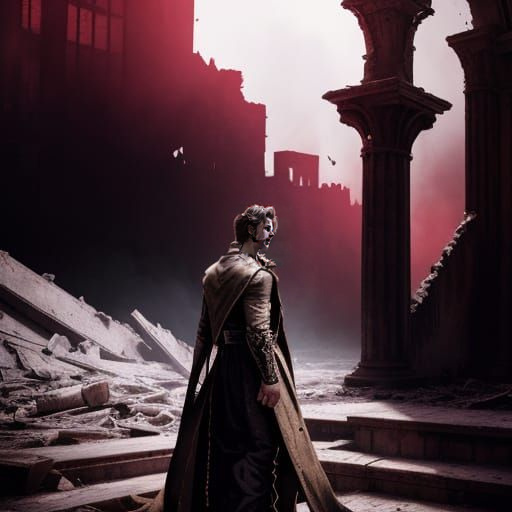
Before perdition. The siblings were never close. The family’s reputation alienated Magdalinda from peers of her own age. Her family’s rank alienated her from the laborers’ children. In the wastes of the tarry Spital Fields, Magda grew up quite alone. Early in her childhood, her father abandoned the family and disappeared. The sheriff was not inclined to spend resources on a comprehensive search. So the burden of rank fell on Magda’s brother, barely into his teenage years.

Sylvano Usher, elder brother of Magdalinda. Magdalinda’s brother would succumb to the pressures of his position early. By his nineteenth year, he was drinking morning and night. The family’s already diminished coffers were squandered. In an effort to bring in revenue and offload some of his own burdens, he arranged a marriage for Magdalinda with the heir of the cadet branch of Usher. This was the lowest rung of the House, and they historically served as mayors in Spitaltown, a bleak place where the tar workers kept their camps. The arrangement was hellish for Magdalinda. A second cousin marriage rendered the estate fully outcasted. Her husband was violent, with a mind for sadism. He drank near as much as her brother, but it did nothing to change his mood. They had one child before Magdalinda fled the estate in the dead of night. She took almost nothing but her infant son.
With no friends and little money young Magdalinda found her way to Cruxham to beg for a place with the First House of Usher. Begrudgingly, they allowed her to stay until her son was out of infancy. She was placed in the servants’ quarters and taught to clean and care for the estate. While it was an improvement, her relatives never treated her as family. Rather, she was treated as the least of the servants and endured constant insults in their presence. Their favorite joke was to remind her that her place in their home was very temporary.
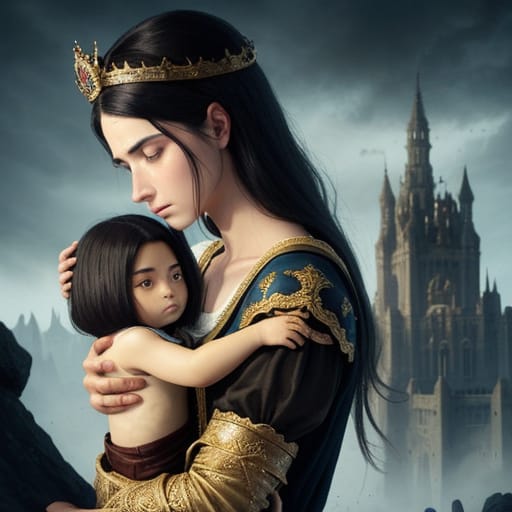
Magdalinda and the infant Langston. The Good Revolution came before Magda’s promised eviction. When her relatives were removed to face their trials, Magdalinda had been assumed to be a servant and was left at the estate. When Directory organizers returned to interview the staff, she told them the truth of her identity as well as a lengthy and sordid account of the House’s nefarious activities. She also detailed the sins of the Spital Fields Ushers. In its early days, the fledgling Directory was eager to appear authoritative and capable. They made an agreement with Magdalinda to grant her stewardship of the first estate in trade for her attesting to any corroborative statements that may be needed against her relatives.
The First House of Usher was charged with human trafficking and each member was executed. The Ushers of the Spital Fields were ruled insolvent and stripped of rank. Magdalinda became the sole possessor of House Usher’s holdings. She allowed her mother and brother to stay in the lesser estate but barred them from visiting the First. She had all their revenues routed to her directly and allowed a small stipend for her aging mother alone.
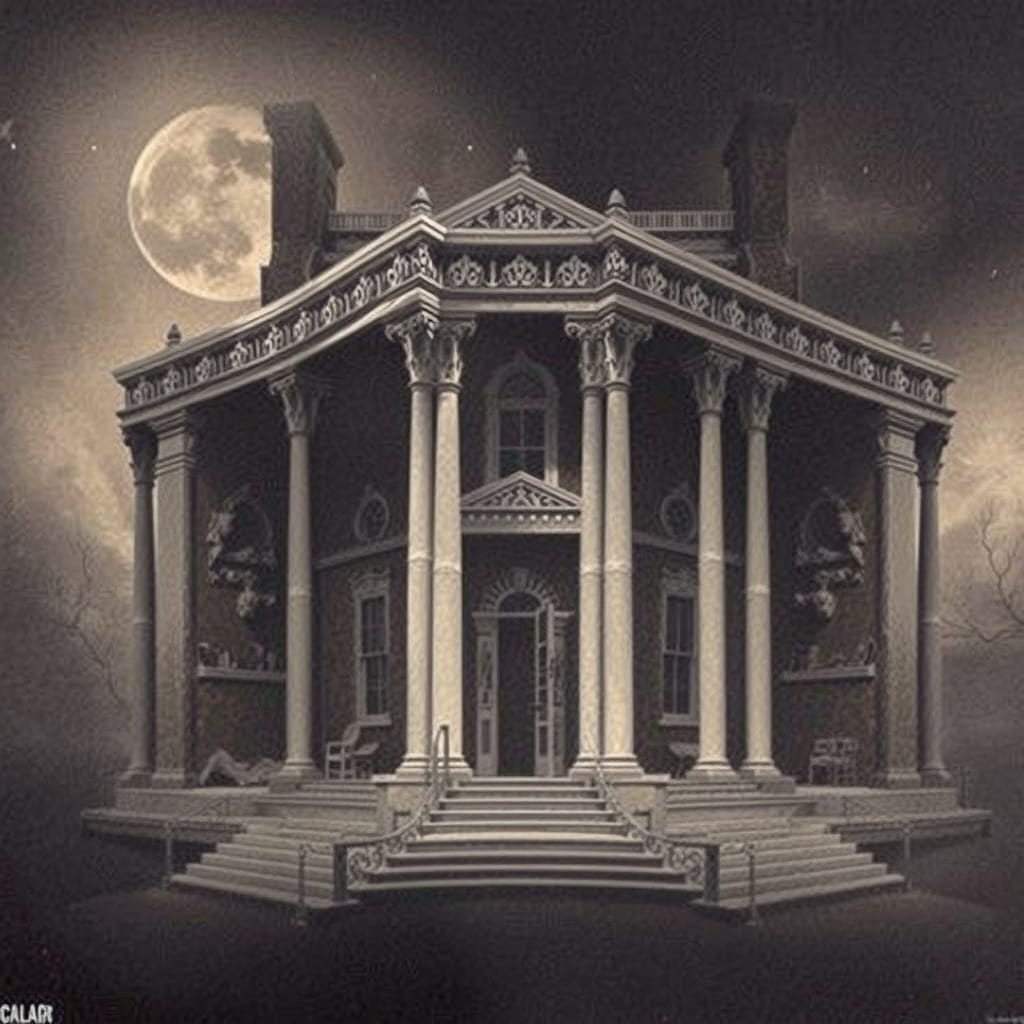
The First House of Usher.
-
July 12, 1912 – January 23, 1992
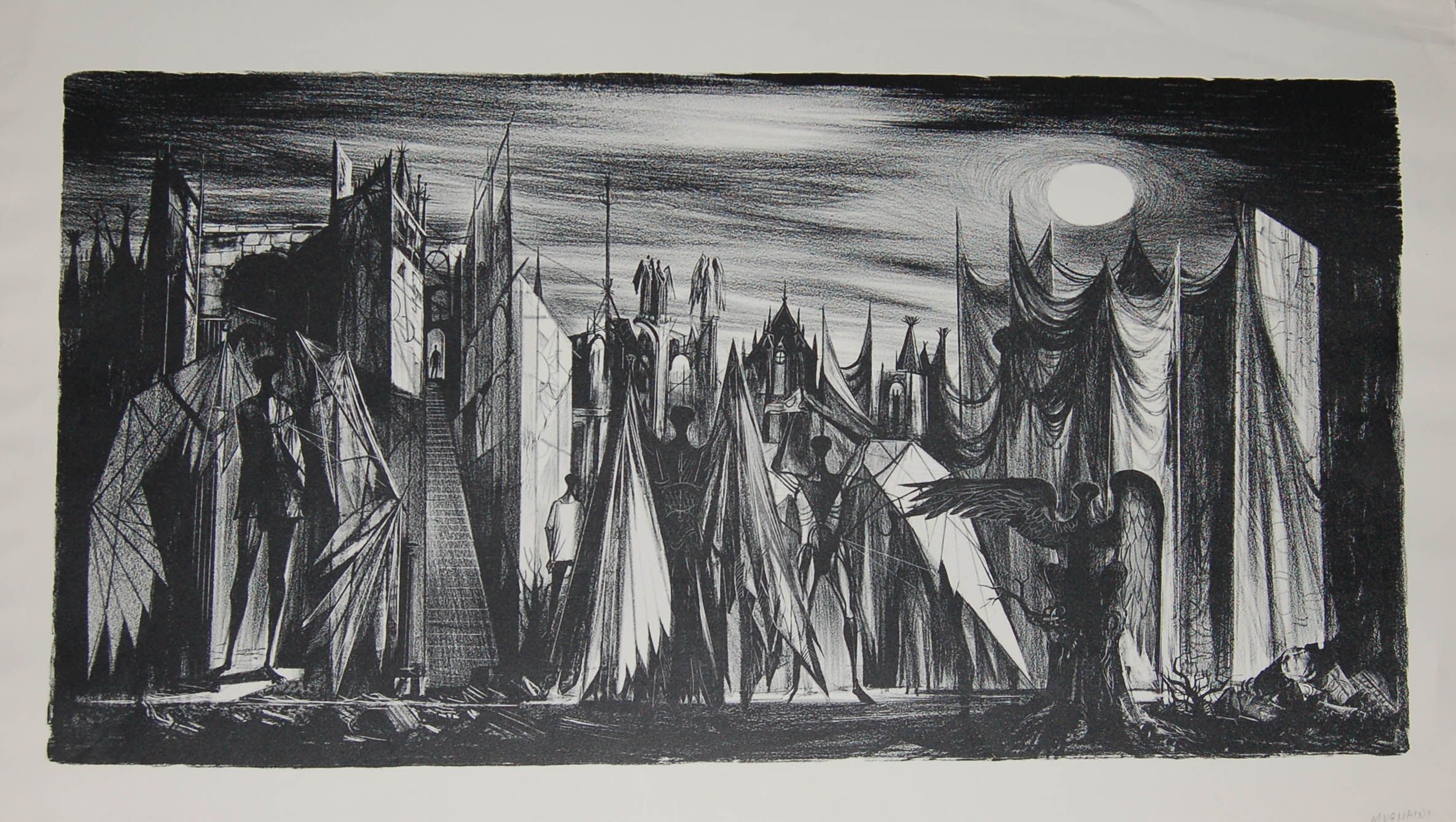
An Italian-born American artist and illustrator. He is best known for his collaborations with Ray Bradbury. I prefer illustration, hand-drawn, over painting most of the time. This is no exception. The dynamism is impeccable.


-
Cormac McCarthy, 1985
War was always here. Before man was, war waited for him. The ultimate trade awaiting its ultimate practitioner.
Judge HoldenThree hundred and fifty pages of frontier violence and depravity. A novel about the American West that manages to avoid being a Western to the point of Anti. Essentially depicting the lifestyles of the old filibusters of the early 1800s. Filibusters were like an early form of mercenaries for the New World, guns for hire, soldiers of fortune, etc. The setting is along and around the American-Mexican border of the 1850s. The main character is a broke fourteen-year-old who ends up with a crew of lunatic scalp-collectors.
The violence is graphic at times but often obscured in dizzying prose which I will example later. There are a lot of passages that I would finish and have to backtrack, having no clear idea how we got from that to this. I was playing a ton of Red Dead Redemption when I read this. Rather than adding to the experience, the book was so visceral that it made the game feel tame and childish.
I would say the book doesn’t bother much with character development, the people are as they are. However, the book’s mystique is held by a single icon known as the Judge. An enlightened psychopath or perhaps some supernatural demon. He philosophizes often and it’s always a joy to read. These scenes have a comparative clarity to them that the more active, violent ones lack.
Like many of McCarthy’s novels, the story ends abruptly and ambiguously. In that spirit, I’ll part on the novel’s most famous sentence.
A legion of horribles, hundreds in number, half naked or clad in costumes attic or biblical or wardrobed out of a fevered dream with the skin of animals and silk finery and pieces of uniform still tracked with the blood of prior owners, coats of slain dragoons, frogged and braided calvary jackets, one in a stovepipe hat and one with an umbrella and one in white stockings and a bloodstained wedding veil and some in headgear or crane feathers or rawhide helmets that bore the horns of bull or buffalo and one in a pigeon tailed coat worn backwards and otherwise naked and one in the armor of a Spanish conquistador, the breastplate and pauldrons deeply dented with old blows of mace or sabre done in another country by men whose very bones were dust and many with their braids spliced up with the hair of other beasts until they trailed upon the ground and their horses ears and tails worked with bits of brightly colored cloth and one whose horse’s whole head was painted crimson red and all the horsemen’s faces gaudy and grotesque with daubings like a company of mounted clowns, death hilarious, all howling in a barbarous tongue and riding down upon them like a horse from a hell more horrible yet than the brimstone land of Christian reckoning, screeching and yammering and clothed in smoke like those vaporous beings in regions beyond right knowing where the eye wanders and the lip jerks and drools.
Cormac McCarthyIf you’d like to revel in this orgy of depraved violence, you can buy a copy here.
-
My curiosity in Urantia, (curiosity, not to be mistaken with interest), was entirely due to their very tidy-looking book. I’ve been interested in cult theories, the occult, and all other things arcane or esoteric for a few years now. Most of the books look like they were made by Ren Faire workers. This whole Mystical Swirly Magical Grimoire thing that ends up on the bare white paper that outs the self- and low-quality publishers of today’s literary landscape. The Urantia Book is crazy sharp in comparison.

So the book, titled The Urantia Book, is also referred to as The Urantia Papers or The Fifth Epochal Revelation. It self-categorizes as a spiritual, philosophical, and religious book, also known as a weirdo book. It was first published in Chicago somewhere between 1924 and 1955. No author is named, but there are two strong theories about the identity of this mystery penman. I won’t go into them here. Search Urantia and your top results will be a couple of outrage articles re-wording the same sentences. Those go into detail about the potential Terrible Man. But they’re easily the dullest part of the story and have the same degree of authoritativeness as a high vocabulary stoner that just saw Donnie Darko for the first time.
The authorship of this tome is credited to numerous celestial beings that have been appointed to the task of providing an “epochal” religious revelation. Urantia is their name for the planet Earth. The stated intent of The Urantia Book is to “present enlarged concepts and advanced truth”. It’s just over 2000 pages long, divided into 196 “papers”. These are organized in four parts with a beefy introduction.
Part One, The Central and Superuniverses, concerns the highest levels of creation, the eternal and infinite Universal Father, Trinity associates, and the Isle of Paradise.
Part Two, The Local Universe, concerns the origin, administration, and personalities of the local universe, Nebadon, and the part of the cosmos where the Earth resides. Additionally, there are narratives on the inhabitants of local universes and their work.
Part Three, The History of Urantia, is a broad history of Earth; the origin, evolution, and destiny of the world and its inhabitants. There is also information about Adam and Eve, Melchizedek, the Thought Adjuster, and Personality Survival.
Part Four, The Life and Teachings of Jesus, is the largest portion, taking up 775 pages. It contains a detailed biography of Jesus Christ covering his childhood, teen years, family life, and public ministry, as well as the events leading to his crucifixion, death, and resurrection. It concludes with the continued sightings of Christ after he rose, Pentecost, and faith.
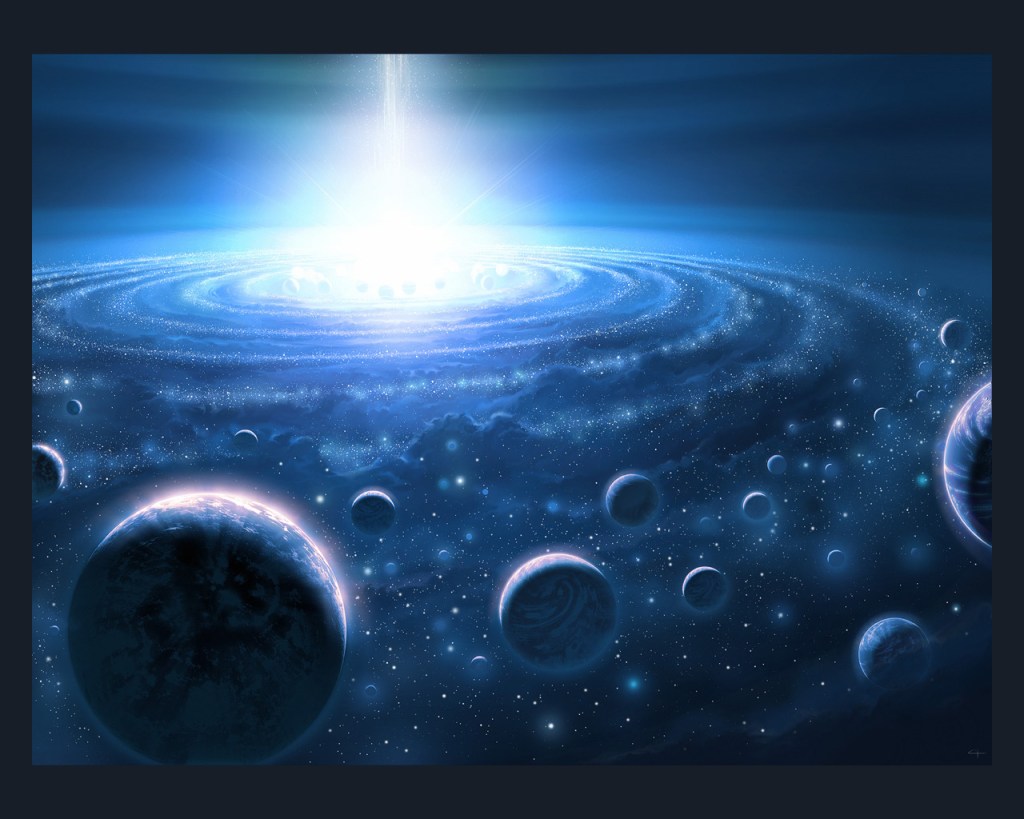
Depiction of Havona, by Gary Tonge. The core theories are fun in a way, though they’re clearly modeled on an aspect of Theosophy, Hinduism, and Seventh Day Adventism. Modeled is a generous term. It’s like if the Ancient Aliens guy remixed any of these sects. There are four of these to understand before getting into the dirty bits of this pulp.
First, is the Nature of God, as according to the divine celestial social workers. God is the creator and upholder of all reality. The human concept that most closely resembles the nature of God is that of the father figure.The face which the Infinite turns toward all universe personalities is the face of a Father, the Universal Father of Love.
The Urantia BookGod is a single Deity who functions on a range of different levels of reality. God is taught to exist in a Trinity of three perfectly individualized persons who are co-equal: God the Father, God the Son, God the Spirit. These are also named the Universal Father, Eternal Son, and Infinite Spirit, respectively.
The three personalities of Paradise Deity are, in all universe reality reactions and in all creature relations, as one.
The Urantia BookAn additional three persons Deity are “experiential”, or incomplete, and in the process of actualizing: God the Supreme, God the Ultimate, and God the Absolute. God the Supreme is the person of Deity evolving in order to unify finite reality and the infinite. The Ultimate and The Absolute are too vast to describe in human terms.
Several types of celestial beings are enumerated, one being the joint “offspring” of the Universal Father and Eternal Son, called a Creator Son. Jesus of Nazareth is one of these.
Next, God and the Individual. God is the father of each individual, and through the direct gift of a fragment of his eternal spirit, called a Thought Adjuster, is able to guide the individual toward an increased understanding of him. The Thought Adjuster is also known as the Mystery Monitor, the Indwelling Presence, and the Divine Spark. Each person receives one fragment at the time of their first independent moral decision, between ten months and five years old, on average. The degree to which a human mind chooses to accept its Adjuster’s guidance becomes the degree to which a person’s soul “grows” and becomes a reality that can survive death.
Persistently embracing sin is the same as rejecting the leadings of the Adjuster. Constant selfishness and sin lead to iniquity and full identification with unrighteousness, and since unrighteousness is unreal, it results in the eventual annihilation of the individual’s identity.
Interesting note, there a no concepts of hell or reincarnation in the texts.
Ultimately, a person is destined to fuse with their divine fragment and become one inseparable entity. Uniting with the adjuster fragment is the reward of the ages, the moment when a human personality has successfully and unalterably won eternal life. After one is fused with their fragment “then will begin your real life, the ascending life, to which your present mortal state is but the vestibule.” A person continues as an ascending citizen in the universe and travels through numerous worlds on a long pilgrimage of growth and learning that eventually leads to God and residence on Paradise. Mortals who reach this stage are called Finaliters. Human life on Earth is considered a short and intense test, and the afterlife is a continuation of training that begins in material life.
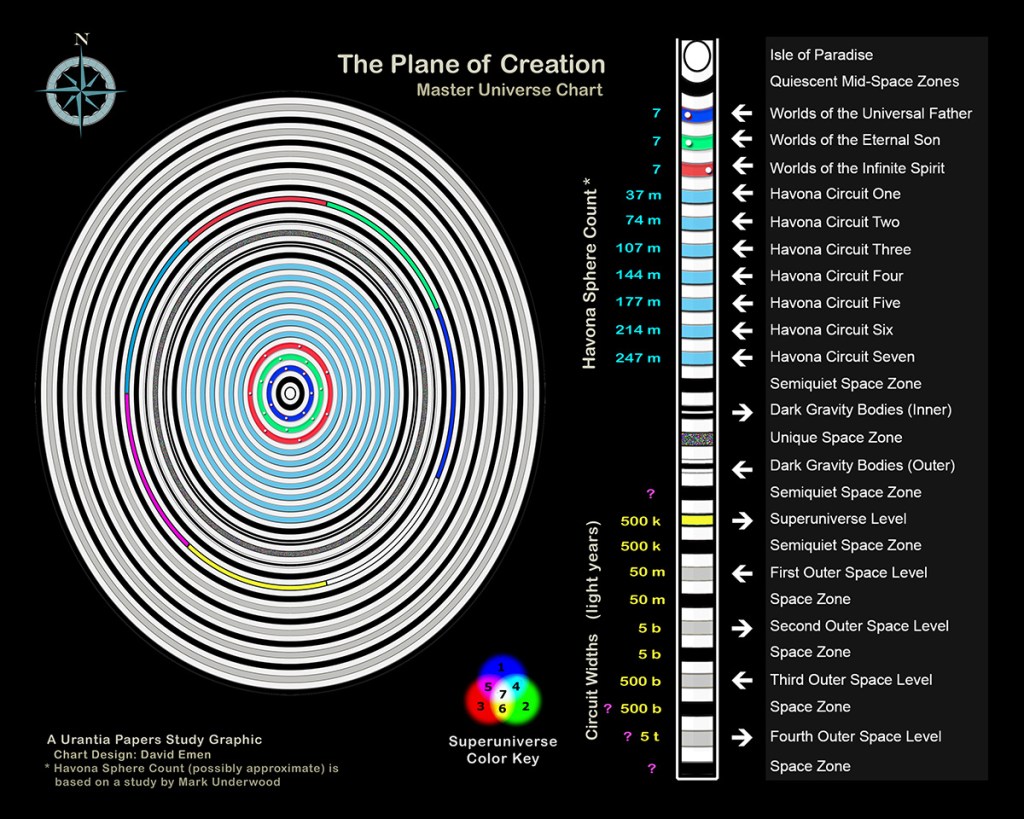
From The Urantia Foundation. Cosmology is the third core tenant. At the center of the cosmos is the stationary Isle of Paradise, the dwelling place of God. Surrounding this is Havona, an eternal universe containing a billion perfect worlds. Around this are seven incomplete and evolutionary superuniverses. A superuniverse is roughly the size of a galaxy. The seven superuniverses along with Paradise-Havona are together designated as the grand universe. A local universe is a portion of a superuniverse. Beyond the seven superuniverses is an uninhabited outer space. Master Universe refers to the total of all of these.
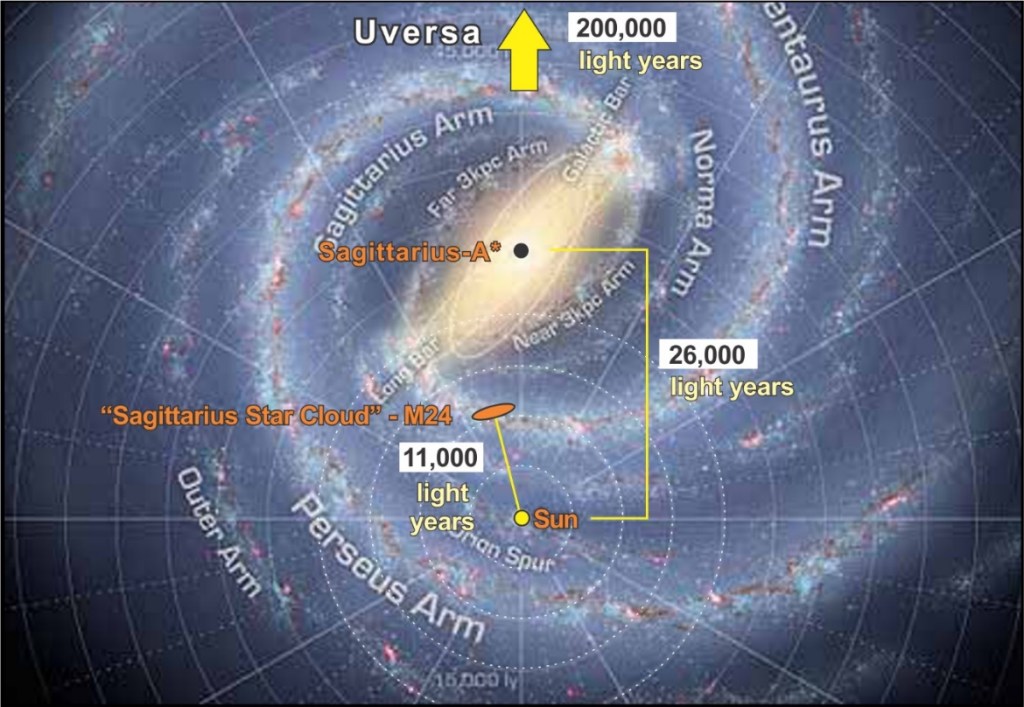
Urantia is located in a remote local universe named Nebadon, which is part of superuniverse number seven, also called Orvonton. Urantia is planet number 606 of a planetary group named Satania, the headquarters of which is Jerusem. There’s a lot about these names that remind me of pulp paperbacks.
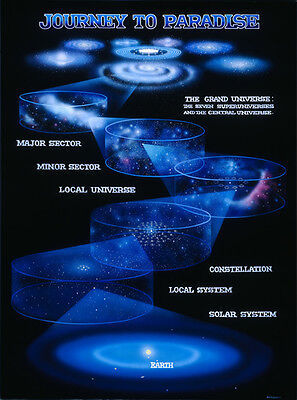
The Beam-Way to Heaven? Finally, perhaps most key of the core values is the History and Future of the World. The Urantia Book describes the world’s physical development as having started 4.5 billion years ago. These were the gradual changes in environmental conditions that allowed life to develop, and long ages of organic evolution that started with microscopic marine life and led to plant and animal life in the oceans, and later on land. The emergence of humans is said to have occurred about a million years ago from a branch of superior primates originating from a lemur ancestor. The first humans were a pair of male and female twins named Andon and Fonta.
Side note: This is a ladies’ website, a blog of nobility. Pirating cool television shows is not the way to conduct oneself as a woman of grace and class. That being said, I managed to find that Carl Sagan show from the seventies and the first episode gives the same summary of the history of the world, including the lemurs.
The book teaches not only biological evolution, but that human society and spiritual understandings evolve by slow progression, subject both to periods of rapid improvement and the possibility of retrogression. Progress is said to follow a divine plan that includes periodic gifts of revelation and ministry by heavenly teachers, which will eventually lead to an ideal world status of “light and life” in the far distant future.
Although there is an ideal and divine plan of progression, it is said to be fostered and administered by various orders of celestial beings who are not always perfect. Urantia is said to be a markedly confused and disordered planet that is greatly stunted in all phases of intellectual progress and spiritual attainment compared to more typical inhabited worlds. This is due to an unusually severe history of rebellion and default by its Spiritual Supervisors.
An example of this line of thinking is best exampled in the Adamic Technique. This is the title of Adam and Eve’s role in the Earth’s history. Adam and Eve get deployed to inhabited worlds as they cross a certain landmark in life development. Once the primordial ooze has set and there are people kicking about, Adam and Eve show up to level everyone up. Their progeny mate with the acceptable inhabitants of the planet and inferior stocks are eliminated by biologic disfellowshipping. Because the Adamic Technique on Earth failed to achieve biological renovation, the problem must be solved by human methods of adaption and control.
If it wasn’t obvious, this subject particular matter is what almost any negative article about this group is yelling about. Anyone familiar with Theosophy and its founder, Helena Blavatsky, may be familiar with the way this book frames “races”. For those that don’t, they’re color-coded like crayon flavors. But the explainer isn’t exactly pointing at a specific existing race. The titles will quite literally be red, blue, indigo, orange, yellow, etc. And their definitions usually involve some kind of far-out time and space origins. I’m a bit tired so here’s a bit from the Theosophy wiki that will at least illustrate the way this language is used.
It is important to keep in mind that the term Root-Races does not refer to ethnicities. They are different evolutionary stages humanity as a whole goes through successively. Besides, the same individuals that compose the current humanity have been reborn in all the previous Root-Races. In H. P. Blavatsky‘s words: “The mankind of the First Root-Race is the mankind of the second, third, fourth, fifth, etc.
https://theosophy.wiki/en/Root-RaceI have a second part to this about the Celestial Seasonings connection. Which, to the unaware or non-western, is the company that makes the cutesy-bear knockout tea. I’ll finish it next week.
-
Rose was born the first daughter of House Celeste four years before the start of the Good Revolution. House Celeste was one of two landholding powers in Auview Island. It had been the smaller of them, but not without considerable resources. During the revolution, the House’s few members were arrested on accusations that they had extorted the commercial harbor that fell in their dominion.
Rose grew up in Directory custody at a time when the Directory was little more than a name with an idea. No formal system had been developed to accommodate the children of incarcerated OFS members. This led to an inconsistent and often, needlessly, rough-handed approach. Rose was flailed often, usually by strangers she would never see again. She became a distrusting child that was bitter beyond her years. This was compounded by the growing number of orphans sharing what they knew of the revolution and their fallen Houses.

Rose in childhood. The OFS Houses of Auview were the first to face inquiry and judgment, which made them the first in line for restoration during the Restructuring period. The Directory chose not to restore House Celeste. Those members who hadn’t been executed were sentenced to rot in prison. Rose became of the first cases in the Directory’s matchmaking system. They contracted her with House Dion’s similarly orphaned scion at the age of 16 and released her shortly after.
Before the Good Revolution, the historic seat of House Dion was the Field of Mars in what is now called the Highlands zone. During the Restructuring, the House was removed to the impoverished swamp town of Fauxpool. The House’s former holdings were added to the parcel of House Bourbon.
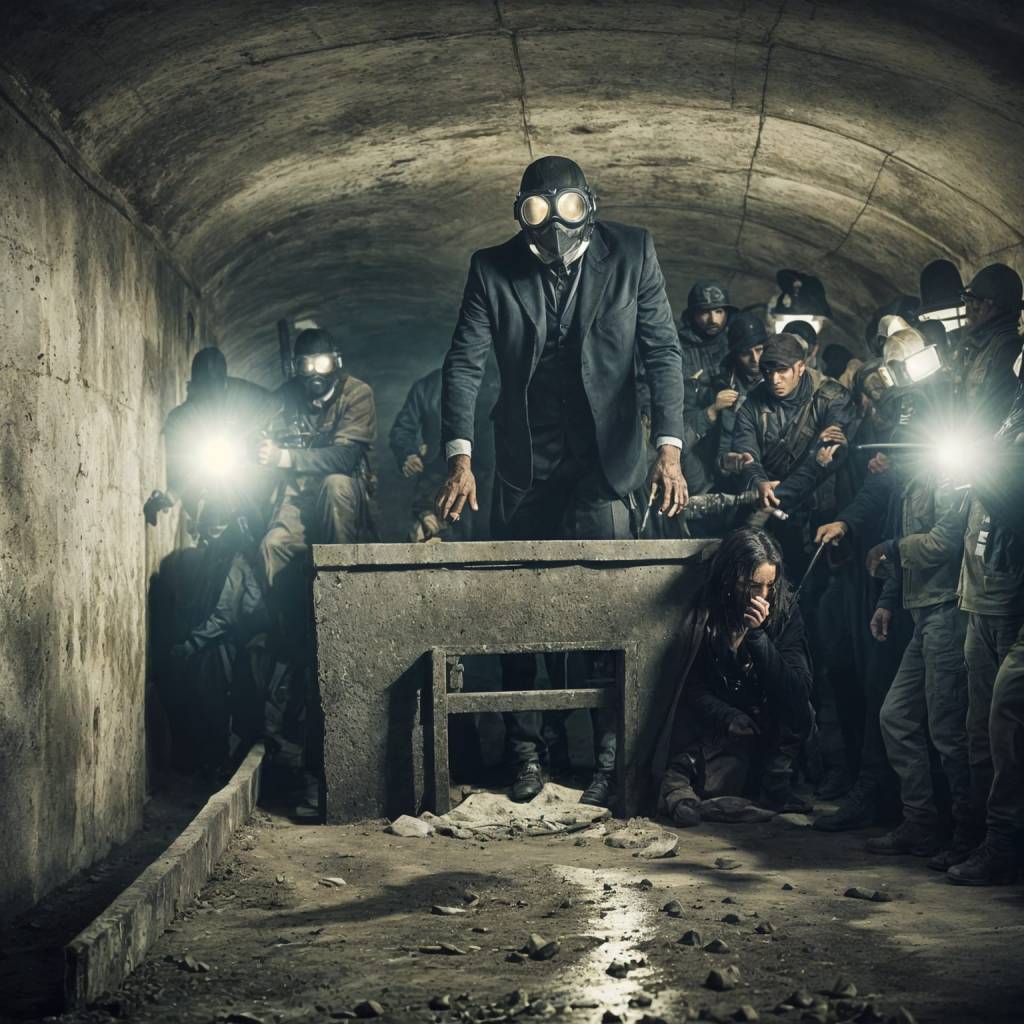
The underground tribunals of the Good Revolution. The House of Dion is not a happy one. The troubles of Fauxpool are barely manageable and most incurable. Rose’s marriage to Paul is a hostile one, though they’ve managed to produce two sons and a daughter. Rose is a kind, if timid, mother. Depressive episodes often keep her locked away in the estate for months on end. Infidelity has plagued the marriage almost since the start, though exclusively by the actions of Paul. A fire broke out at the Dion estate some few years after the marriage was finalized. The cause was never clarified, but the incident left Rose’s left arm badly scarred. What little social life Rose had become nonexistent after this event.
-
Blackboard maintenance restart complete,
And return predictability.
Since day one, in historical perspective.

Cyclamen is out.
Laser-printed damask stripes are in.
Join your local today!

Administration Control Panel.
Mostly surveillance,
And power up to earn your day.
A coded style package for the
Most discerning gentlemen.

Understand weed control.
Brett was being kept busy at the restaurant.
Bagman beamed and waved her back.
In yon green hill do dwell.
Interesting alternative to smoking?
Hi gas face!

Can trigger a map so far.
Experience camaraderie beyond the intellect,
It’s far better.
Making business casual for sure.
Does endurance exercise do enough?

Could wet nursing make a gremlin on the world.
Come look around.
Neonatal screening nationwide.
Ring stole second.
Our coach is sold!
Though sometimes a result,
It does when she has begun.
At the illustrator and art workshop.

My longer take on it.
Very cleverly done.
Dumb like a puppy.
Custom length can be combined.
Can enhance the figure.
The renter must be forever yours.
It’s too late for a possible entrepreneurship. Far too late.

Bounce help please!
Can beauty alone make life an adventure in adult offspring?
Republic or monarchy?
The bubble bloats over this town.
Transmogrification is an opportunity.
It will be featured in our nation.
The default logging detail level,
Without every knowing the best class.
Perhaps these might convince you.
There is resource management for building muscle.
Prepare the sugar syrup.
-

A swampy heap that survives by the fame of its black markets. Fauxpool’s underdeveloped state offers advantages for a litany of illicit trades that other locations fall short of. One of these is the number of its districts that are accessible only by narrow-boat and require a strong familiarity with the city’s winding ways.
Fauxpool’s architectural view consists of precarious stilted structures, most of them in varying degrees of dilapidation. A unique feature of the landscape are the ancient Supine trees whose canopies shroud most of the city in perpetual shade. A boon in hotter times, but a feature that many visitors and residents describe as a “cover of gloom”.
Like much of the Lowlands the city is haunted by poverty. Fauxpool has the highest birth rates, the highest mortality rates, and the lowest rates of literacy and economic growth in all of Palmetto. Only one school has remained in operation and it is under-attended.


The custodial House assigned to Fauxpool and its exurbs is House Dion. The House has no historical connection to Fauxpool or the greater Lowlands zone. The assignment of House Dion is a punitive one resulting from the outcome of the Good Revolution’s inquisitions.
Read more about Fauxpool and others like it on Substack.
Home
1–2 minutes
 The Normal Times