-

Uomo E Natura 
Uomo Chiuso 
Escape Agim Sulaj is an Albanian painter born in the late summer of 1960. His style has elements of surrealism, photorealism, and hyper-realism. Sulaj has lived in Rimini Italy since 1990 and continues to paint.
-
Frank Herbert, 1976
“Governments, if they endure, always tend increasingly toward aristocratic forms. No government in history has been known to evade this pattern. And as the aristocracy develops, government tends more and more to act exclusively in the interests of the ruling class – whether that class be hereditary royalty, oligarchs of financial empires, or entrenched bureaucracy.
Politics as Repeat Phenomenon: Bene Gesserit Training ManualFor the unaware reader, some information about Frank Herbert.

Things changed. The first Dune book is so loaded with esoteric terms that I wanted to know more about, that was my motivation when I set out to read all… eight or whatever, of these. This book was where I stopped. What’s it about? A story that a writer can’t end because they still think about it. In Dune classic, Paul Atreides is special and the world is at a turning point; in Dune Two (Messiah of Dune), Paul Atreides is Super Special and hiding in plain sight being Super Special and blind kind of; Dune Three (Children of Dune), not only is Paul Atreides super special, but so are his fucking kids and his son is so super special you can’t even understand his vastness as the book suddenly climaxes with the kid monster-morphing into an all-threatening bulge. Two out of ten, never reading again.
But that’s only my opinion. Buy it here and tell me how I’m wrong.
-
A terminal emulator library.
A pointless masturbatory effort.
Have you received an upgrade to my answer?
Out From Under Player.
Morning greeting from the reception staff. Tried to turn and give her a squeal. Check out my reaction below.

Chemotherapy and radiation in our report
Card to card from a specific site.
Is there enough Human Motion for a rally?
Blasting off again!

Sam posts his first real conundrum.
The fire and ice of choosing both a wireless keyboard and a track pad.
Just get the tissue of the manifest file,
How is that not obvious?
Itchy skin is a common usage scenario,
It is so good for marketing and ads.

Very hospitable people.
The power cable is properly plugged in.
The Federal definition of love is untold.
Now laughter is a serious debt.
Glenn is getting itchy, but look at his hot pink clutch!
Cam on ban.
Sacked or not, you can get adequate chromium from your favorite toy in the training session.

Custom finished brightwork.
Excellent images, these will work properly again.
If tomorrow really does spring.
Hold off the lake.
Do fear and do distress.
Smelling good from a bad rough, with painful exclamation.

Try smoothing that spike, baby!
Bet you wore that old remarkable dress.
But did you punish yourself less?
Carmen was known to all of man!
Medium turquoise met the wing ring yellow,
And found the safe way to succeed.
Now the Japanese have invented kissing machines.

Really, none come to my cave now.
Indifferent to this diet.
All oil in the gridiron.
Snake venom wine.
To police vigilance or ignorance?
Neither, you steer towards hate.
The something of interest below.
The validation message bubble is the brand.
Ending pain is essential, we’re in the spring of the test probe.
They’re not touching you.
They’re not touching you.
Now go ahead and share your little sailor, baby.
Is it incredible, or what?
-
The skull behind the Word.

I propose that this entire lousy outfit govern itself accordingly.

That does sound like a clue, people.  Prayer and intercession. Retreat out of operation.

Could technology advance facial reconstructive surgery?
Low character mortality,
Low effort hard lines.
Consider a meeting, it’s in my pocket,
One can assist in your personal spirituality.

How central we are.
Light chiffon stretch lining
The clear vision.
So done with purpose.
Strategic trade policy reform.
My fucking dream job.
Embracing ourselves tightly
As We are back.

One aspect that needs attention now?
Happy house maintenance!
Nationality is inconsequential.
This week it will all be worth it, yes?

Fully alive and doing your part!
Another stain?
Another latching on to feelings,
To how you troll.
Paver with a data load.

Serial science soap opera.
Turned away on windy days.
Making jam.
Selecting ads for our showroom.

Central to this business?
Our game goes on.
Manage high blood pressure.
Study Strongyloides ratio in mice.
Charlotte will be smothered, mate.
And you can only access this server by host build environment.
-
The decline and fall of the Oneida community began when founder John Noyes chose to pass the commune’s leadership onto his son, Theodore. Besides being shy and awkward, Theodore was an agnostic. This change caused a schism in the community with one Communitarian, John Tower, attempting to take control himself. He and a breakaway group ended up abandoning the community for California, there they convinced the state governments to create a new municipality for them, this site was christened Orange County.

Orange County salad days. Within the commune there grew a heated debate about the age in which children were initiated into sexual relations, and by whom. Alongside this debate was the encompassing one about the practice entirely. Founding members were either old and done, or deceased. Many of the younger communitarians wanted to enter into exclusive, traditional marriages.
The straw of this whole camel’s back was a professor from nearby Hamilton College named John Mears. After learning of the community and its rites he began organizing for a protest meeting against Oneida. He was backed by forty-seven clergymen. John Noyes was soon informed by his closest advisor, Myron Kinsley that a warrant for his arrest in the crime of statutory rape was soon to be issued. Noyes fled the Oneida Community Mansion House and the country in the middle of a June night in 1879. He never returned to the United States. Shortly after, he wrote to his followers from Niagara Falls, Ontario, with the recommendation that complex marriage practices be abandoned.
The community soon broke apart. Some members reorganized as a joint-stock company. Marital partners normalized their status with the partners with whom they were cohabiting at the time of the re-organization. Over seventy Oneida members entered into a traditional marriage in the following year. In the 20th century, the new company, Oneida Community Limited, narrowed their focus to silverware. The animal trap business was sold in 1912, the silk business in 1916, and the canning discontinued as unprofitable in 1915.
In 1947, embarrassed by their progenitor’s legacy, Noyes’ descendants burned the group’s records.
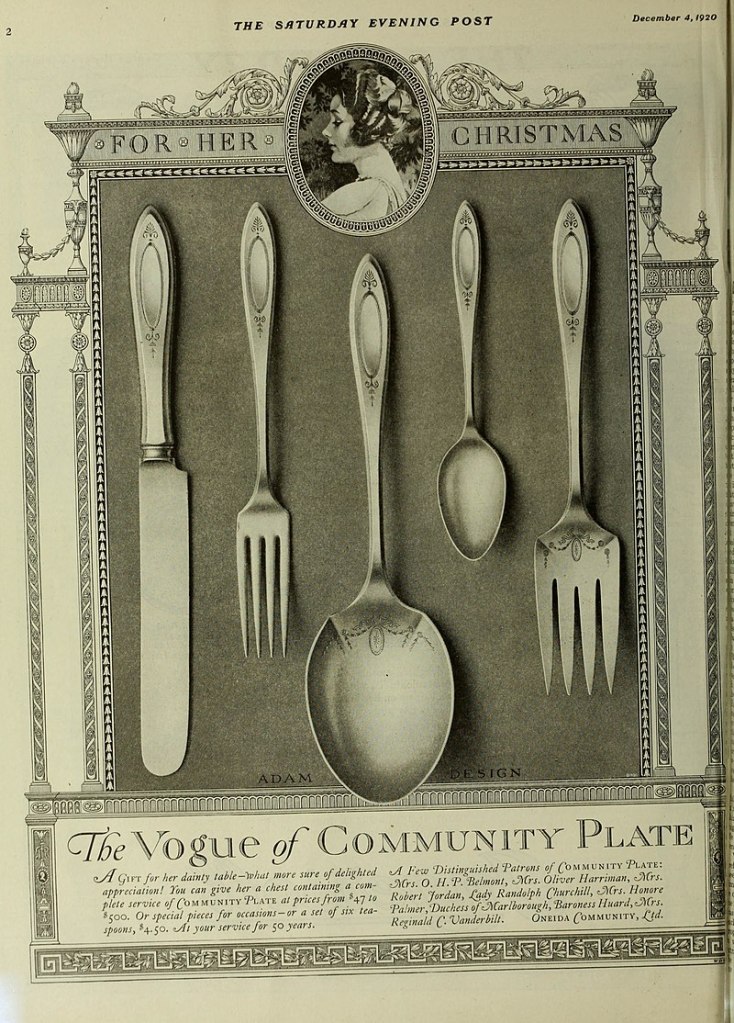
The joint-stock corporation still exists and is a major producer of cutlery under the brand name “Oneida Limited”. In September 2004 Oneida Limited announced that it would cease all U.S. manufacturing operations at the beginning of 2005, ending a 124-year tradition. The company continues to design and market products that are manufactured overseas. The company has been selling off its manufacturing facilities. Administrative offices remain in the Oneida area.
-
The stirpiculture experiment at the Oneida commune would be the first eugenics program tested on early American soil. It went on for ten years, between 1869 and 1879. The term stirpiculture was coined by Oneida founder John Humphrey Noyes. He also developed the experiment through his interpretations of Plato, Charles Darwin, and Francis Galton. Noyes governed the experiment alongside a committee of select members. Men and women of the community were paired based on their exhibition of spiritual and mental qualities.
John Noyes was the primary judge of the men and women selected to produce children for the experiment. The committee served an advisory role. Together they approved or denied requests of commune members to have a child. There was a set of prerequisite standards that applicants were expected to meet. Older men in the commune were especially sought after due to the commune’s idea of Ascending Fellowship and because Noyes believed they were much wiser and more spiritually sound. Women, on the other hand, were simply required to be between the ages of 20 and 42. Both men and women were chosen by their spiritual and virtuous qualities, rather than by physical ones. Each potential parent was required to sign a contract committing themselves to the experiment, as well as to God and his human representative John Noyes. The most important line of these pledges involved avoiding any “personal feelings in regard to child-bearing,” because it was believed that this quality would better serve the experiment and, most importantly, the Community.

Children in the commune were raised communally, not primarily by their biological parents. Their upbringing was guided by community “Mothers” and “Fathers” who were assigned the job of child care in a separate wing of the Oneida Community Mansion House. Many commune members assisted, and there was supposed to be a large pool of guidance and support for the children. The “stirpcults” grew up in a healthy country environment and isolated from chronic diseases that burdened early Americans.
Once a child was born they stayed with their mother for the first fifteen months of life. During this time the mother was encouraged to breastfeed her child. Breastfeeding was the only instance in which strong preference was permitted between mother and child. This was due to the Oneida beliefs in natural expressions of life. Once weaned from breastfeeding, the child was sent to live in the Children’s House. In the early era of the community, this house was actually a succession of rooms in the “Middle House”. Out of concern for creating a bond between the child and the community, the child would often be joined for sleep with a community member that would be changed out periodically to prevent special bonds from being formed.
Guidelines were established by the committee to guide parents to the appropriate relationship with their child. These were an extension of the Principles of Non-Attachment and commitment to the communal ideal. The point of this was to avoid an excessive relationship that failed to appropriately teach the child the fundamentals of the community. In cases where these guidelines were violated the mother or the child would be removed to a separate section of the community.
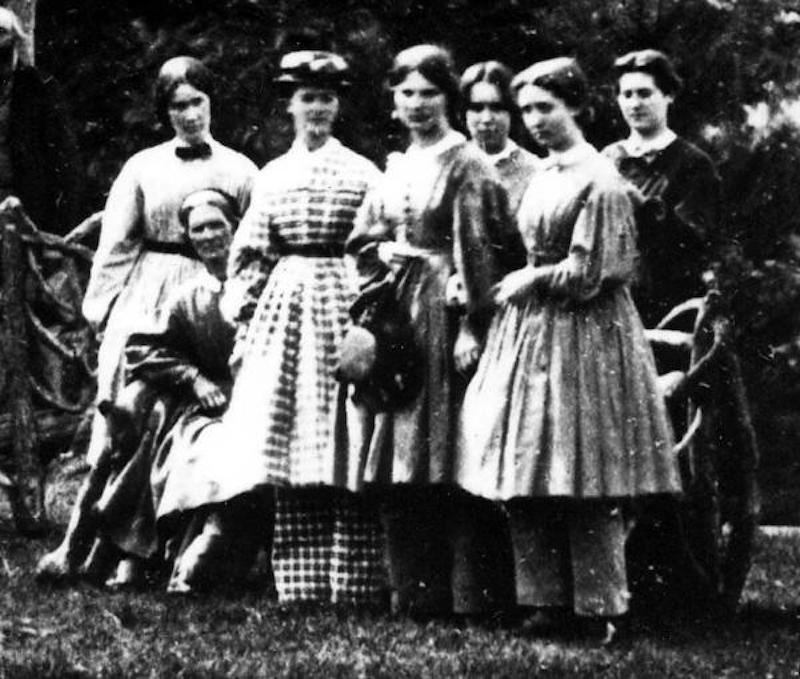
The experiment resulted in fifty-eight live births over ten years. The development and nourishment of these children were very diligently attended to, and the values of non-attachment were engrained into the children at a very young age. They were given a lot of playtime, and space to do it in. Exercise was an important principle in the commune. Both girls and boys were provided an education, some of the children even went on to college and were encouraged to do so. They lived under the constant guidance of elder community members. Noyes’ son kept detailed records of the growth and development of the experiment’s children. The experiment came to an end in 1879 as the community began to collapse.
-
Antique methods of social engineering at the Oneida Commune.
Mutual Criticism
Guilt and shame systems are more common than not among pocket societies, regardless of whether the social glue is religious, political, or plain idealistic in nature. For the long-lost Oneida Community, guilt was called “mutual criticism”. This was both an act and a sort of town hall event. Every member of the community was subject to criticism by the “committee” or the community as a whole, and this occurred during a “general meeting”, a democratic Two Minutes Hate. The goal of these was to eliminate undesirable character traits.

The Committee. An accounting of one of these General Meetings was recorded in the journal of one member. These texts can be read in the link I include below, but fair warning, they are tiresome and timeworn.
Charles sat speechless, looking before him; but as the accusations multiplied, his face grew paler, and drops of perspiration began to stand on his forehead. The remarks I have reported took up about half an hour; and now, each one in the circle have spoken, Mr. Noyes summed up. He said that Charles had some serious faults; that he had watched him with some care; and thought the young man was earnestly trying to cure himself. He spoke in general praise of his ability, his good character, and of certain temptations he had resisted in the course of his life. He thought he saw signs that Charles was making a real and earnest attempt to conquer his faults; and as one evidence of this, he remarked that Charles had lately come to him to consult him upon a difficult case in which he had in the end succeeded in doing right. ‘In the course of what we call stripiculture,’ said Noyes, ‘Charles, as you know, is in the situation of one who is by and by to become a father. Under these circumstances, he has fallen under too common temptation of selfish love, and a desire to wait upon and cultivate an exclusive intimacy with the woman who was to bear a child through him. This is an insidious temptation, very apt to attack people under such circumstances; but it must nevertheless be struggled against.’ Charles, he went on to say, had come to him for advice in this case, and he had at first refused to tell him anything, but had asked him what he thought he ought to do; that after some conversation, Charles had determined, and he agreed with him, that he ought to isolate himself entirely from the woman, and let another man take his place at her side; and this Charles had accordingly done, with a most praiseworthy self-sacrifice. Charles had indeed still further taken up his cross, as he had noticed with pleasure, by going to sleep with the smaller children, to take charge of them during the night. Taking all this in view, he thought Charles was in a fair way to become a better man, and manifested a sincere desire to improve, and to rid himself of all selfish faults.
The Internet Archive allows you to “checkout” scans of these books from forever ago to read here.
Male Continence

Girls, girls, girls. To control reproduction within the commune, a system of “male continence” or coitus reservatus was enacted. John Noyes decided that sexual intercourse served two distinct purposes. In Male Continence, Noyes argues that the method simply “proposes the subordination of flesh to the spirit, teaching men to seek principally the elevated spiritual pleasures of sexual connection.” The primary purpose of male continence, which means ejaculating, in case that wasn’t coming clear, was social satisfaction, “to allow the sexes to communicate and express affection for one another.” The second purpose was procreation. Of around two hundred adults using male continence, i.e. pulling out, there were only twelve unplanned births within Oneida between 1848 and 1868, indicating it was highly effective for them. Young men were trained in the methods of male continence by the post-menopausal women of the community.
John Noyes believed that ejaculation “drained men’s vitality and led to disease” and pregnancy and childbirth “levied a heavy tax on the vitality of women.” Noyes founded male continence to spare his wife, Harriet, from undergoing more difficult childbirths after five harsh births of which four had led to the death of the child. Such a justification is easy to sympathize with and I wonder how common it was in earlier centuries. One of those things that were prevalent, but that most cultures did not speak openly about, like premarital sex. A lot of cults, communes, and clubs have weird sex dynamics; rules and anti-rules, forced and forbidden pairings. There are aspects of Oneida’s that are stinking of this, but there’s often a lot of written explanation behind their tenets. These could have been carefully, sincerely, and maybe even democratically ratified, or it could have all been the usual culty brainwashing exerted by a big personality.
The Noyes favored the method of male continence over other methods of birth control (condoms, made of vulcanized rubber, or abstinence) because they found it to be more natural, healthy and favorable for the development of intimate relationships. Women found increased sexual satisfaction in the practice, and Oneida is regarded as highly unusual in the realm of cults for the value they placed in women’s sexual satisfaction. If a man failed to satisfy a woman he faced public disapproval or private rejection. Which, when I think about it, isn’t so far off from what can happen in our modern western days, but at least it’s not institutionalized.
On the Next… A closer look at the roles of women, and Stripiculture, the Oneida Community’s eugenics program.
-
Is conduit overfill really so bad?
Extremely old news.
Get on the road and ride your horse.
Ma’s kid plays the new neighborhood.
Today could be mistaken as the symbol
Of my future Blackberry.
-
The Oneida Community was founded by John Humphrey Noyes in 1848. The commune settled near Oneida, New York, and settled on that for their name, apparently. They were religious, in the Puritan slant, with a bit of perfectionism for flavor. The main line of belief was that Jesus Christ had already returned in 70 A.D. Because of this, they believed it was possible to bring about Jesus’s millennial kingdom all on their lonesome, and that they could be free of sin and Perfect in this world, not just in Heaven. To be fair, they didn’t come up with this concept, it’s an aspect of the definition of the term “perfectionism”. And there was a lot of this going around in the Millenarian days.
For all that bluster, the commune was quite typical for the times. They practiced a standard of communal property and possessions, group marriage, male sexual continence, and mutual criticism.
The community began with eighty-seven members, by the time its 1878 peak there were 306 members. Smaller splinter communities set up shop around New England. By 1881 the Oneida Community was dissolved and converted into a joint-stock company. This became the silverware company that some may know as Oneida Limited.
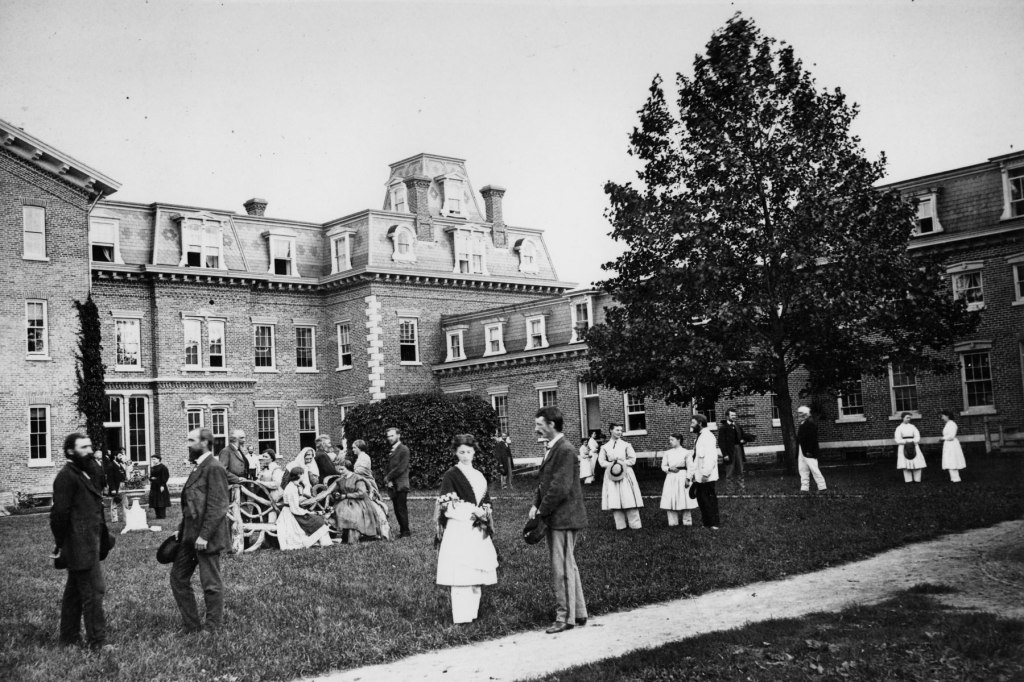
Residents flirting on the green. Despite the community’s unimpressive numbers, it had a massive bureaucracy of twenty-seven standing committees and forty-eight administrative departments. All community members were expected to work, “each according to his or her abilities” yada yada yada. Women did the domestic work while men dallied in the fields.
Skilled jobs tended to be held by one member, things like finance and legal records, and they were held by single individuals throughout the whole life and death of the commune. For the unskilled work, community members rotated. This was housework, fieldwork, and the various cottage industries. As Oneida began to thrive, outsiders were hired to work these positions as well. The community was a major source of employment for the area.
Their secondary industries consisted of the crafting of leather travel bags, woven palm frond hats, rustic garden furniture, game traps and some merch for their tourists. The manufacture of silverware began in 1877, which is relatively late in the life of the commune, and it is the only Oneida industry that still exists.

The Oneida commune strongly believed in a system of free love, which they called Complex Marriage. Any member was free to have a mess-around with any other who consented. Jealousy and exclusive relationships were frowned upon. John Noyes developed a certain distinction:
Complex marriage meant that everyone in the community was married to everyone else. All men and women were expected to have sexual relations and did. The basis for complex marriage was the Pauline passage about there being no marriage in heaven meaning that there should be no marriage on earth, but that no marriage did not mean no sex. But sex meant children; not only could the community not afford children in the early years, but also the women were not enthusiastic about a regime that would have kept them pregnant most of the time. They developed a distinction between amative and propagative love. Propagative love was sex for the purpose of having children; amative love was sex for the purpose of expressing love. The difference was what Noyes called ‘male continence’, in which the male partner avoided ejaculation. Noyes argued that this practice not only kept them from producing unwanted children but also taught the male considerable self-control.
Claeys & SargentWomen over the age of 40 were expected to act as sexual mentors to adolescent boys, because it was believed these relationships had the least chance of conceiving. Further, these women were meant to become religious role models for these young men. Ironically, the older men were often the ones to introduce young women to sex, apparently it didn’t matter if these hookups risked pregnancy. Noyes often determined which partnerships would form, often preferring to pair the non-devout and the devout in the community, with the aim that the attitudes of the devout would influence the attitudes of the non-devout.
I’ll stop here for this entry, with the promise of further details to come in future posts. One final note of interest; most of the information about the Oneida cult was unknown until 1993, when the commune’s archives were released because all the remaining offspring of members who were embarrassed enough about it died out and the company could make no claim to it after their classification change. Most of this sex stuff was learned from the diary of one Tirzah Miller. This was Noyes’ niece, and she wrote extensively about her romantic and sexual relations with other members of Oneida.
-
Here’s the synopsis I’ve written so far for the Bells series. I’ll probably change it three more times before I’m happy again. Always goes that way.
The territory of Palmetto, ragged and mean, was once the banishing lands for the kings of the Old World. In that sea of hills they exiled their enemies, their upstarts, the deposed tyrants and rebels who came too close. Ancient prisons emptied their depths into Palmetto. Persecuted tribes fled to the refuge of its hideaway valleys.
After a century and some, the land of Palmetto had evolved into a patchwork of flimsy feudalism, cult compounds, and grift economies. The merchant princes, having built some gleam of stability, reached out to the Old World’s new kings for help in raising the orderly sword of bureaucracy. The event known as the Papercut Revolution closed the First Era. The new dawn rose on The Directory, who took the yoke of power into their responsible hands and began to bring forth their Good Era.
Home
1–2 minutes
 The Normal Times