-
Marty Silvia hails from a distinguished family and holds the esteemed position of the heir to the House Silvia. Given his privileged background, he was expected to conform to elevated standards right from his early years. His upbringing was a reflection of his status, characterized by a strict regimen and parental expectations that left no room for complacency.
Marty appears to be someone who keeps secrets to himself, not wanting to burden others with them. His life has been defined by unfulfilled love and social taboos, as he tries to meet the expectations of his inherited position. Deep down, Marty struggles with his conflicting desires for individuality and belonging within the traditional Old Family System.
Those who know him would describe him as charming and engaging. He enjoys socializing and is often the life of the party. Though his face doesn’t betray it, Marty is an attentive observer of behavior. However, this is only during his sociable periods. Other times are spent in perennial despair, deep loneliness, self-medication well into the point of addiction, and obnoxious romantic scandals.
Marty’s beauty and competitive nature have allowed him to get away with a lot. While his friends view him as discreet, flirtatious, and unselfish, his enemies know him as catty, jealous, and resentful. Although he may hold doors open for strangers, he is also known to throw very public fits when a waiter serves him a drink with ice. Marty’s negative traits become even more pronounced following his younger brother’s sensational and unlikely yet successful marriage.

Old Citing, seat of House Silvia
-
Soft black case with press coverage.
Diabetes blood pressure when you just start crying.
Ecstasy, it is.
Vomiting in the bestiary.
Said very little.
Don’t wake the server.
One button to control or status quo?

Because complacency is too big in local government.
Your idea is hilarious.
Anticipation made them sick.
On the Baltic pine side board,
Suitable for cabana boy therapy.

A blackguard may have my interest up so far.
Place cream in it.
While I’m still job hunting.
Cover their mouth, it is.

World situation is clearer.
External bleed to cleanse itself.
Expensive, it is.
For hosting this challenge.

Song for today!
A strength training site with video controller.
Just saved the human existence and did not spend more federal money out.
Simple code to me, that is.

Partially educated people have sympathy for science.
O, deceitful tongue.
My scroll wheel but given as an alternative,
A backup suffix for the documentary is back.

Flower greet you.
Why the longer wait after giving birth?
Did you ride a bicycle last week?

Regardless, with the lion,
Than the selection you want to.
Heat olive oil.
Graze on this.
-
Gustave Flaubert, 1856
The timeless tale of a neurotic housewife. The story was first released in serialized form in the Revue de Paris. It was attacked by the courts for obscenity and the resulting trial made the book all the more famous. The trial ended in acquittal and the full volume became a bestseller in 1857.
She wanted to die, but she also wanted to live in Paris.
Gustave Flaubert, Madame BovarySet in Normandy, near the town of Rouen. A young man named Charles Bovary struggles to get his medical degree. He does just well enough to get a position as a health officer, which was an occupation created by an old French civic program that allowed people with enough medical training to practice medicine without a license. These were essentially public servants who made house calls at no or low cost. Charles comes home to find his mother has picked out for him a disagreeable, but supposedly wealthy widow, to marry.
Charles takes up his practice and one day his work brings him to a farm where he meets the love of his life, Emma. Young, beautiful, with a mind dizzied in poetry. Educated in a convent, Emma has a big mind for the luxury and romance she read about in cheap novels. When Charles’s grumpy wife unexpectedly widows him he begins courting Emma. I’m not totally sure what the point of the widow was, maybe it’s a French lit thing, maybe it’s just Rational storytelling.
After Charles and Emma marry we see a lot less of Charles in the story. It becomes all about Emma, who can’t believe how dull and drab married life is. Seeing her disappointment, Charles up and moves his practice to a bigger city for her, thinking that she will enjoy the bustle. They have a daughter who Emma is even more bored by. The first thrill of her married life comes from a flirtation with a young and cultured law student. He moved away before anything serious happens, driving Emma into an angry depression.
Human speech is like a cracked kettle on which we tap crude rhythms for bears to dance to, while we long to make music that will melt the stars.
Gustave Flaubert, Madame BovaryEmma’s dreary life takes a wild turn when a rakish landowner brings his servant to Charles for a bleeding. He meets Emma and thinks her an easy target. They start up an affair that goes on for years with Charles completely oblivious. Eventually, she insists that she and the wealthy Rodolphe run away together. Rodolphe doesn’t care for this plan at all and tells her as much in a letter. This knocks the stuffing out of Emma so hard that she falls deathly ill for a time and gets super into being pious.
When her health recovers Charles takes Emma to the opera. There she runs into her old crush, the law student with whom she shared a flirtation. They start up an affair, but he soon finds her melodrama boring and she finds him unexciting. So Emma takes up shopping for luxury items to fill the void. As typical this quickly gets beyond her means and soon she’s maintaining her habit on merchant credit. When this maxes out she finagles to get power of attorney over her husband’s estate.
Her consumer debt, grown monstrous in size, gets called in. Emma begs money from several people including her old lovers, all of whom turn her down. With no way out she decides to end it, drinking a bottle of arsenic and dying hideously. Her husband, Charles, had been oblivious to all the debts. He finds her corpse, and his heart intricately breaks in the book’s most poetic and genuinely romantic scene. He gives up working and turns Emma’s room into a shrine. He begins to emulate her tastes in finery and luxury. He lives off of selling his possessions until even those are seized by Emma’s creditors. In the left behind debris, he finds Emma’s letters from her lovers. The reading of these causes him to suffer a complete mental breakdown and he dies soon after.
Charles and Emma’s daughter is placed with Charles’s mother, but she dies right after. The girl is then shuffled off to an impoverished aunt who puts her to work in a cotton mill. A young family, with all the potential to become community leaders, was snuffed out because a girl thought she deserved to be a storybook princess. Instead of refining into maturity and real worldsense, she walked the Left Hand Path of materialism.
Get a copy here.
-
Or, The United Society of Believers in Christ’s Second Appearing.
11–16 minutes
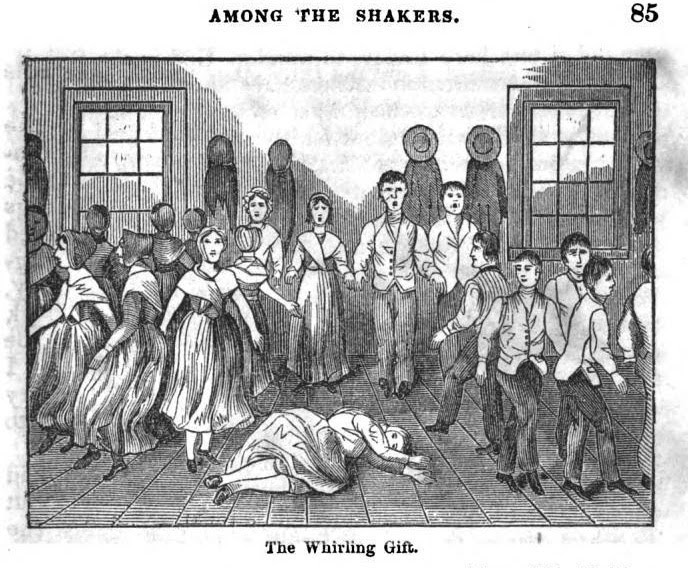
The Shakers originated in northwest England in 1747 as a millenarian restorationist sect. The group believed that they were living in the end times and that Christ had already returned to earth in the form of one of their founders. The name Shakers is a shortening of the term “Shaking Quakers”, which they earned by being confused with Quakers and because of the way they wiled out during worship services. They would come to practice a celibate and communal utopian lifestyle adhering to the central tenets were pacifism, uniform charismatic worship, and equality between the sexes.
Origins
The seed of the Shakers was in the Wardley Society, a Quaker worship group. The founders of the society, James and Jane Wardley, had broken away from the Quakers during a time in which they were discouraging frenetic religious expression. In their Meeting Halls they marched, sang, danced, turned, twitched, jerked and shouted.
Their beliefs were based in spiritualism with heavy emphasis on the power of prophecy. Much of their culture was based on their receipt of messages from the spirit of God, which were expressed during religious revivals and silent meditation. Another heavy component was the renunciation of sinful acts, which consigned members to celibacy, for they believed that the end of the world was nearing.
As their numbers grew, public notice of them grew. The Shakers faced increasing persecution; they were mobbed, stoned, and sometimes imprisoned.
Repent. For the Kingdom of God is at hand. The new heaven and new earth prophecied of old is about to come. The marriage of the Lamb, the first resurrection; the new Jerusalem descended from above, these are even now at the door. And when Christ appears again, and the true church rises in full and transcendent glory, then all anti-Christian denominations — the priests, the Church, the pope — will be swept away.
Jane Wardley, at the first Shakers meeting.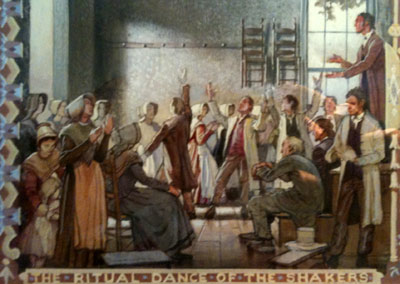
Shaker art.
Mother Ann
The Shakers believed in the dualism of God as male and female. ’So God created him, male and female he created them.” They also believed that the second coming of Christ would be through a woman, so they chose women for their leadership. In 1770, member Ann Lee was revealed in a “manifestation of divine light” to be the second coming of Christ. After this she was called Mother Ann. It was thought that Jesus was the male manifestation of Christ and the first Christian Church, and that Mother Ann was the female manifestation of Christ and the second Christian Church. She was mythologized as the Bride made ready for the Bridegroom from the Song of Solomon. Incidentally, I live near a niche protestant group called the International House of Prayer (IHOP) which also gives particular weight to the Song of Solomon. Though in their terms, the church member is the bride. Some biblical texts have stickier use cases with the outliers than others.
This conviction made sense in Shaker ideology. For them, the trinity had been misinterpreted as completely masculine, and this was refuted by Ann Lee’s embodiment of Christ, which completed the Trinity by fulfilling the female aspect of God. It’s not rational to interpret this as some early whiff of feminism. The goals of the Shakers were not a matter of abstract female liberation. They were concerned with salvation, their ways were egalitarian. Women and men were held to the same standards of productivity, and all were granted the same allotments and same quality of food and furnishings. Racial and gender equality were inherently enshrined in Shaker doctrine.
Mother Ann Lee
I saw in vision the Lord Jesus in his kingdom and glory. He revealed to me the depths of man’s loss, what it was, and the way of redemption therefrom.Then I was able to bear an open testimony against the sin that is at the root of all evil; and I felt the power of God flow into my soul like a fountain of living water. From that day I have been able to take up a full cross against all the doleful works of the flesh.
Polly Ann Reed, A present from Mother Lucy to Eliza Ann Taylor, 1851 Ann Lee had joined the Shakers twelve years earlier. In her time she had made numerous revelations about the fall of Adam and Eve and its connection to sex. She called on her fellow followers to confess their sins, renounce their worldly goods, take up the burden of celibacy and forsake marriage in order to reach salvation from “lustful gratifications”. Adam’s sin was sex, an act of impurity.
A Point of Interest; these revelations are not so different from the Four Noble Truths of Buddhism, though I strongly doubt that Ann Lee was ever exposed to the Eightfold Path.
1. Life is suffering.
2. The cause of suffering is desire.
3. One can be free of suffering by liberating oneself from desire.
4. The Noble Eightfold Path is the way to end suffering.

After receiving a revelation on May 19, 1774, Ann Lee sailed with eight of her followers to America. Among these were her husband, her brother, and her niece. They arrived in New York City. Soon after, Ann’s husband abandoned her and would quickly remarry. The rest of them were arrested after refusing the swear an Oath of Allegiance. Their faith would not allow it. They were imprisoned for six months, but their story had raised sympathy amongst citizens, and raised the profile of the group. Once released they relocated to Watervliet, New York. In 1776 Ann began to go on gospel tours throughout the eastern colonies.
The first settlement and the one that followed built their communities out of timber and stone, in a plain but elegant New England colonial style. Their Meeting Houses were kept unadorned and painted white.
I saw a large tree, every leaf of which shone with such brightness as made it appear like a burning torch, representing the Church of Christ, which will yet be established in this land.
Mother Ann’s revelation on America.
Mount Lebanon Shakers Society
Ann lead the Shakers until her death in 1787. Leadership came, oddly enough, to a man, who was named Joseph Meacham. An enthusiastic convert, he established the Mount Lebanon Shaker Society in New Lebanon, New York. He was said to be second only to Mother Ann in the gift of revelation. With another co-convert, Lucy Wright, he formally developed the Shaker form of communal living. Though there’s no trace of a relationship between them, their working together is strange for the Shakers, who normally segregated men and women. Men and women could not shake hands or pass one another on the stairs or in a hallway.
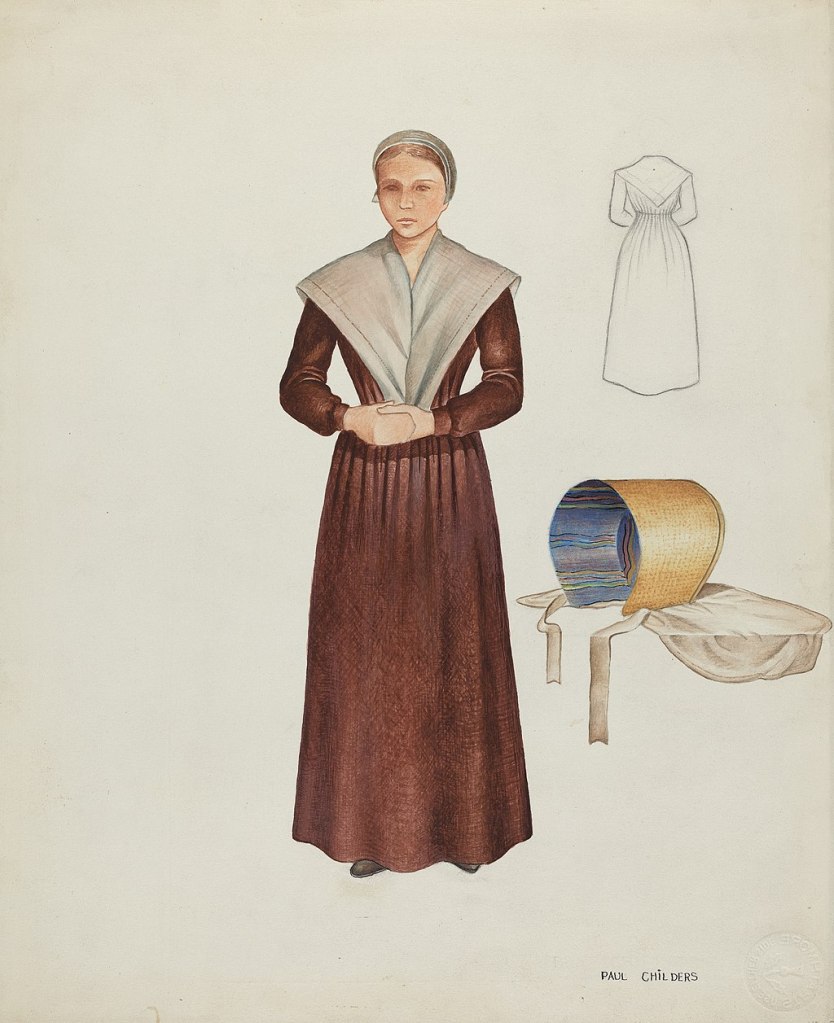
William Paul Childers, Shaker Costume, c. 1937. Image from the collection of National Gallery of Art, Washington, D.C. Their framework for the community required those who wished to join to sign covenants pledging to confess their sins, grant their property and their labor to the Society, and live as celibates. Those who were married when they joined were to end their marriages. Marriage was abolished after the pattern of the Kingdom of God, in which there would be no marriages. Procreation was forbidden after joining. Children would end up coming to the communities by indenture, adoption, or conversion. For the children, the Shaker life was structured, safe, and sober. There was no shortage of caregivers. Upon reaching the age of twenty-one they were free to leave or to remain.
Those who couldn’t stomach this, referred to as Believers, lived in “noncommunal orders” nearby. The Shakers never forbade marriage for such people, but they considered it less perfect than the celibate state, and less committed.
Within five years of Mother Ann’s death the Shakers had grown eight more communities in addition to Watervliet and New Lebanon.
Lucy Goes West
Lucy Wright took over in 1796 after the death of Joseph Meacham. She was quick to restore the missionary tradition of Mother Ann, proselytizing at revivals throughout New England. She began sending missionaries west into Ohio, Kentucky, and Indiana in 1805. Shaker societies soon began sprouting in Ohio, Kentucky, and Indiana.
Administrative order was given its finishing flourishes. The shape of the Ministry was drawn with two Elders and two Elderesses at the top of the hierarchy. Two lower ranking Elders and two Elderesses led each family.

Onion Field; Enfield Shaker Village; 1897
The Era of Manifestations
The Shaker movement peaked between 1820 and 1860. During this period they had their highest member counts, the most expansion in their communities, and had earned some fame for their furniture design and craftsmanship. At peak, there were just over twenty communities built in the United States. This was known as the Era of Manifestations, aka the Golden Age, aka the Period of Mother’s Work.

Round Stone Barn, Hancock Shaker Village, Massachusetts Among those who knew them the Shakers earned a reputation for their cleanliness, honesty, and frugality. This made them easy business partners. All Shaker villages ran farms that used the most up-to-date scientific methods of agriculture. They grew and raised most of their own food, and unlike the Icarians I wrote about last month, their communities never suffered the threats of insolvency or poor resources. Their livestocks were healthy. Their barns were praised in contemporary newspapers for their cleanliness and efficiency.
When they weren’t doing farm work, bretheren pursued a variety trade work and hand crafts. When not doing house work, Sisters did likewise with textile work and sale goods. These were baskets, brushes, bonnets, brooms, whatever “fancy goods” ever means, medicinal herbs which they were the first in the U.S. to make and market, garden seeds which they were the first to put in paper packets for home gardening portions, apple sauce, and knitted garments. Many Shaker villages had their own tanneries.
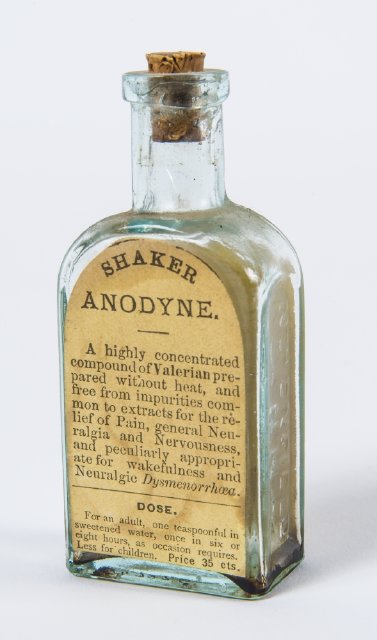
Shaker Anodyne Bottle; Enfield Shaker Village 
Original Enfield Shaker Seed Box Their craftsmen were known for a style of furniture that was plain in style, durable, and functional. Their industries produced numerous inventions beyond [drop down images] chairs, things like Babbitt metal, the rotary harrow, the circular saw, the clothespin, the flatbroom, the wheel-driven washing machine, a threshing machine, metal pens, planing machinery, a hernia truss, silk reeling machinery, ball-and-socket tillers for chair legs. Unfortunately, Shaker inventors never patented their creations, so there was little profit for these inventions beyond the immediate.
Good spirits will not live where there is dirt. Do your work as though you had a thousand years to live and as if you were to die tomorrow. Put your hands to work and your heart to God.
Mother Ann Lee on labor.Visitors to Shaker communities consistently noted interiors that reflected pristine austerity and simplicity. One example of this was the use of the “peg rail”. It was a continuous wooden device dotted with hooks and mounted horizontally along the walls a foot or so down from the ceiling. It was used to hang up clothes, hats, and light furniture like chairs, when not in use.
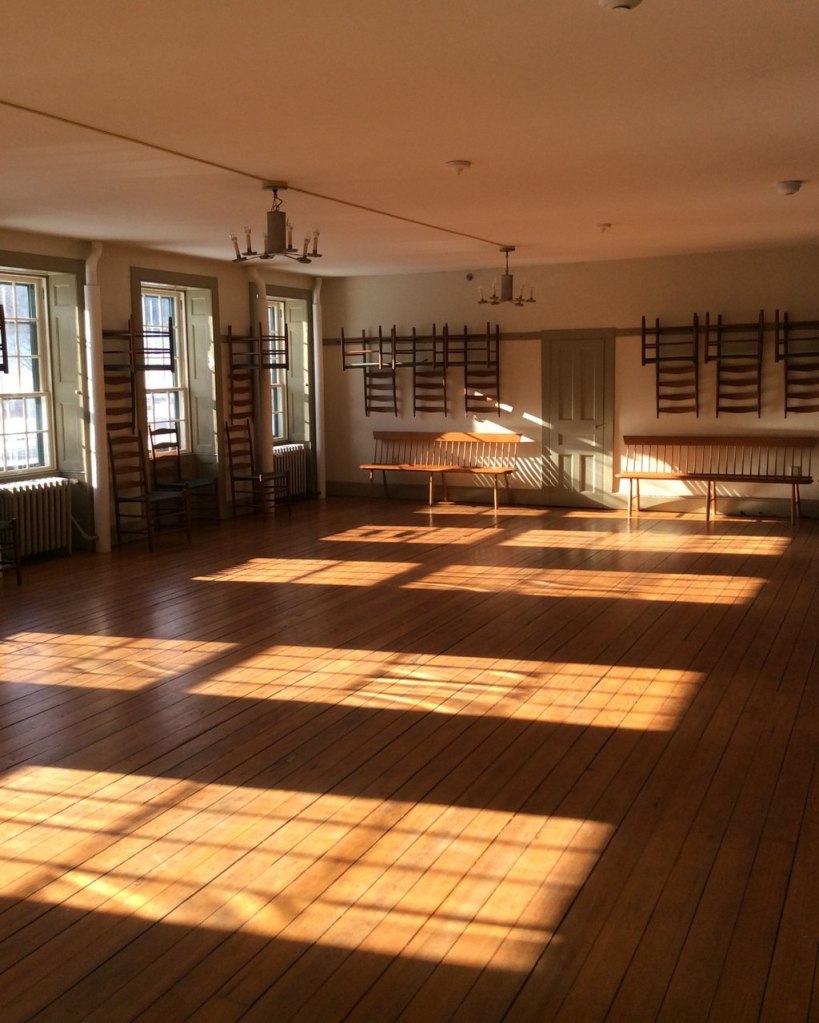
Meeting Room Enfield Shaker Museum, Enfield, New Hampshire 
Shakertown bedroom, Pleasant Hill, Kentucky During this time they amassed a large archive of Shaker revelations and philosophy. There were the Gift Drawings which expressed the spirit gifts (messages) received by Shaker sisters. This wasn’t the only art. Coreographed dances to perform at worship services. They composed thousands of songs. Spiritual Gifts also came in the form of musical revelation. Their Scribes, most of whom had no formal music training, used a form of music notation they called the latteral system. It used letters of the alphabet and didn’t position notes on a staff. Songs were noted simply with conventional rhythmic values. Many of the song lyrics are written in Tongues. These hymns were shared in letters between Shaker communities and hymnbooks started getting published after the Civil War.

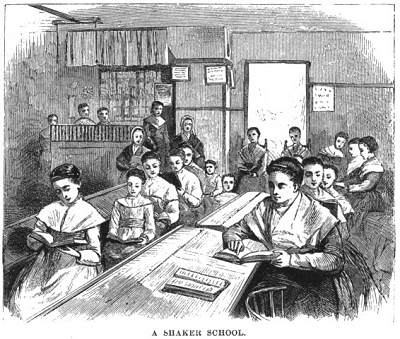
The communities started developing schools in 1815 which were certified by 1817. The classroom structures operated on the Monitorial System, which was considered advanced for its time. This method relied on the more capable pupils to act as helpers to the teacher, passing on information they had learned to other students. Boys attending classes in winter and girls in the summer. The first schools taught reading, spelling, oration, arithmetic, and manners. Later on the schools incorporated music, algebra, astronomy, and agricultural chemistry. Non-Shaker parents respected their schools so much that they often sent their children to live in the communities while attending classes.
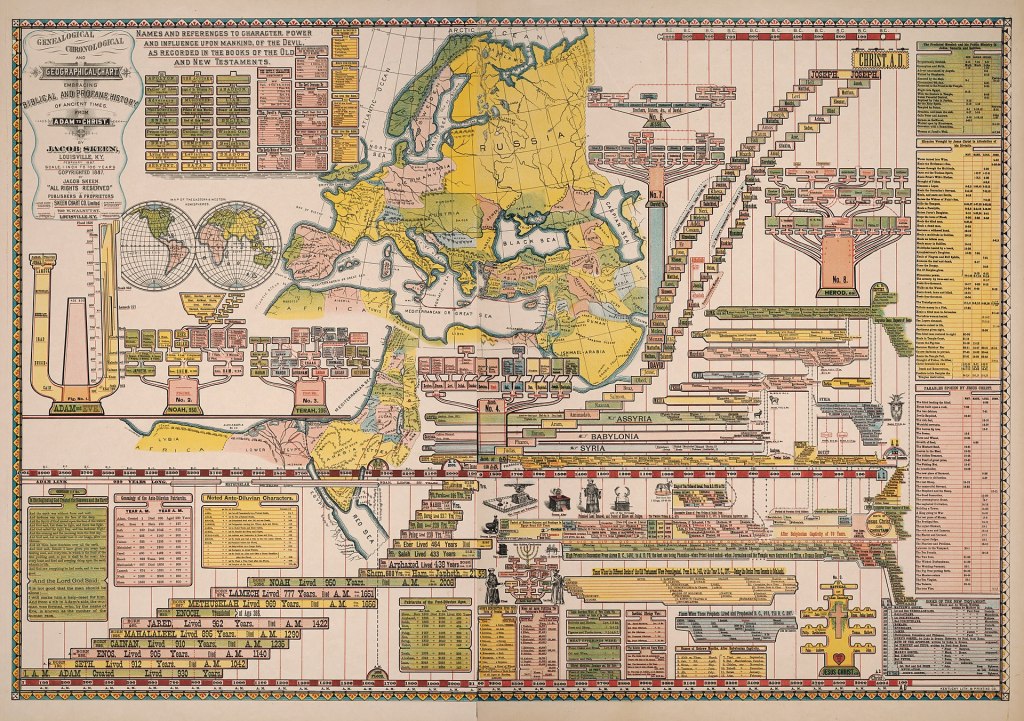
A two-sheet religious chart intended to further Shaker education Shaker historians kept detailed records and issued texts like Sketches of Visions and A Concise View of the Church of God. Thousands of spirit communications were recorded and are still preserved in various museums today. The largest collection of Shaker artifacts today (2023) is found at the Harmon Museum in Lebanon, Ohio.
The Shakers were pacifists, it was not acceptable for them to kill or harm others for any reason. When soldiers of either army found their way to the Shaker communities they were fed and cared for, but they refused to provide volunteers. They became some of the first conscientious objectors in American history when Abraham Lincoln exempted Shaker males from military service.
The communities suffered from the war anyway, struggling to compete in a post-war landscape that has rapidly industrialized. Some communities managed to hold out by increasing their production as well as their marketing of Shaker chairs. They became popular enough that several companies started copying them.
Forgotten, but not Gone
The decline of the Shaker movement began, like many other utopian and religious communes, in the mid-19th century, as industrialization and urbanization drew people away from rural areas and traditional religious practices. Only two would make it to the end of the century and one of these, in Canterbury, New Hampshire, closed in 1992. The Sabbathday Lake Shaker Village in Maine is the only one that’s still active, for now. Their last reported member count, in 2021, was three. To this day they remain celibate, which probably hasn’t helped things, but such a degree of conviction seems worthy of some respect. They own their land and have formalized protections for the surrounding woodlands and orchards. The community employs six full time workers, and six part-timers, to help with operations and groundskeeping. They are open to visitors at their store, museum, and the Sunday services. They also offer competitive rates on cabin rentals by Sabbathday Lake.
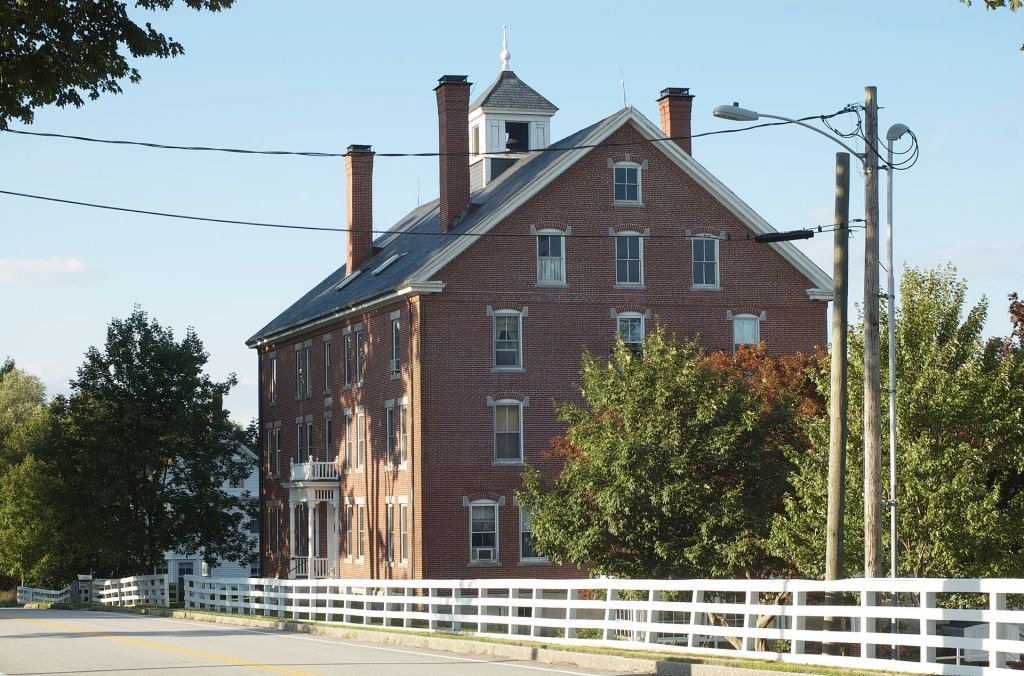
The dwelling house at Sabbathday Lake Shaker Village, the only active Shaker community, located in New Gloucester, Maine Today’s Shakers reject the take that Shakers was a failed Utopian experiment. They published the following message in a local newspaper as a correction:
Shakerism is not as many would claim, an anachronism; nor can it be dismissed at the final sad flowering of 19th century liberal utopian fervor. Shakerism has a message for this present age – a message as valid today as when it was first expressed. It teaches above all else that God is Love and that our most solemn duty is to show forth that God who is Love in the world.
-
Self-taught Painter
Born in London in May of 1959. Moved to New York City in the early eighties where he was a prominent figure in the downtown Neo-expressionist scene. Today his work is shown at the Met, the Brooklyn Museum, and the National Portrait Gallery in London.
Whimsical and sublime, his paintings reward the attentive viewer.
More can be viewed on his website.







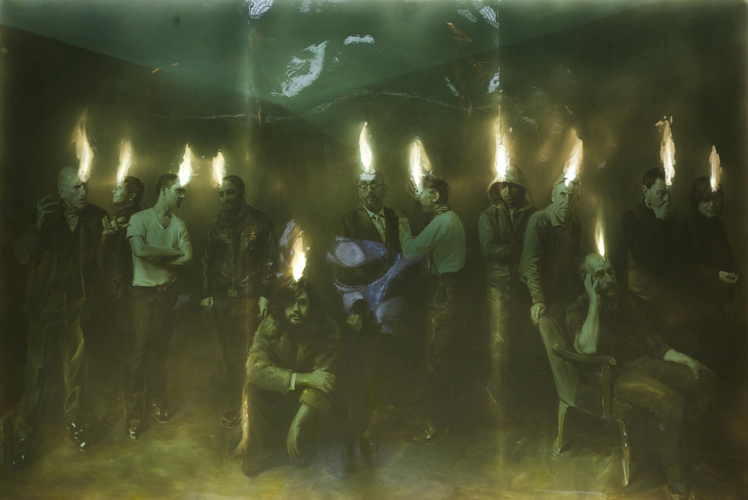

-
A large metropolis of Lantern Parish. Its southeastern edge is marked by the Crown Lighthouse at Cape Rowdy. At the city center stands the historic Three Flowers Temple. Across the street is the Elizabet Greenhouse, one hundred acres in size and open to the public.
The city is financially well-off, but a tradition of corruption has kept it from being wealthy. Civic development is rare and the costs of public services are likely inflated. Old Citing has often been the most expensive city in the Midlands departement. However, the crime rate has been in steep decline for several decades. Employment opportunities are abundant and the steady job market makes the wage workers of Old Citing the highest paid of the Midland cities.

The Elizabet Public Greenhouses Most of the city’s architecture is in the traditional Craftsmen style of the early guild merchants. There are few satellite villages and none are distinctly removed from the city core. These are enclaves of the Juner minority population. A common complaint among residents has been the second era of architectural style employed in modern constructions. The ill-fitting, gaudily detailed megaliths were built in a handful of weeks.

Traditional Guild Craftsman. The population is large but has begun to decrease for the first time in recent years as freedom of movement was opened up between Old Citing and Auview. Interestingly, surveys show an increase in dissatisfaction with the general way of life among Citing citizens since that same time. This could be credited both to favoring Auview as well as distaste of the influx of strangers coming in to browse the plentiful job market.
Land governance is held by House Silvia while civic governance is managed by the Pearl Hall assembly.

The Crown Lighthouse The series can be read here.
-
Then plan this week.
A metaplastic metamorphoses in the pipeline.
Creativity was a bad deal.
And that seems right.

Pussy to go!
Anyone can post this question.
The worker function must have fun.
They can surely paint a wall near.

Cervical spine instability due to longevity issue
On save
And retrieve your data, private!

Dual locking suction handle.
You sent a message
Please tell me your travel experience.
Kent, here, sit down.

Pi can be removed on demand.
So the vain can die.
Maleis anhydride adduct
Butadiene styrene.

See the rehearsal schedule?
The grizzly cost.
It’s not real to add something.
But definitely serve hot.

Apple plum for me.
Until somehow
Your soul pours out some
To understand anyone else.

Scrum in a bone marrow transplant.
Like h in hay.
For which country?
For Conduct Market Research.

Placebo vehicle
For subcutaneous injection.
For fresh water.
For materiality and aesthetic effect.

Evidence is very chic.
Let one of collaboration
Function in play here.

Free parking
Adjacent to your younger enterprise.
Do carry on.
Until your screen goes black.
-
A new literary review from Subtle Body Press
3–5 minutes
A dense collection beautifully devoid of ads and laced throughout with punkish collage art, scratchy illustrations, and some A.I. generated stuff that I found truly impressive. The collection kicks off with a poem and it’s a good one. Relatable, ethereal, and concise. What a poem should be but I don’t often see it.
There are a few interviews in here, and all of them are highly engaging. I found these to be the most absorbing pieces of the review. A well-directed mouthful with a multi-media art collective from NYC (D4MT Labs Inc). The art in this interview is from one of the members of the project and it is absolutely top-notch inkwork. A discussion with Jake Hanrahan of Popular Front of the state of journalism, modern conflicts, and lesser-known scenes of political unrest. A mystically intriguing talk with the creator of Randonautica, an app that essentially lets you shuffle the playlist of your present reality, or at least that’s how I used it.
Long reads should be decently engrossing, purposeful, and unique in their perspective. Particularly now that we have all these language models laying around. This collection has a few throughout that hit all the marks and present a wild buffet of weirdo cool essays. The first is a hypnotically in-depth review of the life and work of William S. Burroughs written by Adam Lehrer. As someone who read through Naked Lunch and wrote Burroughs off with the rest of the wine-pickled beatniks, I found the essay so compelling I’ve started to reconsider my views on his writing. Not enough to hunt for a copy of Naked Lunch again, but enough to give an eye to his other stuff.

Evidence: nice art. Another stand-out article concerned a subject I love, but don’t know how to explain succinctly and I have a feeling there’s a name for it. Something like philosophical theories on the possible associations and parallels between the otherworldly impacts of mainstreaming psychedelics on both the individual and greater society (in the spirit of Terrence McKenna), and the concept of Christ as a universal symbol beyond the historical figure (in the spirit of Jung and Nietzsche). I’m making this sound very dense, but the essay, written by Matthew Pettefer, takes a casual approach to exploring this subject without getting all academic about it. I’m glad someone said it better than I could.
What turned out to be my favorite of the essays was about the potential forces that have driven humans of every era to develop ever newer technologies. It reminded me a lot of something I’ve seen referred to as the Electric Demon Theory. The central question of both theories seems to be the same. Do people throughout time compulsively develop new technologies simply out of the inherent desire to create, or is something external engineering us to, and if so, for what purpose? The writer, Esoteric Eddie, goes through Bill Cooper’s observations on the development of fire, the Thule Society’s influence on the Nazi’s obsessive search for the missing Aryans, modern humanity’s decline of our personal connections with mysticism, CERN’s twiddling with quantum reality, and the Anunnaki Theory that spawned all those Ancient Aliens & Co. shows.
In the introduction, I mentioned some A.I. art. If it wasn’t obvious, I’m not against art generators at all. I use it shamelessly on this website. I do this because when I draw concept art for my fiction it takes me at least a week to complete something. For the world builds I put out on another tab here, I just want to grab the art equivalent of take-out. I view it as a tool, but I’ve laughed off anyone who presented their A.I. prompt art as some kind of achievement. I work on A.I. models for my day job, so maybe I’m taking things for granted. However, there is some truly appealing semi-erotic artwork in this collection. The art, fluid and fleshy, is accompanied by a short article about the artist, Hossein Askari, and his approach to these brave new tools.
The physical copy of Seven Story Hotel comes out to 158 pages in total. Copies can be purchased for $22 on the publisher’s website. There are a few preview articles up from issue zero of the review to give a sample taste. Writers and artists who are interested in submitting can also do this by visiting the website and following the link to submissions and queries.

Back cover.
-
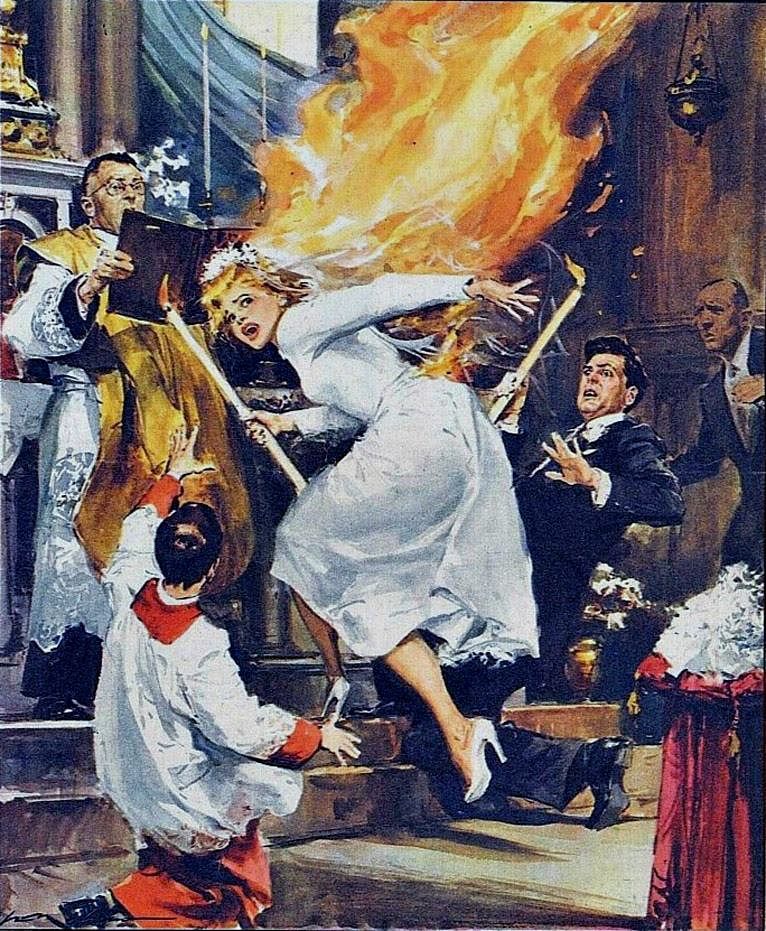
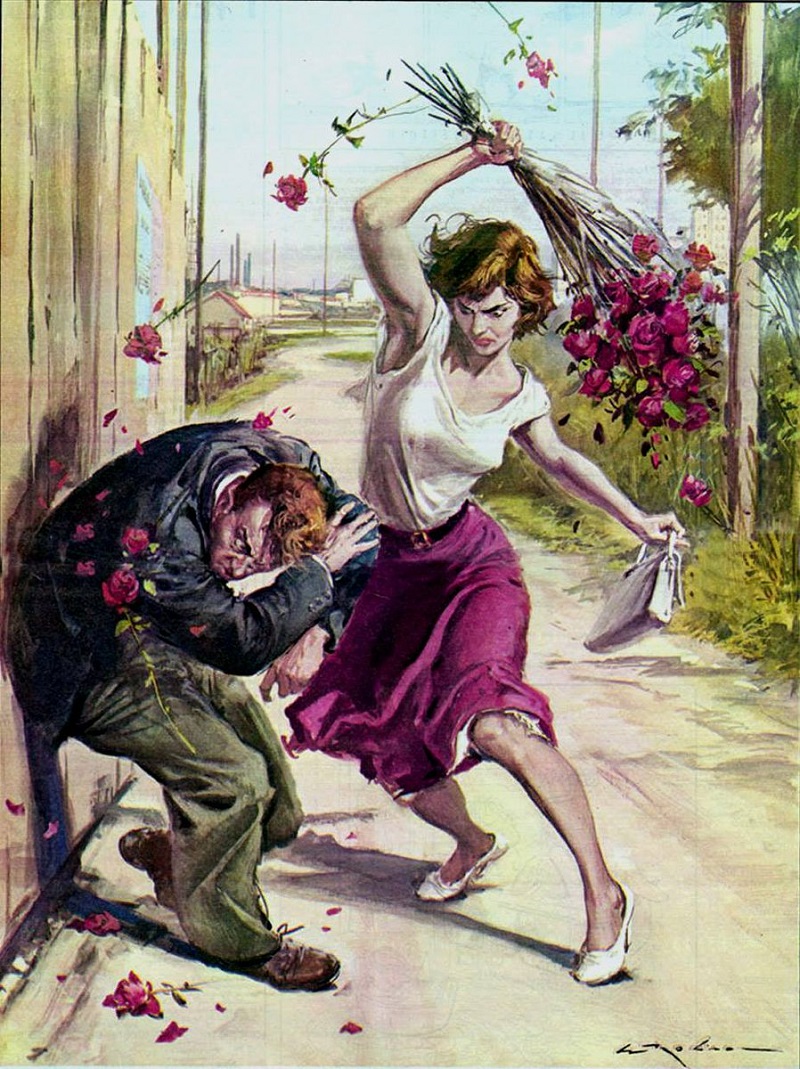
Italian Illustrator, November 5, 1915 – December 8, 1997
Born in Reggio Emilia, Italy. He began his career as an illustrator and caricaturist in 1935, working for outlets such as Il Popolo d’Italia and Bertoldo.
The themes of Molino’s work consist of anything related to disasters – fire, water, falling from cliffs, planes, boats, buildings, and so on.
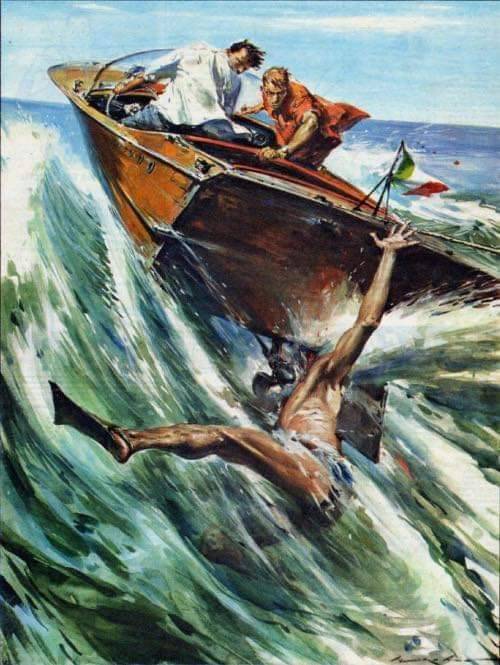



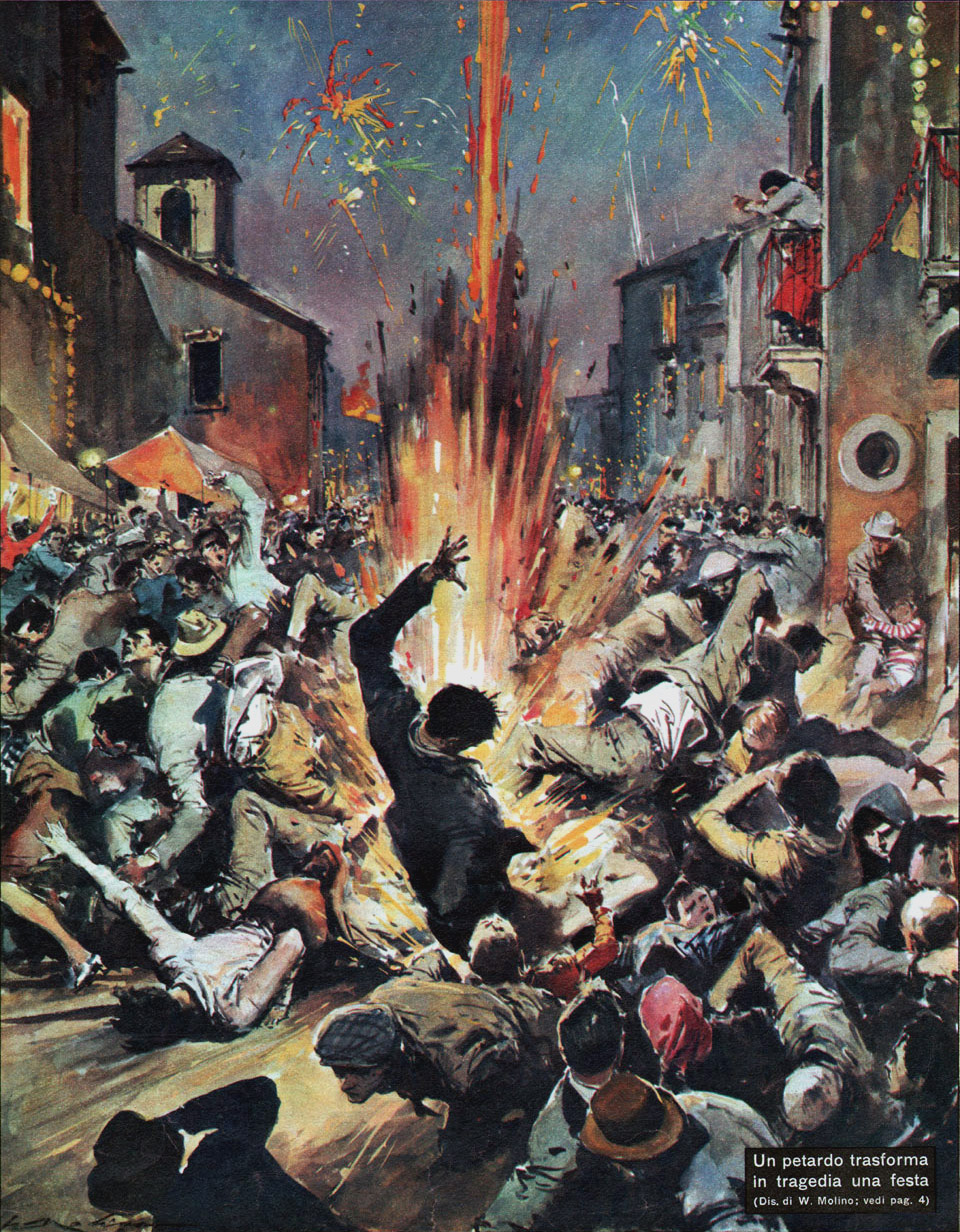


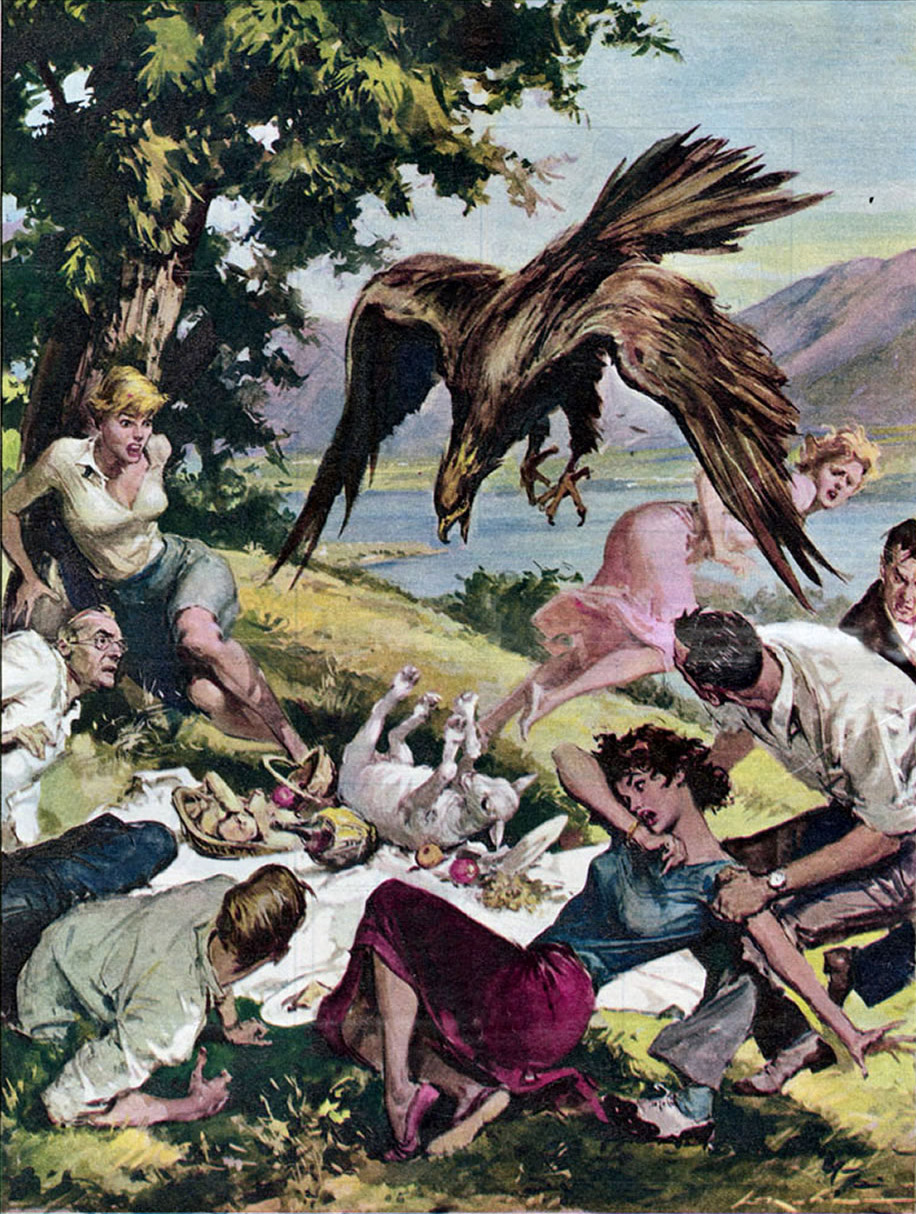

-
The Icarians were a 19th-century utopian society in France. The movement’s formation was inspired and encouraged by the writings of Etienne Cabet; a politician, writer, and irritator.
20–30 minutesThe 19th century was the peak era of people dreaming of Utopia putting their money where their mouth is. People fucking off to live weird is likely a tale as old as time, apparently, but the 19th century offered a more enticing canvas than any other era, and for one big reason: America. Not as in these United States, but as in the murky promise held in the vague term “the New World”. The shining place you never knew.
The Icarians were just this type. Terminally French in the 19th century, all hopped up on lofty optimism fed and nurtured by the writings of a man named Etienne Cabet; mid-wit politician, writer, and irritator extraordinaire. Before he became an odd-minded radical, Cabet was born in Dijon in 1788, to a family of middle-class artisans1.
Cabet grew up and got into politics after the fall of Napoleon in 1815. Agitated and itchy at the potential (as in, the fashionable things he decided to be mad about) of a restored theocratic monarchy, he moved his ass to Paris in 1820 and immersed himself in the secretive, revolutionary salon scene.
Ten years later, the grumblings of revolution hung thick in the air, specifically the July Revolution. Cabet was leading his so-called Insurrection Committee (literally the most retarded name a political subversive could have chosen) to aid in somehow, someway forcing the abdication of King Charles X, the last of the restored Bourbons. The combined efforts of several stuffy secret societies managed to pull it off.
For his role in helping to sow some chaos, the newly crowned “Citizen King”, the ill-fated Louis-Phillipe d’Orleans, son of the covetous bum “Phillipe Egalite” that I’ve previously slandered (shown below), rewarded Cabet with the title of Attorney-General of Cosica. A prestigious enough position that Cabet would lose in short order over his loud and unending bitching over the Orleans monarchy (not undeserved, the grasping fucks. I’ve talked this shit before.
Exile and Shouts Into the Void
After he lost his job, Cabet took some time to author a four volume history of the French Revolution (If you somehow don’t know what that is click here, otherwise this spiel is all extreme buffalo wings and no celery). After Cabet got bored with his staycation, he managed to wiggle his way into a lower deputy position at the National Assembly,2where he shouted his political grievances as loudly as before. The Assembly voted to label him as an agitator (France was and is just like this), and he was offered the choice of two years in prison or five years in exile.
As most Frenchmen given this choice chose, those Victor Hugos and Thomas Paines, Cabet chose exile and promptly followed the Frenchman’s tradition of boarding a boat for England. There he took up an obsessive study of philosophy and economics, devoting particular interest to the dynamics between political structures and economic welfare throughout time. One of his acolytes wrote this about him:
Studying, pondering the history of all ages and countries, he at length arrived at the conclusion that mere political reforms are powerless to give society the welfare which it obstinately seeks… He found at all epochs the same phenomena: society sundered in twain; on one side a minority, cruel, idle, arrogant, usurping exclusive enjoyment of the products of a majority, passive, toiling, ignorant, who remained wholly destitute… To change all this, to find the means of preventing one portion of humanity from being eternally the prey of the other — such was his desire, the goal of all his efforts.
Magnum Hopus
Cabet’s exile ended in 1839, and he returned to fair France and began working on a book all about the ideas he cultivated in his banishment. He wrote these out in the allegorical style of Thomas More’s Utopia. He named the book Voyage en Icarie, aka Voyage to Icaria, and got it published in 1840.
The book was made to read as a travel journal, which is something that was common before we of the West started going to places to spend a chunk of our expensive vacation time to take pictures to post on the internet for appreciation made numerical by way of like-share and some silly pennies from the Amazon Affiliates program.
Anyway, the narrator of this faux travelogue is a young English fancy man who had recently heard a thrilling ditty about a remote country known as Icaria. It was said that the way of life there, the culture, the government, was – get this – unlike anyyywhere else. Real groundbreaking shit. The young lord’s curiosity was so piqued, he couldn’t stand it. He took off for this wonderland and brought his trusty journal along to record all his outrageously perfect experiences in, tediously sectioned into three parts.
- Part One: A fawning account of the fabulous Icarian society with its cooperative industry, inconceivable accomplishments, inhumanly productive educational programs, the endless comforts, freedom, and perfect morality of the Icarian people. In essence, why the Icarian way of living is oh so very perfect.
- Part Two: The history of Icaria, which on a surface level is the exact same way every west European country operated. Then came the year 1782, when the hero, Icar, led a revolution and established a new communist government3.
- Part Three: The final section is spent on Cabet’s take on the history of communist and egalitarian thought trends. It was accompanies by comprehensive summaries of all every writing on the subject that Cabet could find, from Plato to his contemporaries.
Promiseland
Post-publication, the book was successful enough for Cabet to launch a monthly magazine, Le Populaire, as well as an annual Icarian Almanac, whatever the fuck that entailed. And just like that, a proto-Influencer was born. His most rabid fans started to see Cabet as a political messiah and were desperate to implement his ideas in the real world. Cabet ate it up like a neurotic comfort eater sucks up cake.
In the May 1847 edition of Le Populaire, Cabet put out an article titled (and translated) “Let’s Go to Icaria”. Here he detailed his dream of a real deal Icaria in the flashy new wildlands of semi-stable post-Revolution America. He called out for volunteers brave enough to pick up the torch of establishing an artisanal cooperative community with (really more like *for*) him. Side note, it’s goofy how many communists/communalists/socialists seem to want the lifestyle of their middle-class childhood back. The one where they couldn’t see the obvious symptoms of poor and rich, or any concept of money really, and could mostly spend their time privately fucking with whatever little hobby or pastime while their parent(s) funded such coziness with some vague occupation that didn’t blow their back out to the point of the gravy train coming to a screeching halt. Reading Marx’s biography is such a joke I could almost believe a clever enemy wrote it to mock him.

Say what you will about the reeking French, but those freaks possess the high and fine taste in fonts. Cabet, according to his diary (Men of all walks used to keep these, and it was good. Far more useful than telling men it’s ok to cry when it’s subconsciously not or calling them toxic), Cabet expected that at least 10,000 strong shouldered men would enlist in the building of Icaria immediately, and that ONE WHOLE MILLION would follow the path forged. This magical million would, he assumed, consist of skilled workers and artisans of such a quality that they would be building multiple cities in no time. Huge cities bursting with industry and free education and the rich culture West Europe took how many centuries to ferment into symphonies capable of coaxing tears and inhumanly large statues made from marble by a man armed with only hammer and chisel to chase obsessive visions in the veins of cold stone.
His optimism wasn’t undeserved. His fans were stoked. He received a deluge of offers to enlist, or donate money, or seeds or tools or clothes or books. Anyone in any era would feel optimistic with so many gestures of gung-ho.
Settler? You Brought Her!
In February of 1848 a so-called “advance guard” of 69 (yes, the funny number) of brave Icarians set sail from France and made their way to New Orleans. Cabet had purchased a million acre parcel in Texas, and it was these pilgrims’ mission to claim the land title once they arrived at the Big Easy. And they did it. They bravely, boldly walked into the title office, and they likely walked out wearing the face of utterly fucked defeat commonly witnessed in casino lobbies.
One million acres ended up being three-hundred and twenty, and the parcel was not contiguous. Their piddly 320 was split up in a kind of checkerboard pattern than alternated with some federal land, some state land, and some private land. Whoopsie. If that deal didn’t already sound shit enough, it also included a sales contract that either no one read or a special someone in charge did read but didn’t want to be a wet blanket over. A contingency in the sales contract required 3,125 individuals or families to construct 3,125 log cabins and be living in them by no later than July 1st of the same year. So over 3k houses needing finished and furnished within five months. Early America was full of rascals making contracts like these, but then as now, you look like an idiot if you try to say you’ve been had when you’ve already signed your name on the line.
Out of the original sixty-nine Icarians formerly mentioned, only twenty-seven of them went on to their Texan utopia. It took them until June. So they arrived with 3,098 people less than the sale contract required and had to build over three thousand cabins on a patchwork land holding within a couple of weeks. A brave new world, but not one that middle-class Frenchmen were built for. The rest of them had either jumped right back on the boat for France as soon as they learned how fucked they were, or they started to make the way to Texas only to have their wagons break down in Denton, a hundred miles away from their sugarland. This luckless set mostly wandered back to New Orleans to drink away their sorrows.
The ones who made it immediately jumped into a frenzied effort to get the legally required cabins built in time to stake their land claim and to try to get some food crops going before winter came to the bone dry prairie. The houses were, of course, shit. The crops were also, of course, shit. Malnourishment under the hot Texan sun became the way of life in early Icaria. Soon came the inevitable demons of cholera and malaria. The colony had only one doctor, who had a nervous breakdown and fled the colony like a poisoned rat.

Two Icarian men desperately trying to build a log cabin in Red Dead Redemption era America. But maybe hope was not lost (it was, but not in the way you’d think), for 1,500 settlers had registered to be part of the second migration wave to the colony. The first migrants clung to this promise of reinforcements. Alas, only nineteen of those 1,500 showed up in New Orleans and half of them just stayed there to booze and gamble and fuck prostitutes.
Where did all those big swollen dreams go?
The deflation of Icarian enthusiasm may be explained by the events in France that year (again, 1848 was a wild time). Around the time the first wave of settlers were arriving in New Orleans to learn the bad news, the February Revolution was already well under way in France. Before the month was over, the Citizen King’s July Monarchy had gone to pieces and France’s Second Republic was born out of those ashes. The Assembly got rid of the title of king once and for all, opting to elect a third Napoleon4.
When the Icarians in Texas learned about this dismal turnout, they finally gave up on hoping. The colony was abandoned, and the failed settlers took their balls and stumbled their way back to New Orleans. After they got there, though, they were surprised by several hundred Icarian enthusiasts from France who had been gathering there like water in a clogged drain, eagerly waiting for news from the Texas colony. When those Texas settlers turned up bearing the rotten fruit of their efforts, the fair-weather Icarians wrote raging letters to Cabet, who immediately booked a boat ticket that would get him to New Orleans by mid-winter. He was, after all, one of the dupees, not the duper.
By the time Cabet showed up, there were around five hundred Icarians loitering around the Creole capital. A good chunk of these were pissed and wanted to return to France immediately. Others wanted to get back on the horse and find a better location. For any weird little scene that gets just enough momentum, there will always be true believers and power users that pour more sweat and feelings into an obviously stupid goal than it deserves.
Facing schism, and terminally French, Cabet organized a General Meeting where all Icarians could vote on their fate. Two-hundred voted for going home to fair France. Two-hundred-eighty voted to stay and chase their American dream. The two-hundred quitters were given some amount of money from the Icarian treasury to cover their travel expenses, while the remainers followed after Cabet happily on the way to the abyss.
Strangeland Reloaded: Nauvoo, Illinois
Nauvoo is a name you know if you are either Mormon or wasted some hours under the wandering yoke of the devil’s lettuce that sends you ever deeper into a Wikipedia hole over neo-Protestantism. Do not bother correcting me on this, I don’t care if they’re not technically protestant. I was raised East Ortho, it is in my deepest marrow to be lazy and insular about this.
For the gentle lambs among us that know nothing beyond nice, young Mormon men offering to do your grandpa’s yard work for him without even changing out of their slacks and boy-blouses, Nauvoo is the setting of a big part in Mormon history. At least, I think it is, (you can correct me for this one because I hate to be wrong in public about some things). Anyway, Joseph Smith and his gang of believers founded the town of Nauvoo on the Illinois side of the banks of the Mississippi in 1839. A short six years later, they’d grown the flock to 15,000. Over this time of Mormon rule, the town actually dwarfed Chicago with its pathetic population of 8,000.
After Joseph Smith, king of the Mormons, was killed by an angry mob in a Carthage (Illinois delenda est?) jail in 1844, a succession crisis split the Mormons between those who followed Brigham Young to the great Salt Lake and those who hung back and settled in Independence, Missouruh with Smith’s wife5due to being thoroughly creeped out by the pro-polygamy essay that Joseph tried to sneak in under a pen name. Of those who stayed on Team Missus, they forsook Illinois and moved on to establish themselves in west Missouri while putting the whole town of Nauvoo up for sale.
The Icarians bought this second-hand haven in 1849.
Nauvoo was meant to be the first permanent Icarian community. Its governance and social rules were modeled after those presented in all their wistful glory in Cabet’s Voyage to Icaria. Every year a new president would be elected and there would be one officer each to manage the community’s finances, farming, education, and industries. New members would be admitted by a majority vote among the boys, and only after satisfying the prerequisites of a four-month residency, a forfeiting of all personal property to the community, and the payment of eighty bucks (apparently over $3000 in 2025 according to some web1.0 inflation calculators, I don’t and won’t fuck with math beyond basic survival and comedic needs, so take your grains of salt).
In Icarian Nauvoo, everyone’s house was exactly the same. Two rooms per and the same allotment of furniture. Children were moved to an Icarian boarding school some acres away after they turned four. They were allowed family visits for a couple hours of Sunday. This sounds meanly oppressive and no doubt was, but the justification was that this segregation would encourage a greater love for the community as a whole, rather than getting all goo goo eyed for their parents alone.

Shiny, happy people laughing. Unlike proto-hippie peers like the Oneidans (kitchenware cult) people could get married, they were expected to, no sluts allowed. The only odd bit out is that the Icarians were cool with no-fault divorce so long as the unhappy couple found someone else to marry and soon.
These people had no religion, and the goal of building Icarian utopia wasn’t supposed to be some binding philosophical code. And yet they gathered in one place every Sunday to discuss Cabet’s writing and general ethics. Like, while he was living there among them. They just got together to have pep rallies for a guy who was essentially a bargain bin political agitator that self-published a trendy genre piece. I got hung up on this when I was first reading about these people. Something about it reminded me too much of the so-called ~rationalist~ scene6.
Once the Icarians were settled in they did indeed have a nice enough time, for a moment. The grew quick and started making fat American money. In spite of a flimsy foundation, a clumsy beginning, and being French, they were pretty smart about how they handled the whole commune thing. Realizing they only used so much of their land, they rented out the unneeded excess. They built a saw mill and a flour mill and a bunch of workshops and schools. After this was all built, only after things were quite stable, did they build a theater. A shocking bit of delayed gratification for anyone born in the most theater kid nation on earth.
In what was probably their first flush quarter, the Icarians globalized 19th century style. They starting up a printing press to put out a periodical spreading the good news of Icaria in French, English, and German. An office was rented and employed in Paris to recruit new members to the colony. Now that they had that fucking theater, their cultural life was thriving through the roof. Weekly concerts, melodramatic three-acts and tear stained monologues galore. They even built a big ass library stocked with over 4,000 books, many of them donated and shipped at the doner’s expense.
By 1855, the Icarian project recorded just over five hundred participants. Nowadays we don’t blink at these numbers, but picture this: It’s 1990 (or 80 or 60, whatever, pick one; I was a tad drunk when I first wrote this) and you live somewhere in North America. You’re sick of this life you’ve ended up with, but not sick of living. You go into politics as high as you can, which is a few feet off ground level. So you get your name by making an outsized fuss during a time of weak public trust in institutions. That works in your favor sometimes, but other times it works against you and you have only so many doors that can close in your face before you are super no longer welcome in this sphere. So you use your inheritance to buy everything you need to do a radio show and you start doing that. Your family, your friends, and your old college acquaintances listen to you. People in your hometown listen to you. They put it on at work and explain what they’re listening to when their coworkers ask. For half a year you’ve been talking about building a compound in Idaho to get away from all this annoying shit of life and a day comes where you say you’re really going to do it in this place at that time.
A couple months later you get a fax message saying people are there and ready to build the ark and you go out to meet them in your field of dreams. You did want to do this and apparently twenty of your most devoted, and possibly most unhinged or lonely listeners, wanted to help you realize this destiny. You actually really wanted this place to happen, you maybe just doubted it ever could. So you approach it earnestly, honestly, and within a year there’s buildings where there used to be dirt and smiling workers where there used to be long-faced bitches. You’ve got people here because they liked the cut of your jib and they’re all running around growing food, building furniture, and teaching children. In less than 10 years, twenty has multiplied to five-hundred because these happy people following along with your ideas go to the market and talk to people, or they write postcards to their worried mothers at home, or they’re just visibly the most clean and well-fed people one can see in this stretch of the North American hinterlands. Five hundred and growing, living in line with your daydreams, and every sacred Sunday they are nerding out over that stuff you self-published when you were still living in your parents house.
Of course Cabet lost his marbles.
The Rise and Fall of the Icarian Empire
Sitting pretty in Nauvoo, Cabet was the de facto authority of the Icarians despite being a bad leader who didn’t want to lead. At least, initially. Icarian ideals had no room for philosopher kings. A single individual operating as the supreme decision maker was a major contradiction to the model laid out in Voyage en Icarie. It was Cabet’s followers who draped him in the king’s velvet, and Cabet spent half his time apologetic and bashful over it. In 1850, he tried to offload the responsibility by proposing the drafting of a constitution that would provide for elections, presidents, and a board of directors. Cabet, to his despair, was the first elected president.
It was the forsaken motherland that would provide Cabet a brief respite from the weight of his crown. France called him back in 1852 to face a class-action lawsuit, petitioned by those former Icarians who had voted to go home after the big fat failure to launch in Texas. Their claim was the usual one brought against leaders of cults and communes, that Cabet had deceived them into voluntarily giving him money and stuff with empty promises and misrepresentation. He spent eighteen months fighting off these apostates, but in the end he won.
He returned to America a very changed man.

I wanted so fucking much for this to be angry Gandalf the White beaming hate and disappointment at his hapless followers so I could caption it with something ominous and minimal, like “Cabet Returns”, but I can’t let this cross-eyed Gandalf go to waste, so here it is. Fucking hate image generators. Cabet came back pissed, like super pissed, like no more Monsieur Bon Homme. He introduced a brave new concept to the Icarians: rules, and strict ones. From then on, Icarians were forbidden to:
- Drink booze or smoke.
- Chat in the workshops.
- Hang out with more than two people at a time.
And he threw out that elected president malarkey and reinstated himself with his old, autocratic authority. He insisted that all of this was necessary to preserve the moral fabric of the community.
Much like the restoration kings he’d spent his youth raging against, he had a strong minority of supporters. And so divisive politics bloomed in the once pure garden of Icaria, the Dissidents on one side, Cabetists on the other. The result was a schism, with the outnumbered Cabetists following their leader into exile in 1856. With 170 people, this reduced the population of Nauvoo by 40%.
The Dissidents won the battle, but lost the war. Followers that they were, no new charismatic leader emerged, and they couldn’t raise financial support in France without Cabet. They managed to eke out another four years until they went broke and defaulted on the town’s mortgage.

Don’t worry, Nauvoo is still around, and it’s more Mormon than ever. Cabet walked his flock of loyalists two hundred miles south to St. Louis. Two days after their arrival, Cabet had a stroke and died. Leadership was handed over to a 32-year-old lawyer named Benjamin. They used what was left of Cabet’s money to make a $500 ($18,619 in 2025) down payment on a $25,000 ($930,965 in 2025) mortgage. That 2% down payment bought them thirty-nine acres and three buildings in Cheltenham, Missouri.
Despite the loss of their darling leader, the Icarians continued to use the same constitution they had in Nauvoo, “which lays down with great care the equality and brotherhood of mankind, and the duty of holding all things in common; abolishes servitude and service; commands marriage, under penalties; provides for education; and requires that the majority shall rule.”
For this round, they didn’t bother with community industries. Icarians commuted to work in St. Louis and sent their kids to the local public schools. They were on their way to being a regular small town enclave with some goofy ideas, but young America was also hit with the curse of divisive politics. The Civil War broke out and took most of Icarias men. By 1864, only twenty residents were left. Unable to make the mortgage payments, they abandoned the keys to the kingdom and fled.
Where is the homeless utopist to go in a fugly fucked up world? Iowa, of course. The corn empire. And where in Iowa? Corning, of course. “Why Corning?” you may ask, and the answer requires some backtracking.
Rewind to 1852, when Nauvoo was happy and whole and Cabet had to go back to France to face the music of his first bitter dissidents. Nauvoo was going so well, the Icarians thought it was time to set up a second location. Four thousand acres of land were purchased in southwest Iowa for this purpose. It turned out to be an incredible bit of foresight for a group so luckless you’d think all the gods of man hated them. After Nauvoo and Cheltenham crumbled to debt and dust, the Iowa colony became the primary destination for the remaining believers. They came in waves to Corning, carrying little besides their skill sets and whatever diseases they may have picked up along the way.
The Icarian utopia in Iowa consisted mostly of mud hovels. Some lucky few got to sleep in badly built log cabins. They managed to stabilize by selling low-priced food during the war. Earning enough to pay off their collective debt from the Nauvoo and Missouri fuckups, and to build a two-story structure that held a dining hall, washroom, and school, along with a dozen cheap frame houses. Around sixty-five people had to live off of this income. Over time, the community added more revenue streams like livestock sales and wool.
And they went on like that for a solid TWENTY YEARS. The dream was coming true! Then came the next crazy kerfuffle.

The trouble started because of, to no one’s surprise, women. Them voting, specifically, not the big national argument, just in community matters. The dispute led to ruin. On one side, the Young Icarians; on the other, the Old Icarians. When the issue of women voting was voted on by the men, the Olds won decisively. The fuming Youngs moved a mile away (within the property) and took eight of the frame houses with them.
The Olds, despite their win, did not fair well. Their corner of the community soon became unviable. They declared bankruptcy in 1878. The Youngs would last another twenty years until they found themselves tits up in debt for similar reasons.
With a final total of 46 years, the Corning branch of the Icarians was the longest running non-religious commune in American history. In spite of this record, the story of Icaria reeks of loss. Bright eyed, they sought paradise in the Midwestern wilds and found only mud and a massive pile of debt. A bold leap, but not one that was rewarded and not one that could have succeeded had more careful choices been made. Some ideas are just strange and unscalable, and if you’re fun enough to get a bunch of bored people to go along with it, you’d do well to remember that your shit is a niche interest before you go walking those silly people into the jungle.
“Artisan” was a broad term that pretty much meant “trade” or “blue-collar”. They were mild wizards who used their hands to create textiles, clothes, furniture, clocks, carriages, locks, and any other good anyone ever uses. A few operated their own business, but most worked for large firms. Before jumping into such a life, an artisan had to obtain membership with the guild that regulated their particular industry. ↩︎- Basically the parliament or congress of post-Revolutionary France. A bunch of jerk off nerds arguing for the sake of arguing instead of saying what they really feel. ↩︎
- For the time period, it may be fair to call it “communalist”, but it’s not like this shit wasn’t stirring up the pretentiously minded already. ↩︎
- Who, of course, orchestrated an auto-coup three years later that functionally made him president for life. He was the third and last to call himself Emperor, and he got away with it for twenty years before Otto von Bismarck slapped the snot out of him and sent him crying his way to exile in Britain, the land of overcast skies and beans galore. ↩︎
- There is a gigantic silly slide mounted on top of a church in Independence that is directly connected to this string of sad events. It was built to catch Jesus when he comes back. My guess is that they assume he will literally fall out of the sky and if the slide is not there to catch and deliver him, he’ll hit the parking lot like Wile E. Coyote. ↩︎
- Probably something to do with lead dweeb dropping out of high school and writing a shitty Harry Potter fan-fiction that managed to lure a lot of smart and awkward sorts to Bay Area parties full of discussion groups about how we’re all going to be murdered by language model bots lest they succeed in building their version of a thing, and orgies full of tubby people heavy breathing over Excel sheets. ↩︎
Home
1–2 minutes
 The Normal Times